
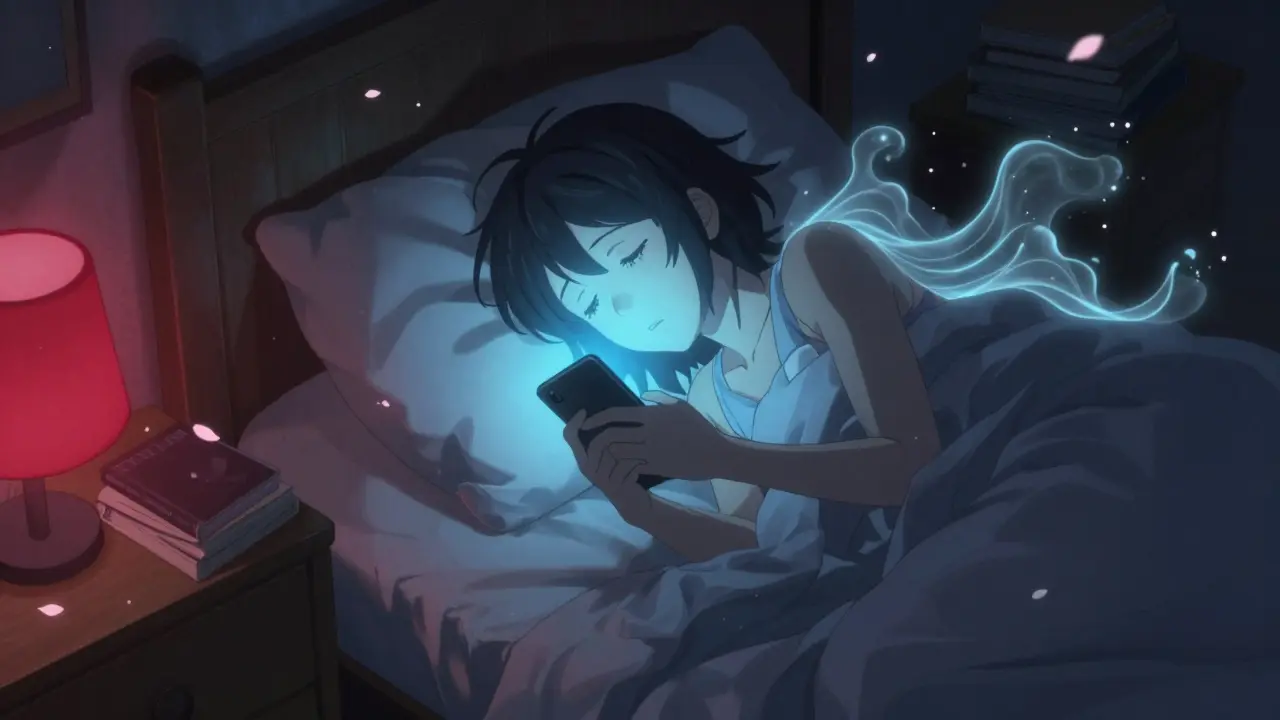
Ever lie in bed staring at your phone, wide awake, even though you’re exhausted? You’re not alone. Millions of people do it every night, and it’s not just about being distracted-it’s biology. The blue light from your screen is quietly sabotaging your sleep, even if you don’t realize it.
Why Blue Light Keeps You Awake
Your body has an internal clock, called the circadian rhythm, that tells you when to feel alert and when to feel sleepy. This clock is mostly controlled by a hormone called melatonin. When it gets dark, your brain naturally starts releasing melatonin to make you drowsy. But blue light-especially from phones, tablets, and laptops-tricks your brain into thinking it’s still daytime.
Research from Harvard Medical School in 2012 showed that just 6.5 hours of blue light exposure suppressed melatonin for about 3 hours. Compare that to green light, which only cut melatonin by 1.5 hours. Blue light between 460 and 480 nanometers is the worst offender. Modern LED screens emit 30-40% blue light. That’s double what old incandescent bulbs put out. At a normal reading distance of 30 cm, two hours of phone use before bed can flood your eyes with 30-50 lux of blue light. That’s enough to slash melatonin by half compared to dim red light.
It’s not just about how long you’re on your phone-it’s about timing. If you’re scrolling at 10 p.m. and plan to sleep at midnight, your brain is still in "day mode." Even if you feel tired, your body isn’t ready to shut down.
What Science Says About Screen Time Limits
The American Academy of Sleep Medicine (AASM) recommends avoiding screens for at least one hour before bed. Why one hour? Because it takes about 60-90 minutes for melatonin levels to rise enough to make you feel sleepy. If you’re still staring at a bright screen during that window, you’re fighting your own biology.
But here’s the kicker: 83% of Americans use electronic devices within an hour of trying to sleep, according to the National Sleep Foundation. That’s not just bad habit-it’s a public health pattern. Studies show people who use screens right before bed take 20-45 minutes longer to fall asleep. They also wake up more often during the night and report feeling less rested in the morning.
Some studies have tried to challenge this. A 2022 University of Toronto experiment found no difference in melatonin levels between blue, yellow, and white light when the total stimulation of light-sensitive cells was kept equal. But that study had a small sample size and controlled conditions that don’t reflect real life. In the real world, people aren’t sitting in a lab with perfectly balanced light. They’re scrolling in bed, with screens at full brightness, right next to their face.
Meanwhile, a 2023 crossover study found that wearing blue-light-blocking glasses for two hours before bed improved sleep quality, increased total sleep time, and boosted satisfaction. Users reported falling asleep faster and waking up less. But not everyone benefits. Some people say the yellow tint of the glasses makes reading or working on screens uncomfortable. Others notice no change at all.
So what’s the real answer? The evidence leans heavily toward one thing: limiting screen time before bed works. Even if blue light isn’t the whole story, it’s a major part of the problem.
The 90-Minute Rule That Actually Works
One habit keeps coming up in sleep forums, Reddit threads, and surveys: the 90-minute rule. Stop using screens 90 minutes before your target bedtime. That’s not a random number-it’s based on how long it takes your body to shift into sleep mode.
A Sleep Foundation survey of 1,200 people found that those who stuck to this rule cut their sleep onset time from over 45 minutes down to under 20 minutes. That’s a 55% improvement. The same group also reported fewer nighttime awakenings and better morning energy.
How do you make it stick? Start small. Pick one night a week to go screen-free for 90 minutes before bed. Use that time to read a physical book, take a warm shower, or just sit quietly. After a few weeks, it becomes routine. A University of Glasgow study found it takes about 5.7 days on average to form this habit. That’s less than a week.
And you don’t need expensive gear. Apple’s iOS 17 Sleep Focus mode, launched in September 2023, automatically dims your screen and blocks notifications an hour before your scheduled bedtime. Android has similar features. Apps like f.lux and Night Shift reduce blue light by up to 60%. But here’s the truth: software filters help, but they don’t replace the need to put the device down.
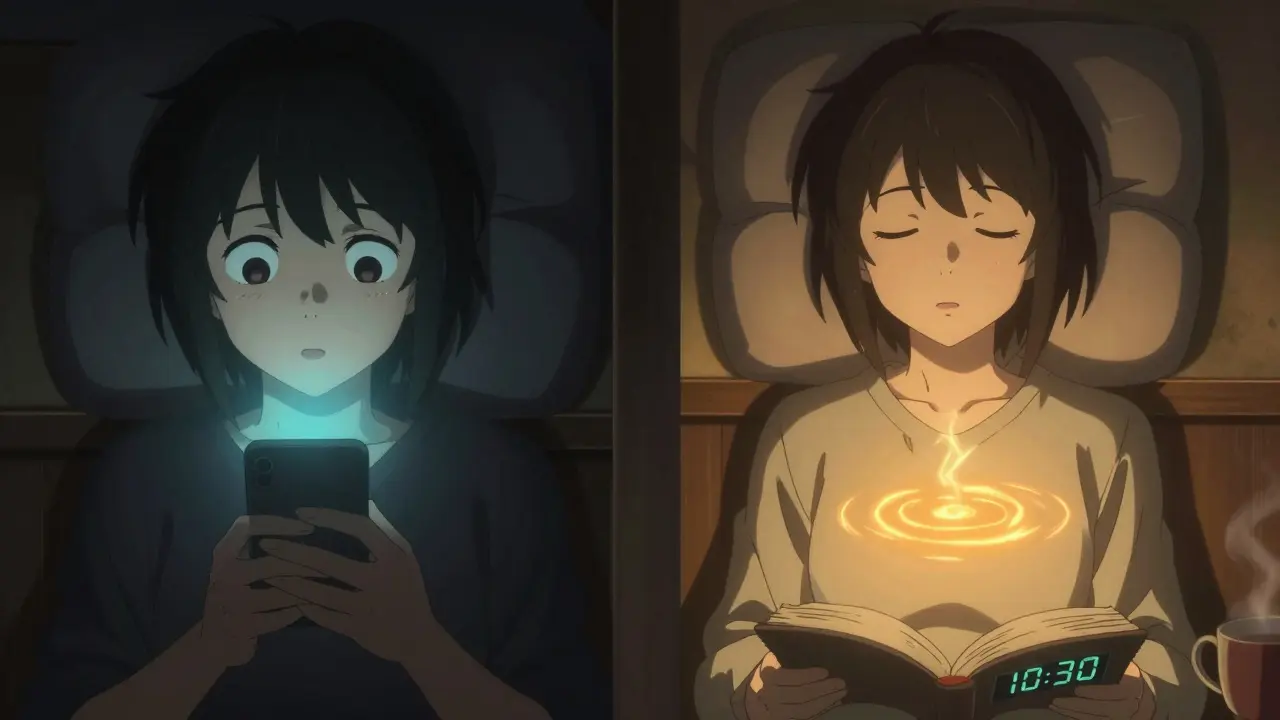
What Else Matters: Brightness, Distance, and Environment
Even if you’re using a blue light filter, you’re still exposing yourself to light-and light is the trigger. So here are three simple rules to follow:
- Brightness: Keep your screen below 50 nits (about 30% of max brightness). Bright screens are more disruptive than dim ones, no matter the color.
- Distance: Hold your phone at least 40 cm away. The closer you are, the more intense the light hitting your eyes. At arm’s length, the exposure drops significantly.
- Environment: Dim the room lights. If you’re using a screen in a dark room, your pupils open wide, letting in even more light. A soft lamp on the side of the room helps balance the contrast.
These aren’t just tips-they’re science-backed adjustments. A 2021 study by DisplayMate Technologies found that reducing screen brightness alone improved melatonin production by 35%, even without filters.
Why Some People Swear It Doesn’t Work
You’ll find people online who say, “I use blue light filters and still can’t sleep.” And they’re not lying. But they’re missing the bigger picture. Blue light isn’t the only reason people struggle to sleep. Screen time replaces wind-down routines. Scrolling through social media or watching videos keeps your brain active. It’s not just the light-it’s the content.
A 2023 Lancet commentary by Dr. Matthew Walker pointed out that even if blue light’s effect is overstated, the fact that people replace calm, quiet time with stimulating digital activity is enough to wreck sleep. If you’re watching a thriller at 11 p.m., your heart rate goes up. Your mind races. That’s not the kind of state you want to be in when trying to fall asleep.
Another reason filters don’t work for some: inconsistency. People turn them on for a few nights, then forget. Or they use them while still scrolling for two hours. It’s not the filter that’s broken-it’s the behavior.
And then there’s placebo. Some people buy blue-light-blocking glasses and feel better because they believe they should. That’s fine-if it helps. But real, lasting improvement comes from changing habits, not just adding gadgets.
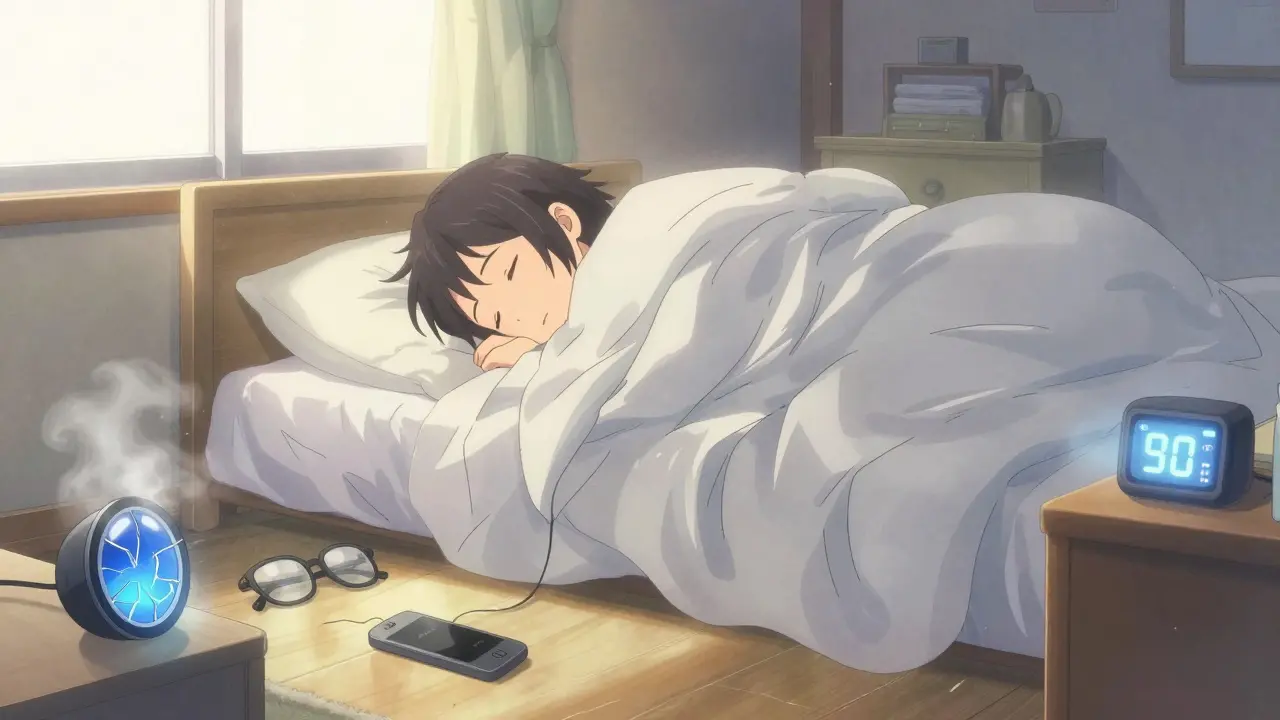
What You Can Do Right Now
You don’t need to quit screens forever. You just need to give your brain a chance to wind down. Here’s a simple plan:
- Set a bedtime alarm for 90 minutes before you want to sleep. When it goes off, put your phone in another room.
- Turn on Night Shift or f.lux if you must use a device, but keep brightness low and distance far.
- Replace screen time with something calming: tea, journaling, stretching, or listening to quiet music.
- Make your bedroom a screen-free zone. No phones, no tablets, no laptops on the bed.
- Stick with it for 7 days. Most people notice a difference by day 4.
The Sleep Health Foundation’s "Darkness Before Dawn" program has a 82% success rate among people who follow their 7-day plan. You don’t need to join a program-you just need to start.
What’s Coming Next
The science is still evolving. In 2024, Chronomics launched the first commercial test that measures your genetic sensitivity to blue light. Some people naturally process light differently-some are more sensitive, others less. Future sleep advice may be personalized.
The FDA is reviewing blue light exposure guidelines and may release official recommendations by late 2024. Meanwhile, NIH has funded a $2.4 million study on teens’ sleep and screen use, with results expected in early 2025.
But you don’t need to wait. The evidence right now is clear: if you want better sleep, reduce screen time before bed. Not because it’s trendy, not because someone told you to, but because your body knows what it needs-and it’s not more light at night.
Does blue light from screens really affect sleep?
Yes. Blue light, especially between 460-480 nanometers, suppresses melatonin production-the hormone that signals your body it’s time to sleep. Studies show even short exposure before bed can delay sleep onset by 20-45 minutes and reduce sleep quality. This effect is strongest with bright screens held close to the face.
How long before bed should I stop using screens?
The American Academy of Sleep Medicine recommends at least one hour. For better results, aim for 90 minutes. This gives your body enough time to naturally increase melatonin levels and prepare for sleep. People who follow this rule report falling asleep faster and sleeping more soundly.
Are blue light blocking glasses worth it?
They can help, but they’re not a magic fix. Studies show users who wore them for two hours before bed improved sleep quality and duration. However, 22% of users in surveys reported no noticeable change, and some found the yellow tint made screen use uncomfortable. The best results come from combining glasses with reduced screen time and lower brightness.
Do Night Shift and f.lux really work?
Yes, they reduce blue light by up to 60%, which helps. But they don’t eliminate all disruption. Brightness and content matter too. If you’re still using your phone at full brightness while scrolling through social media, you’re still stimulating your brain. Use these tools as part of a broader routine-not as a replacement for putting the device down.
What if I need to use my phone at night?
If you must, keep the screen dim (under 50 nits), hold it at least 40 cm away, and avoid stimulating content like work emails or social media. Use night mode, and try reading something calm-like a physical book or an audiobook with a soothing voice. Even small changes can reduce the impact on your sleep.
Comments
Bro just turn off your phone 📵🌙 I don't care what science says. I did this for 3 days and slept like a baby. No glasses. No filters. Just PUT IT AWAY. My back ain't mad at me anymore either. 🤙
OMG YES!! I started this 90-min rule last week and now I'm actually dreaming again 😍 I used to think I was just 'bad at sleeping' but turns out my phone was my enemy 📱💔 Love how simple it is - no expensive gadgets, just discipline. You got this!
i tried the blue light glasses and honestly? they made my eyes feel weird like i was in a 90s movie 🤪 but i kept the 90-min rule and now i read actual books before bed?? like paper ones?? and i dont even miss my phone. weird right? 🤷♀️
I’ve been doing this for 6 months now. The biggest change wasn’t the blue light - it was the silence. No notifications, no doomscrolling, just me and my thoughts. Turns out I kinda like that. 🌿
i dont get why people make it so hard. just put phone on charger in kitchen. easy. i do it. sleep better. wake up happy. no magic. just common sense. 🙃
Let me tell you what they’re not telling you - the blue light is just the tip. The real issue is that your phone is a psychological trigger. It’s not about melatonin - it’s about dopamine loops. Every swipe, every like, every notification rewires your brain to crave stimulation. The government and tech companies know this. They don’t want you to sleep because awake people buy more. They’re monetizing your exhaustion. Wake up. 🕵️♂️
Oh wow, so we’re supposed to believe that 30% brightness is somehow magically better? 🤡 I’ve been using Night Shift for years and still wake up at 3 a.m. like a haunted ghost. Maybe it’s not the light - maybe it’s that we’re all just emotionally exhausted and pretending screens are the villain. 🙄
Anecdotes aren’t data. And 90 minutes? Arbitrary. You’re just replacing one ritual with another.
The methodological limitations of the cited studies are non-trivial. The 2022 Toronto study, while underpowered, controls for irradiance and spectral power distribution - parameters that are rarely reported in consumer-facing research. The reliance on self-reported sleep quality introduces significant recall bias. Furthermore, the notion that ‘putting the device down’ is causally superior to photobiological intervention lacks longitudinal validation. One cannot infer causality from cross-sectional habit surveys.
You’re all just giving in to corporate sleep propaganda. My grandma slept with a radio on. She died at 94. You think she cared about blue light? 🤦♀️
I used to be one of you - until I realized I was addicted. Not to the phone. To the feeling of being needed. Every ping, every DM, every comment - it was my emotional lifeline. So when I stopped scrolling, I didn’t just sleep better… I had panic attacks. I had to see a therapist. And now? I still use f.lux. But I also journal. I also call my mom. I also let myself be lonely for a little while. That’s the real cure. Not the filter. Not the rule. The healing. And if you’re not ready for that? Then no, blue light isn’t your problem. You are.