
The U.S. Food and Drug Administration doesn’t just approve new drugs - it ensures millions of Americans can afford the medicines they need every day. That’s where the FDA generic approval system comes in. Every time you fill a prescription for a generic drug, you’re benefiting from a carefully designed regulatory pathway that balances speed, safety, and cost. This isn’t a shortcut. It’s a science-backed system built to deliver the same results as brand-name drugs - at a fraction of the price.
How Generic Drugs Get Approved: The ANDA Pathway
The FDA doesn’t require generic drug makers to repeat the same clinical trials that brand-name companies spent billions on. Instead, they use a streamlined process called the Abbreviated New Drug Application, or ANDA. This isn’t "abbreviated" because it’s less important - it’s abbreviated because it skips redundant steps. The FDA already confirmed the safety and effectiveness of the original drug. Now, the generic maker just needs to prove their version works the same way. To get approval, a generic drug must match the brand-name drug in four key ways: the same active ingredient, the same strength, the same dosage form (pill, injection, cream, etc.), and the same way it’s taken (by mouth, injected, applied to skin). Inactive ingredients like fillers or dyes can be different - but they can’t affect how the drug works. The real test is bioequivalence. That means the generic drug must enter the bloodstream at the same rate and to the same extent as the brand-name drug. The FDA requires this to be proven through studies with 24 to 36 healthy volunteers. Blood samples are taken over time to measure how much of the drug is absorbed. The results must show that the generic’s absorption falls within 80% to 125% of the brand-name drug’s levels. This narrow range ensures there’s no meaningful difference in how the drug performs in the body.What Happens Behind the Scenes at the FDA
The Office of Generic Drugs (OGD), part of the Center for Drug Evaluation and Research, handles every ANDA. Their job isn’t just reviewing paperwork - it’s evaluating science. Each application can be 15,000 to 20,000 pages long, covering everything from how the drug is made to how stable it is over time. The process starts with a filing review. If the application is missing key information - like incomplete chemistry data or unclear manufacturing details - the FDA issues a Refuse-to-Receive (RTR) letter. In 2022, nearly 1 in 6 submissions got rejected at this stage. That’s not a failure of the drug - it’s a failure of the submission. Once it passes filing, the substantive review begins. Standard applications have a 10-month target review time. If the drug is in short supply or is the first generic version of a brand-name product, the FDA can cut that to 8 months. In 2023, they approved 1,256 ANDAs - up 12.7% from the year before. That’s more generics reaching patients faster. Manufacturing sites are inspected too. The FDA checks that factories follow Current Good Manufacturing Practices (CGMP). In 2023, over 82% of generic drug facilities were inspected - and that number keeps rising. A single violation can delay approval for months.Why Generic Drugs Cost So Much Less
Brand-name drug development can cost over $2.6 billion and take 10 to 15 years. Generic manufacturers don’t face those costs. Their typical development budget? Between $2.4 million and $6.3 million. That’s why a generic version of a drug that costs $300 a month can drop to $30. The FDA’s Generic Drug User Fee Amendments (GDUFA) help fund this process. In 2025, each ANDA application costs $389,490 to review. Facility fees range from $207,700 to $415,400 per year. These fees pay for the scientists, inspectors, and systems that keep the process running smoothly. The savings aren’t just theoretical. In 2023, generic drugs saved the U.S. healthcare system $132.6 billion. They make up 9 out of every 10 prescriptions filled - but only 23% of total drug spending. That’s a massive shift in how medicine is paid for.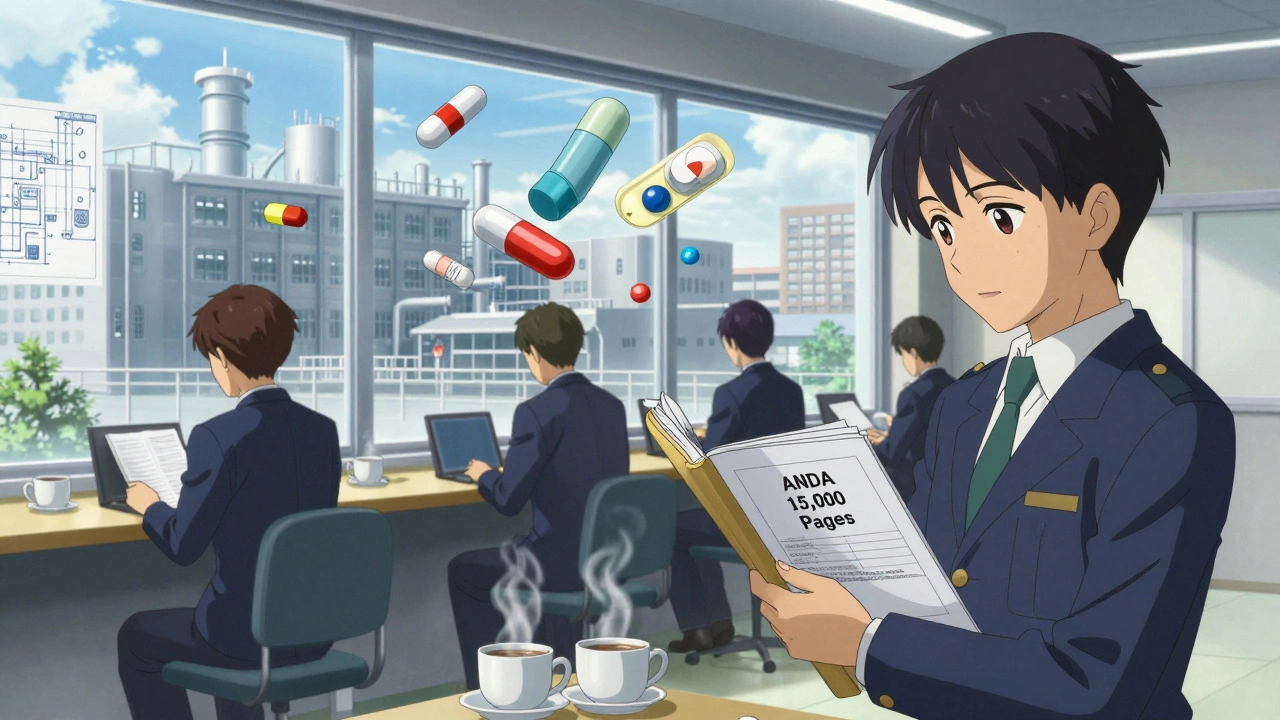
Complex Generics: The New Frontier
Not all generic drugs are simple pills. Some are complex - think inhalers, injectable gels, or long-acting patches. These are harder to copy because small changes in manufacturing can change how the drug works. The FDA has been pushing hard to approve more of these. In 2018, just 22% of new generic approvals were for complex products. By 2023, that number jumped to 37.5%. The FDA’s Complex Generic Drugs Initiative has helped. They’ve released more guidance documents - 287 as of 2024 - to help manufacturers get it right the first time. Pre-ANDA meetings, where companies talk to FDA scientists before submitting, are now used in nearly 80% of approved applications. The agency is also testing new tools. In late 2024, they began using artificial intelligence to help review some ANDAs. And by 2026, they aim to use real-world data - like patient outcomes from electronic health records - in up to 25% of complex generic approvals.What Patients and Pharmacists See
Patients don’t always know the science behind their prescription. But they feel the impact. A 2023 survey by CVS Health found that 78% of patients trust FDA-approved generics. Over 63% said they noticed no difference in effectiveness compared to the brand-name drug they used before. Pharmacists see it even more clearly. A National Community Pharmacists Association survey found 89% of pharmacists report generics cut patient out-of-pocket costs by 80% to 85%. One Reddit user shared how their patient’s insulin bill dropped from $390 to $98 after switching to a generic biosimilar approved by the FDA in 2021. There are concerns, though. Some patients report feeling different on a generic. The FDA’s adverse event database shows 22.7% of reports involving generics mention reduced effectiveness. But when the FDA investigates, over 92% of those cases turn out to be due to the disease progressing - not the drug failing.
Challenges and the Road Ahead
The system isn’t perfect. In 2022, over 1,800 ANDAs were still waiting for review. Some had been stuck for more than three years. The FDA admitted that 14.8% of applications got a complete response letter - meaning they were rejected due to issues with bioequivalence data or manufacturing. Supply chain risks are real. Nearly 78% of the active ingredients in generic drugs come from outside the U.S., mostly in India and China. The FDA is working on strategies to strengthen this, but it’s a long-term challenge. The biggest win? The Drug Competition Action Plan. Since 2017, approval times for first generics have dropped by 37%. What used to take 42 months now takes just 26. That’s faster access to cheaper drugs for millions. In October 2025, the FDA launched a new pilot program to speed up reviews for generic drugs made in the U.S. Applications from domestic manufacturers now get a 30% faster review time. And with GDUFA IV funding secured through 2027, including $412 million for complex generics, the pipeline looks strong.What This Means for You
If you’re taking a generic drug, you’re getting the same medicine your doctor prescribed - just at a lower cost. The FDA doesn’t cut corners. They just avoid repeating work that’s already been done. The science is solid. The oversight is strict. The savings are real. You don’t need to worry about quality. You don’t need to fear side effects. You just need to know that the system is watching - closely - to make sure what’s in your pill is exactly what it should be.Are generic drugs as safe as brand-name drugs?
Yes. The FDA requires generic drugs to have the same active ingredient, strength, dosage form, and route of administration as the brand-name version. They must also prove bioequivalence - meaning they work the same way in the body. Every generic drug is held to the same quality standards as brand-name drugs. The FDA inspects manufacturing sites and monitors safety reports just as closely for generics.
Why do generic drugs look different from brand-name drugs?
By law, generic drugs can’t look identical to brand-name drugs - that would violate trademark rules. So they may differ in color, shape, or flavor. But these differences are only in inactive ingredients like dyes or fillers. They don’t affect how the drug works. The active ingredient - the part that treats your condition - is exactly the same.
How long does it take for the FDA to approve a generic drug?
The FDA aims to review standard ANDA applications within 10 months. For priority applications - like first generics or drugs in short supply - the target is 8 months. But timelines can be longer if the application is incomplete or if the drug is complex. In 2023, 1,256 ANDAs were approved, with many cleared within the target window thanks to improved processes and funding.
What’s the difference between an ANDA and an NDA?
An NDA (New Drug Application) is for brand-name drugs and requires full clinical trials to prove safety and effectiveness. An ANDA (Abbreviated New Drug Application) is for generics and only needs to prove bioequivalence to an already-approved brand-name drug. This skips the need for expensive and time-consuming clinical studies, making generics faster and cheaper to develop.
Can a generic drug be pulled from the market after approval?
Yes. The FDA monitors all drugs - brand and generic - after approval. If safety issues arise, manufacturing problems are found, or bioequivalence is no longer confirmed, the FDA can request a recall or withdraw approval. In 2023, several generic drugs were recalled due to contamination or stability issues. The same standards apply to everyone.
Do all generic drugs have the same quality?
All FDA-approved generics must meet the same strict standards. But different manufacturers may produce them. The FDA inspects every facility - domestic and international - and requires consistent quality control. If one company’s product fails, it doesn’t mean all generics from other companies are unsafe. The Orange Book lists all approved generics and their therapeutic equivalence ratings, so pharmacists and doctors can choose confidently.
Comments
Genetics are wild, but this? 🤯 I’ve been on generics for years and never had an issue. FDA’s got my back. 👍
So basically the government lets companies copy pills and calls it science lol
Makes sense if you think about it
I think it's important to recognize that the FDA's approach to generic drugs isn't just about saving money it's about equity in healthcare access and ensuring that people from all socioeconomic backgrounds can get the medications they need without having to choose between rent and refills and the bioequivalence standards are actually incredibly rigorous and based on decades of pharmacokinetic research and the agency's commitment to inspecting manufacturing sites globally even in countries with less transparent regulatory systems shows a level of diligence that many people don't give them credit for and the fact that they're now integrating AI and real-world data into their review process is a huge step forward in making sure these drugs are not just chemically identical but functionally identical in diverse populations
You think this is impressive? Most of these generics are made in India and China. The FDA inspects less than half the facilities. You're lucky if your pill doesn't have lead dust in it.
Oh wow so we pay 10x more for the same pill just because someone trademarked the color? Capitalism is poetry
The systemic inefficiencies inherent in the current ANDA framework are exacerbated by geopolitical dependencies on active pharmaceutical ingredient supply chains, particularly in jurisdictions with insufficient regulatory oversight. The statistical probability of substandard manufacturing practices remains non-trivial despite FDA assertions.
This is actually really cool. The FDA’s doing the heavy lifting so we don’t have to pay $500 for insulin. 🙌 I’ve seen friends switch and save hundreds. No drama, just cheaper meds. More of this please!
The ontological underpinnings of bioequivalence are fundamentally reductive. By quantifying pharmacokinetic parameters within an arbitrary 80-125% confidence interval, the FDA implicitly privileges pharmaceutical homogeneity over phenomenological patient experience-a Cartesian fallacy that ignores the placebo-nocebo continuum as a legitimate therapeutic variable.
So let me get this straight-Americans pay $300 for a pill and then we let China make the same thing for $30? And you call this progress? We’re outsourcing our medicine and calling it a win. Pathetic.
I want to take a moment to express my profound appreciation for the dedication and precision of the FDA’s Office of Generic Drugs. The meticulous attention to detail in reviewing 15,000-page applications, the unwavering commitment to CGMP compliance, and the strategic use of GDUFA funding to accelerate review timelines represent a model of public service that is both rare and invaluable. For millions of Americans who rely on these medications daily, this is not bureaucracy-it is lifeline. Thank you to every scientist, inspector, and analyst who works behind the scenes to ensure that safety, efficacy, and affordability are not competing ideals, but interconnected imperatives.
so the fda check if the generic work same as brand? that good. my uncle take generic for blood pressure and save money. no problem. good job fda