
The Federal Food, Drug, and Cosmetic Act isn’t just a dusty law from 1938-it’s the reason you can buy life-saving medications for a fraction of what brand-name drugs cost today. Before this law, companies could sell drugs with no proof they were safe. In 1937, over 100 people died after taking a toxic antibiotic solution. That tragedy forced Congress to act. The FD&C Act gave the FDA the power to require safety data before any drug hit the market. But it didn’t stop there. Over the decades, this law evolved into the engine behind the modern generic drug system-saving Americans trillions of dollars and making medicines accessible to millions.
How the FD&C Act Started
The original FD&C Act was signed by President Franklin D. Roosevelt on June 25, 1938. Before then, drugmakers didn’t need to prove anything. They could sell anything-even if it killed people. The elixir sulfanilamide disaster, where a solvent called diethylene glycol poisoned patients, was the final straw. The law changed everything: new drugs had to be proven safe before being sold. It created the FDA’s authority to review drugs, but it didn’t require proof of effectiveness. That came later.The 1962 Kefauver-Harris Amendments: Adding Efficacy
By the early 1960s, the thalidomide crisis in Europe showed the world how dangerous untested drugs could be. Even though thalidomide wasn’t approved in the U.S., the FDA’s cautious approach saved thousands of American babies from severe birth defects. That moment pushed Congress to strengthen the FD&C Act. The 1962 Kefauver-Harris Amendments made it illegal to sell a drug unless it was both safe AND effective. Suddenly, every new drug had to go through clinical trials. But here’s the catch: if you wanted to make a copy of a drug, you still had to run the same expensive trials all over again. That made generic drugs nearly impossible to bring to market.The Hatch-Waxman Amendments: The Game Changer
In 1984, Congress fixed that problem with the Drug Price Competition and Patent Term Restoration Act-better known as the Hatch-Waxman Amendments. Named after Senator Orrin Hatch and Representative Henry Waxman, this law didn’t rewrite the FD&C Act-it added a new section: 505(j). That’s the legal foundation for every generic drug approved today. Before Hatch-Waxman, generic companies had to submit a full New Drug Application (NDA)-the same paperwork as the brand-name maker. That meant repeating animal studies, clinical trials, and years of testing. It cost tens of millions of dollars. Most companies didn’t bother. Only 19% of prescriptions were filled with generics back then. Hatch-Waxman changed that. Instead of redoing clinical trials, generic manufacturers now submit an Abbreviated New Drug Application (ANDA). They don’t need to prove safety or effectiveness again. They just need to show their drug is the same as the brand-name version in four key ways:- Same active ingredient
- Same strength
- Same dosage form (pill, injection, cream, etc.)
- Same route of administration (taken by mouth, injected, inhaled)
The Orange Book: The Generic Drug Bible
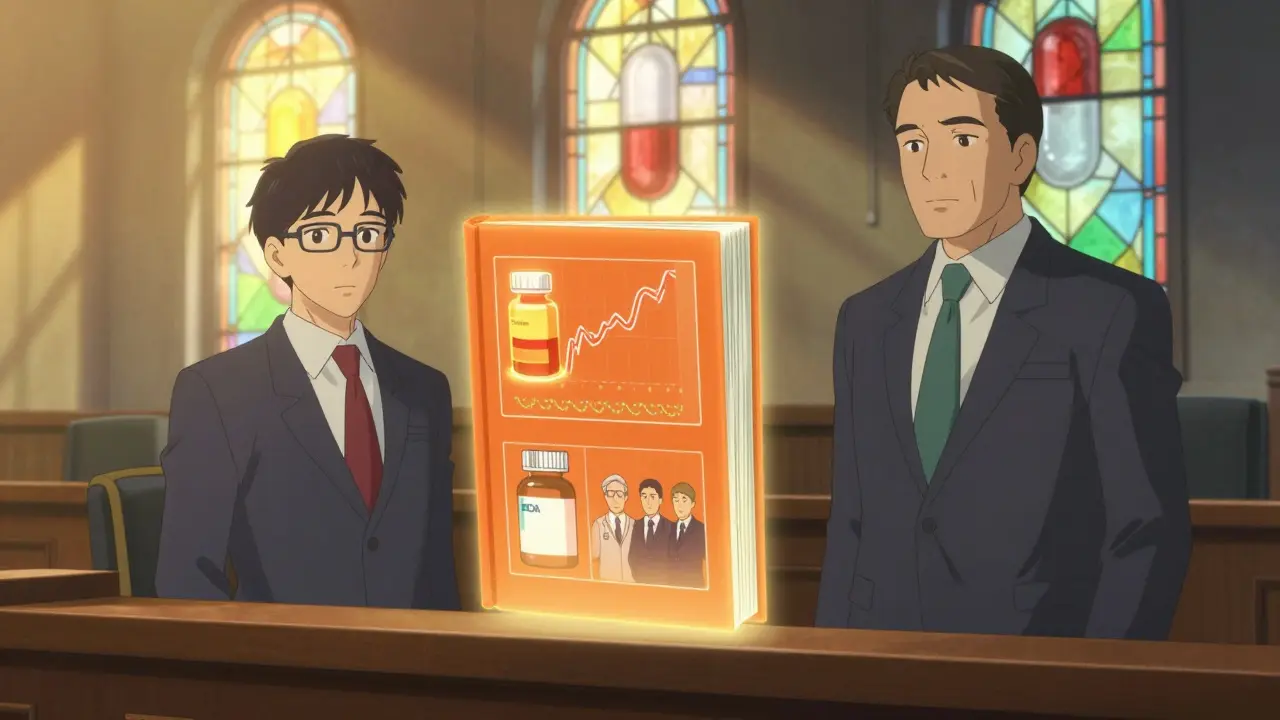
The FDA’s Approved Drug Products with Therapeutic Equivalence Evaluations-the Orange Book-is the official list of all approved drugs and their generic equivalents. It’s updated daily. If a drug isn’t listed there, no generic can be legally sold as interchangeable. The Orange Book also lists patents held by brand-name companies. Generic manufacturers must check this list and certify whether they’re challenging a patent, waiting for it to expire, or claiming it’s invalid. This is where Hatch-Waxman’s balance kicks in. If a generic company is the first to challenge a patent and win, they get 180 days of exclusive rights to sell their version before anyone else can. That’s a huge incentive. It’s why companies like Teva, Mylan, and Sandoz spend millions on legal teams to fight patent battles.How Generics Save Billions
The numbers speak for themselves. In 1984, generics made up just 3% of total drug spending. Today, they make up 90% of prescriptions but only 17% of spending. Over the last decade, generic drugs have saved U.S. consumers more than $2.2 trillion. That’s not a marketing claim-it’s from the Federal Trade Commission. The Congressional Budget Office estimates that continuing current policies will cut federal drug spending by $158 billion between 2023 and 2032. That’s why the FDA spends so much time reviewing ANDAs. In the 1990s, it took over 30 months to approve a generic. Now, 95% are approved in under 10 months thanks to the Generic Drug User Fee Amendments (GDUFA), which gave the FDA more funding and set clear review deadlines.
Comments
Let’s be real-this whole generic drug system is a fucking joke. The FDA approves these ANDAs like they’re printing coupons. I’ve seen generics that look like they were made in a garage in Bangalore. And don’t even get me started on the ‘bioequivalence’ bullshit-80-125%? That’s not science, that’s a fucking range you’d use to guess someone’s weight. If my blood pressure med is 15% off, I’m not getting treated-I’m getting gambled on.
And yet, somehow, the same people who scream about ‘American manufacturing’ are fine with 70% of our meds coming from China and India. Hypocrites. The FD&C Act was meant to protect us. Now it’s just a license to cut corners.
Someone needs to audit these factories. Not just ‘inspect.’ Actually go in. With cameras. And a hammer.
There’s a fascinating tension here between innovation and access. The Hatch-Waxman Amendments didn’t just lower prices-they created a new kind of pharmaceutical ecosystem where competition wasn’t about branding but about bioequivalence. That’s revolutionary. Before 1984, generics were essentially illegal to produce efficiently. Now, we’ve got a system where a company can reverse-engineer a drug’s pharmacokinetics without redoing Phase III trials, and the FDA has a clear, standardized framework to evaluate it.
But here’s the kicker: the law was designed for small-molecule drugs. It’s not built for biologics, complex inhalers, or transdermal patches. The science has outpaced the regulation. The FDA’s 2023-2027 plan is trying to catch up, but it’s like trying to patch a leaky dam with duct tape. We need new regulatory pathways-not just tweaks to ANDA submissions. We need a 505(b)(2) for complex generics, not just more reviewers.
cool post. i’ve been on a generic blood pressure med for 5 years. never had an issue. my grandma takes the same one. she’s 87. still walks to the store.
don’t know why people freak out about the 80-125% thing. if it works, it works. i’d rather pay $4 than $400. also, the orange book? yes. i looked it up once. it’s wild how many drugs are listed there. like, literally hundreds. kinda makes you feel better about the whole system.
also, the fact that the fda inspects factories in india? yeah, they do. i heard they send teams there like twice a year. not just paperwork. real people with clipboards. so maybe chill out a little.
so like, why do i gotta pay for brand name if the generic is the same? my pharmacist says they’re identical. so why does the brand cost 10x? are they just printing money? i don’t get it. also, my cousin’s kid got sick from a generic and now she’s scared of all of them. but my doc says it’s fine. idk. i’m confused.
One might argue that the FD&C Act, as amended by Hatch-Waxman, constitutes the most elegant equilibrium between intellectual property and public welfare ever codified in American jurisprudence. It is not merely a statute-it is a philosophical manifesto on the sanctity of scientific reproducibility and the moral imperative of equitable access.
Whereas the patent system incentivizes innovation through exclusivity, the ANDA pathway ensures that the fruits of that innovation are not hoarded by corporate titans but dispersed among the citizenry. The Orange Book, then, is not a mere registry-it is the Magna Carta of pharmaceutical democracy.
And yet, the specter of evergreening looms like a shadow over this edifice. To manipulate patent law through trivial modifications-to ‘product hop’ as if the body were a commodity to be rebranded-is not merely unethical-it is a betrayal of the very spirit of the Act. The CREATES Act was a necessary counterweight, but it is insufficient. We require a constitutional amendment to criminalize patent trolling in pharmaceuticals.
Let us not forget: the life of a man or woman is not a line item on a balance sheet.
Okay, but can we talk about how wild it is that the FDA’s review time dropped from 30 months to under 10? That’s not just efficiency-that’s a cultural shift in regulatory philosophy. GDUFA didn’t just pump money in; it created accountability. The FDA went from being a slow-moving bureaucracy to a performance-driven agency with clear SLAs. That’s huge.
And the fact that 90% of prescriptions are generics? That’s not just a statistic-it’s a quiet revolution in public health. Think about it: millions of diabetics, hypertensives, asthmatics-all able to manage chronic conditions because the cost didn’t force them to choose between meds and groceries.
But also… the data manipulation cases? Yeah, that’s terrifying. I had a friend who worked at a lab in Hyderabad that got flagged for backdating stability data. They weren’t even trying to be sneaky-just overwhelmed. That’s the real problem: the system works until human pressure breaks it. We need more oversight, not less. And maybe better pay for inspectors. If you’re risking your career to catch fraud, you deserve more than a thank-you note.
So let me get this straight: we spend billions to invent a drug, then let someone else copy it and sell it for 5% of the price… and we call this ‘innovation’? Wow. The American dream: invent something, then watch a guy in Chennai make it cheaper and call you a villain for charging what it cost to develop.
Also, ‘bioequivalence’? Sounds like a word a chemist made up to sound smart while selling you a placebo with a different logo.
At least the brand names have nice packaging. The generics? Look like they came in a Ziploc from a gas station.
While the FD&C Act and its amendments represent a commendable regulatory framework, the global asymmetry in manufacturing oversight remains a critical flaw. The majority of generic APIs originate from nations with divergent regulatory standards-India, China, and others. The FDA’s inspections are statistically insufficient to guarantee consistent cGMP compliance across thousands of facilities.
Moreover, the legal fiction that ‘bioequivalence’ equates to therapeutic equivalence ignores inter-individual pharmacokinetic variability. A patient metabolizing a drug via CYP2D6 polymorphism may experience clinically significant deviations even within the 80-125% window.
This system is not broken-it is merely optimized for cost, not precision medicine. We are treating a population as a monolith, when biology is inherently heterogeneous.
Just read the Orange Book yesterday. It’s like a secret decoder ring for your prescriptions. I didn’t realize so many of my meds had generics. I thought I was getting the real thing. Turns out I’ve been saving $200/month for years and didn’t even know it.
Also, the part about patent challenges and 180-day exclusivity? That’s wild. So one company can basically monopolize a generic for half a year just by being the first to sue? That’s like winning the lottery but with lawsuits.
Anyway. I’m glad I don’t have to pay $500 for my antidepressant anymore.
As someone who grew up in a country where medicine was a luxury, seeing this system work is humbling. In India, we have some of the largest generic manufacturers in the world-Teva, Cipla, Sun Pharma. They’re not just making pills. They’re making dignity possible.
The Hatch-Waxman Act didn’t just help Americans-it helped the world. A single tablet of metformin made in India costs 10 cents. That’s how a diabetic in rural Kenya survives.
Yes, there are quality issues. Yes, some companies cut corners. But the framework? Brilliant. It’s not perfect, but it’s the best we’ve got. And it’s proof that law, when crafted with care, can heal more than medicine ever could.
Let me tell you something-this is the most underappreciated success story in American history. We didn’t just make drugs cheaper. We made healthcare *possible* for people who were priced out. Think about that. A veteran on fixed income. A single mom working two jobs. A college student with asthma. All of them breathing easy because of this law.
And the best part? It didn’t kill innovation. Brand-name companies still made billions. They just had to innovate *faster* to stay ahead. That’s capitalism with a conscience.
So next time you pick up a $4 prescription, don’t think ‘cheap.’ Think ‘smart.’ Think ‘American ingenuity.’ Think ‘people won.’
Man, I just realized I’ve been taking generics my whole life and never thought twice. My dad’s cholesterol med? Generic. My mom’s thyroid pill? Generic. My anxiety med? Also generic. I thought that was just how it was.
Now I know it’s because of some law from 1984. Wild. So like… if I ever start a company, can I just copy a drug and make a fortune? That’s the American dream right there.
Also, the Orange Book? I’m gonna print it out and frame it. It’s basically the Bible for people who hate paying for medicine.
So the FDA approves a generic drug based on blood tests in 24 healthy volunteers. And then it goes to millions of people with diabetes, heart disease, kidney failure, and autoimmune disorders.
Let me get this straight-we’re using a model of ‘average’ physiology to regulate treatments for wildly heterogeneous populations, and we call this ‘science.’
Meanwhile, Big Pharma spends $2 billion to develop a drug, then gets slapped with a generic 10 years later. And we’re supposed to feel bad for them?
Meanwhile, in India, a factory worker makes $2/hour to fill those capsules. And we call this ‘affordable healthcare.’
It’s not a system. It’s a compromise. And compromise is just capitalism with a smiley face.
My mom had to choose between her insulin and her rent last winter. She took the generic. She’s alive today because of it.
I used to think generics were ‘second-best.’ Now I know they’re the reason people like her don’t die because they’re poor. The FD&C Act didn’t just change laws-it changed lives. And I’m so grateful for every scientist, inspector, and pharmacist who made sure that system worked.
Also, the Orange Book? I printed it. I keep it on my fridge next to my mom’s prescription bottle. It’s not just paperwork. It’s hope.
Thank you for writing this. I needed to read it.
How is it morally acceptable that a drug company can charge $10,000 for a life-saving medication, then get protected by patents for 20 years, while people die because they can’t afford it? And then we celebrate the generic as if it’s some heroic act of charity?
It’s not heroic. It’s justice. And we should be ashamed we needed a law to force corporations to stop profiting off human suffering.
Also, why are we letting China and India make our medicine? That’s not freedom. That’s dependency. And it’s dangerous.