

Biosimilar Savings & Myth Checker
Estimate Your Annual Savings
Enter your current medication details to see how much you might save by switching to a biosimilar alternative.
Myth vs. Fact
"Biosimilars are risky because they aren't identical to the original drug."
No two batches of any biologic are 100% identical. Biosimilars are "highly similar" with no clinically meaningful differences in safety, purity, or potency. Regulators require rigorous "totality of evidence" studies to prove this equivalence.
"Switching to a biosimilar causes new side effects."
Studies show adverse event rates are comparable between reference biologics and biosimilars. The FDA's pharmacovigilance data does not support a higher rate of serious adverse events linked specifically to biosimilar switches.
"Originator companies say biosimilars are unsafe, so they must be true."
Some originator manufacturers engage in marketing campaigns emphasizing minor differences. Always rely on independent regulatory assessments from the FDA or EMA, which confirm biosimilars are safe and effective.
"Biosimilars are just 'cheap generics' with lower quality."
Biosimilars undergo rigorous clinical trials to demonstrate comparability. They are cheaper because manufacturers don't need to recoup billions in initial R&D costs, not because they are lower quality. They maintain high standards of manufacturing and testing.
Imagine you’ve been taking a life-changing medication for years. It works. You trust it. Then your insurance company says, “We’re switching you to a cheaper version.” Your heart skips a beat. Is it the same drug? Will it still work? This is the exact moment many patients face when they are introduced to biosimilar medications, which are biological products determined to be highly similar to an already-approved reference biologic product, with no clinically meaningful differences in safety, purity, or potency.
If you have heard whispers about these drugs but felt confused by the science or worried about the risks, you are not alone. The medical world has spent the last decade proving that these alternatives are safe, effective, and essential for keeping healthcare affordable. By 2026, the data is overwhelming: biosimilars are not just "close enough"; they are clinically equivalent to their originator counterparts. Let’s break down what they are, why they exist, and whether you should feel confident taking them.
What Exactly Is a Biosimilar?
To understand biosimilars, you first need to understand how biological drugs differ from traditional pills. Traditional medicines, like aspirin or ibuprofen, are small molecules made through chemical synthesis. They are simple, stable, and identical from batch to batch. Biological drugs, however, are large, complex proteins created inside living cells-like bacteria or yeast. Because they come from living organisms, tiny natural variations occur between batches. You cannot simply copy-paste a biologic drug like you can a chemical formula.
This complexity is why we do not call them "generic biologics." When a brand-name biologic’s patent expires, other companies cannot make an exact clone. Instead, they create a biosimilar, which is a high-quality biological medical product that is nearly identical to an original biological product that has already been approved. Think of it like two master chefs making the same soup recipe. The ingredients and steps are the same, but because they use different pots and stoves, the final taste might vary by a fraction of a percent. However, if both soups nourish you equally well and cause no stomach upset, those minor differences don’t matter.
The regulatory bodies, including the U.S. Food and Drug Administration (FDA) and the European Medicines Agency (EMA), require manufacturers to prove this similarity through a rigorous process called the "totality of evidence." This means comparing the new drug to the reference product across three key areas:
- Analytical studies: Checking the molecular structure, purity, and biological activity.
- Nonclinical studies: Testing in laboratory settings and animal models to see how the body reacts.
- Clinical studies: Human trials to confirm that the biosimilar works as well as the original and has a similar safety profile.
Crucially, biosimilars do not need to repeat the massive, multi-year clinical trials that the original drug went through. Since the reference product’s safety and efficacy are already established, regulators focus on confirming that the biosimilar matches it closely enough to be interchangeable in practice.
The Safety Record: What Does the Data Say?
Safety is the biggest concern for most patients. It is natural to worry that a "similar" drug might behave differently in your body. However, the real-world data paints a reassuring picture. As of mid-2024, the FDA has approved over 40 biosimilars, and globally, billions of patient treatment days have been recorded.
A landmark review by Sandoz, published in 2023, analyzed more than 1.3 billion patient treatment days across eight major biosimilars. These included drugs for conditions ranging from cancer to arthritis. The study found no significant increase in adverse events compared to the reference biologics. In fact, the benefit-risk profile remained consistent with the original drugs. Another key metric is immunogenicity-the risk that your immune system will attack the drug itself, creating antibodies that reduce its effectiveness. While this is a theoretical risk for any biologic, extensive monitoring shows that biosimilars trigger antibody responses at rates comparable to their reference products.
| Feature | Reference Biologic (Originator) | Biosimilar |
|---|---|---|
| Manufacturing Process | Proprietary, patented process | Similar but distinct process using different equipment/cells |
| Molecular Structure | Established baseline | Highly similar; minor allowed variations in inactive components |
| Clinical Trials Required | Full-scale Phase I-III trials | Comparative studies focusing on safety, purity, and potency |
| Cost | High (due to R&D recovery) | Typically 15-30% lower |
| Regulatory Approval | Biologics License Application (BLA) | Abbreviated BLA based on "totality of evidence" |
The European Medicines Agency actually pioneered this pathway, approving the first biosimilar (somatropin) in 2006. Europe now leads in adoption, with biosimilar market shares reaching up to 65% for certain drugs like filgrastim. The U.S. followed later, with the FDA approving its first biosimilar, Zarxio, in 2015. Despite the later start, American regulators have maintained strict standards. In February 2024, the FDA updated its guidance to recommend fewer tests for demonstrating interchangeability, citing accumulated experience that showed the risks of switching were insignificant.
Efficacy: Do They Work Just as Well?
Safety is one thing; efficacy is another. You want your medication to control your disease, whether that is rheumatoid arthritis, Crohn’s disease, or cancer. Clinical trials and post-market surveillance consistently show that biosimilars deliver the same therapeutic outcomes as their reference products.
For example, in oncology, where precision is critical, biosimilars of drugs like trastuzumab and rituximab have shown equivalent progression-free survival and overall survival rates. A 2024 study examining biosimilar-to-biosimilar switching concluded that moving between different brands of biosimilars did not affect efficacy. This flexibility is vital for supply chain stability. If one manufacturer faces a shortage, patients can switch to another approved biosimilar without fearing a drop in treatment quality.
Real-world experiences support these findings. On patient forums, users frequently report seamless transitions. One patient shared, "Switched from Humira to Amjevita after my insurer mandated it-no difference in efficacy after 18 months, saved me $1,200 monthly." While anecdotal, these stories reflect the broader clinical consensus. Of course, individual reactions can vary, but this is true for any medication. The key takeaway is that the variation is not due to the drug being "inferior," but rather normal human biological diversity.

Why Biosimilars Matter: Cost and Access
You might wonder why we need biosimilars if the original drugs work fine. The answer lies in cost and access. Biologic drugs are incredibly expensive to develop and manufacture. When patents expire, competition usually drives prices down. But without biosimilars, there would be no competition for these complex therapies.
Biosimilars typically cost 15% to 30% less than their reference products. In some cases, the savings are even greater. According to the Association for Accessible Medicines, biosimilars saved the U.S. healthcare system $31 billion between 2015 and 2022. Projections suggest this could reach $307 billion by 2030. These savings do not just help insurers; they allow hospitals to treat more patients and enable individuals to afford necessary treatments without crippling out-of-pocket expenses.
In Europe, where price controls and competitive markets are stronger, biosimilar adoption is widespread. In the U.S., adoption has been slower due to factors like "patent thickets" (strategies used by originator companies to delay competition) and rebate structures that favor brand-name drugs. However, as more blockbuster biologics lose exclusivity, the pressure to adopt biosimilars is growing. By 2030, industry experts predict that 70-80% of biologic markets will have biosimilar competition.
Addressing Common Concerns and Myths
Despite the strong scientific backing, skepticism remains. Some patients and even healthcare providers hesitate to prescribe or accept biosimilars. Where does this fear come from?
Myth 1: "They are not identical, so they are risky."
As explained earlier, no two batches of any biologic are 100% identical. The reference product itself varies slightly over time. Regulators ensure that the biosimilar falls within an acceptable range of similarity that does not impact clinical performance. The phrase "highly similar" is a legal definition, not a warning label.
Myth 2: "Switching causes side effects."
Some patients report new symptoms after switching. While this happens, studies show it occurs at similar rates whether you switch from a reference biologic to another reference biologic or to a biosimilar. Often, these symptoms are unrelated to the drug change or resolve quickly. The FDA’s pharmacovigilance data does not support a higher rate of serious adverse events linked specifically to biosimilar switches.
Myth 3: "Originator companies say they are unsafe."
It is important to recognize that some originator manufacturers have engaged in marketing campaigns that emphasize the "not identical" aspect while downplaying the "no clinically meaningful differences" finding. The AMA Journal of Ethics noted in 2019 that such tactics contributed to physician and patient skepticism. Always rely on independent regulatory assessments from the FDA or EMA, not promotional materials from competing companies.
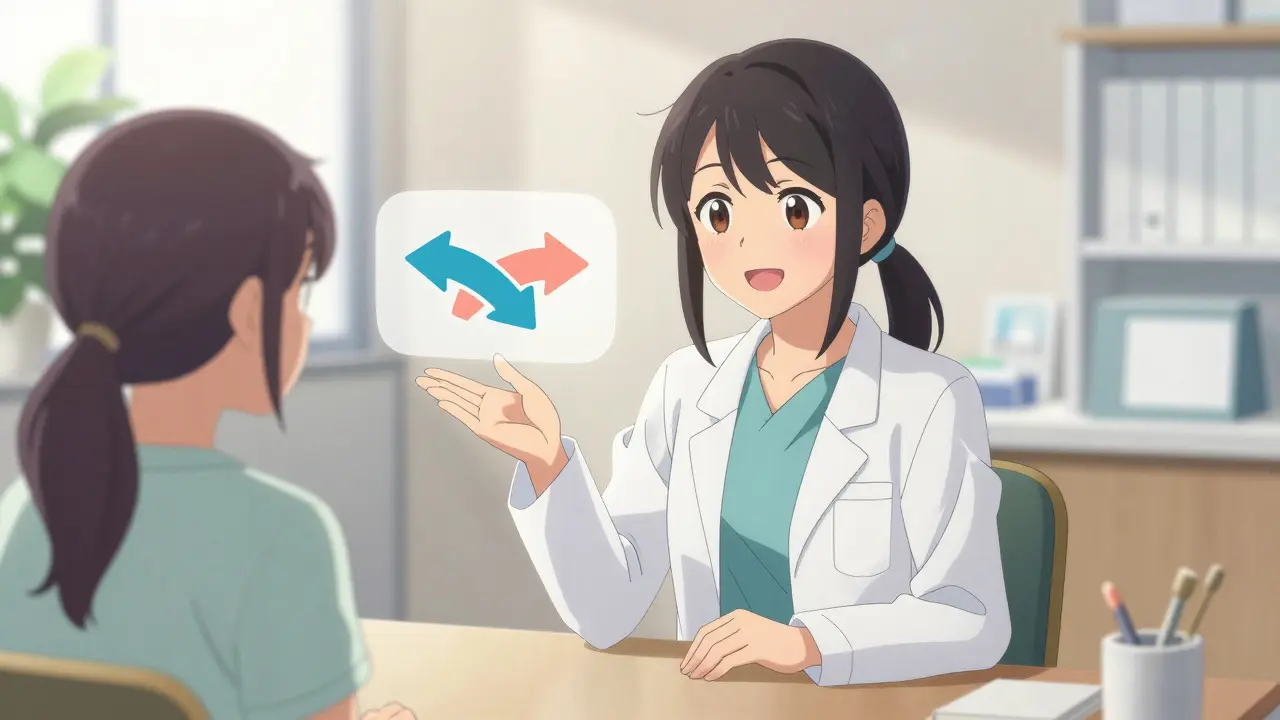
Interchangeable Biosimilars: What Does That Mean?
In the U.S., you may hear the term "interchangeable biosimilar." This is a specific designation given by the FDA. An interchangeable biosimilar meets all the requirements of a standard biosimilar plus additional criteria showing that it can be switched back and forth with the reference product without increasing safety risks or reducing effectiveness.
When a biosimilar is labeled as interchangeable, state laws often allow pharmacists to substitute it for the prescribed reference product without needing a new prescription from your doctor. This simplifies the process for patients and reduces administrative burdens. However, not all biosimilars are designated as interchangeable, and rules vary by state. Always check with your pharmacist or provider to understand your local regulations.
Even if a biosimilar is not yet labeled "interchangeable," doctors can still prescribe it directly. Many specialists choose to prescribe biosimilars proactively to ensure patients get the cost benefits and to monitor their response closely.
What Should Patients Do?
If your doctor suggests a biosimilar, here are practical steps to take:
- Ask questions. It is perfectly okay to ask, "Why are we switching?" or "How is this drug similar to my current one?" Your provider should explain the rationale clearly.
- Check the name. Biosimilars have unique names (e.g., adalimumab-atto for Amjevita). Ensure your pharmacy dispenses the correct product to avoid confusion.
- Monitor your response. Keep track of your symptoms. If you notice changes, report them to your doctor immediately. Most issues are manageable, but early detection is key.
- Trust the evidence. Remember that billions of doses have been administered safely. The global medical community stands behind these products.
For healthcare providers, education is crucial. Understanding the "totality of evidence" approach helps in confidently recommending biosimilars. The FDA offers free online training courses to keep providers updated on the latest guidelines and safety data.
Are biosimilars exactly the same as generic drugs?
No. Generic drugs are exact molecular copies of small-molecule chemical drugs. Biosimilars are highly similar versions of complex biological drugs. Because biologics are made in living cells, they cannot be copied exactly, only replicated to a degree that ensures no clinically meaningful differences in safety or efficacy.
Can I switch back to the original brand-name drug if I don't like the biosimilar?
Yes, you can discuss switching back with your doctor. However, insurance coverage may be limited for the reference product once a biosimilar is available. It is important to communicate any concerns about side effects or efficacy so your provider can determine if a switch is medically necessary.
Do biosimilars have different side effects than the original drug?
Clinical studies and real-world data show that biosimilars have similar side effect profiles to their reference products. Any side effects experienced are typically consistent with what was seen in the original drug's trials. Serious adverse events are not more common with biosimilars.
Why are biosimilars cheaper than reference biologics?
Biosimilars are cheaper because manufacturers do not have to recoup the billions of dollars spent on initial research and development. They also benefit from economies of scale and increased competition in the market. This allows them to offer the drug at a lower price while maintaining profitability.
Is it safe to switch between different biosimilars?
Yes. Recent studies and regulatory updates indicate that switching between different biosimilars, or between a biosimilar and the reference product, is safe and does not negatively impact efficacy. The FDA has cited insignificant risks associated with such switches.