

Anticoagulant Reversal Agent Selector
Select the patient's blood thinner and bleeding situation to determine the appropriate reversal agent. This tool follows current clinical guidelines for emergency anticoagulant reversal.
When Blood Thinners Go Wrong
Imagine taking a pill every day to prevent a stroke, only to fall and hit your head. Suddenly, the very drug keeping you safe becomes a threat. That’s the reality for hundreds of thousands of people each year on blood thinners. When major bleeding happens - like a brain bleed or a ruptured artery - time isn’t just money. It’s life. That’s where anticoagulant reversal agents come in. These aren’t just backup plans. They’re emergency tools that can stop a death sentence in minutes.
There are four main players: idarucizumab, andexanet alfa, prothrombin complex concentrate (PCC), and vitamin K. Each works differently, for different drugs, with different risks and costs. Knowing which one to use - and when - can mean the difference between survival and tragedy.
How Blood Thinners Work - And Why They Need Reversing
Most blood thinners today fall into two groups: vitamin K antagonists (like warfarin) and direct oral anticoagulants (DOACs), such as apixaban, rivaroxaban, and dabigatran. Warfarin has been around since the 1950s. DOACs arrived in the 2010s, promising fewer checks, no diet restrictions, and lower bleeding risk. But when bleeding does happen, reversing them isn’t simple.
Warfarin blocks vitamin K, which your liver needs to make clotting factors. Without those factors, you bleed. DOACs work differently: dabigatran blocks thrombin, while apixaban and rivaroxaban block factor Xa. Each needs its own key to unlock reversal. There’s no one-size-fits-all solution.
Vitamin K: The Old-School Fix
Vitamin K is the original reversal agent. It’s been used since the 1940s. It’s cheap, widely available, and safe. But it’s slow. If you give vitamin K intravenously, it takes 4 to 6 hours just to start working. Full reversal? That can take up to 24 hours.
That’s fine if you’re planning a surgery next week. Not so good if someone just had a brain bleed. Vitamin K doesn’t fix the problem right away - it just helps your body start making clotting factors again. That’s why it’s always paired with PCC in emergencies. PCC gives you instant clotting power. Vitamin K keeps it going.
Doctors give 5 to 10 mg of vitamin K IV. No training needed. No fancy equipment. But if you use it alone in a crisis, you’re gambling with someone’s life.
Prothrombin Complex Concentrate (PCC): The Fast Workhorse
PCC is a concentrated mix of clotting factors - II, VII, IX, X, and sometimes proteins C and S. Modern 4-factor PCC (4F-PCC) is the gold standard for reversing warfarin. It works in 15 to 30 minutes. It corrects the INR (a blood test that measures clotting time) to below 1.5 in 92% of cases.
Dosing is based on INR and weight: 25-50 units per kg. Higher INR? Higher dose. It’s not guesswork. Guidelines from the American College of Chest Physicians spell it out clearly.
Here’s the catch: PCC’s effects last only 6 to 24 hours. That’s why vitamin K is mandatory after it. Without vitamin K, the body can’t rebuild clotting factors. The patient might stop bleeding today - but bleed again tomorrow.
PCC is also used off-label for DOACs when specific reversal agents aren’t available. Emergency rooms in small towns often rely on it. A 2022 survey found that 63% of ER doctors have used PCC for apixaban or rivaroxaban bleeding. It’s not perfect - but it’s better than nothing.

Idarucizumab: The Dabigatran Killer
If someone is on dabigatran (Pradaxa) and has a major bleed, idarucizumab (Praxbind) is the answer. It’s a monoclonal antibody fragment - basically, a molecular sponge that grabs dabigatran and neutralizes it instantly.
The dose? Two vials, 2.5 grams each, given as IV infusions. Total: 5 grams. That’s it. No titration. No weight calculations. Reversal starts in under 5 minutes. In the RE-VERSE AD trial, 98% of patients had complete reversal within minutes.
And it’s safe. Thrombotic events? Only 5% in studies. Mortality? Around 11% in brain bleed cases - the lowest of any agent. It’s targeted. It doesn’t touch other clotting factors. No extra risk.
Cost? About $3,500 per dose. Availability? Nearly universal in U.S. hospitals. That’s why 78% of emergency departments prefer it for dabigatran reversal. It’s simple, fast, and reliable.
Andexanet Alfa: The Powerful But Risky Option
Andexanet alfa (Andexxa) is designed for factor Xa inhibitors: apixaban, rivaroxaban, edoxaban. It’s a modified version of factor Xa - a decoy that tricks the drug into binding to it instead of the real clotting factor.
But here’s the problem: it’s complicated. You need a 400mg IV bolus, then a 4mg/min infusion for 120 minutes. That’s two hours of constant monitoring. Nurses need training. IV pumps must be ready. It’s not plug-and-play like idarucizumab.
Reversal happens fast - within 2 to 5 minutes. But it doesn’t last. Andexanet alfa has a half-life of about an hour. That means the drug can come back. Some patients need redosing.
And the risks? Big. Thromboembolic events - like strokes or heart attacks - happened in 14% of cases in the ANNEXA-4 trial. That’s more than double PCC’s rate. The FDA added a boxed warning for this reason. It’s effective, but dangerous.
Cost? $13,500 per treatment. Availability? Only 65% of U.S. hospitals stock it. Many rural ERs don’t have it. And yet, guidelines still recommend it as first-line for major bleeding from factor Xa inhibitors. The trade-off is clear: faster reversal, higher risk.
Comparing the Four: Speed, Safety, Cost, Access
| Agent | Targets | Onset of Action | Duration | Thrombotic Risk | Cost per Dose | Availability |
|---|---|---|---|---|---|---|
| Vitamin K | Warfarin | 4-24 hours | Days | Very low | $5-$20 | Universal |
| 4F-PCC | Warfarin, off-label for DOACs | 15-30 minutes | 6-24 hours | 8% | $1,200-$2,500 | Universal |
| Idarucizumab | Dabigatran | <5 minutes | 24 hours | 5% | $3,500 | Widespread |
| Andexanet Alfa | Rivaroxaban, Apixaban, Edoxaban | 2-5 minutes | 1-2 hours | 14% | $13,500 | 65% of hospitals |
Idarucizumab wins on safety and simplicity. PCC wins on cost and access. Andexanet alfa wins on speed for factor Xa drugs - but at a steep price. Vitamin K doesn’t reverse bleeding alone - but it’s essential for long-term recovery.
What Do Experts Really Think?
There’s a quiet tension in emergency medicine. Guidelines say: use specific reversal agents if available. But real life is messier.
Dr. Joshua Goldstein at Harvard says: “We don’t have head-to-head trials comparing these agents. We’re making decisions based on fragments.” A 2022 meta-analysis showed idarucizumab had the lowest mortality rate. But PCC performed almost as well for warfarin, and it’s 70% cheaper.
Many ER doctors use PCC for DOACs anyway - because it’s there. A Reddit thread from October 2023 had an ER nurse write: “We used 50 units/kg PCC for a 78-year-old on apixaban with a subdural hematoma. She stabilized. No stroke. No death. We didn’t have andexanet.”
And yet, when andexanet alfa is available, it’s still the recommended choice. Why? Because studies show it restores clotting activity better than PCC for factor Xa inhibitors. But if you’re in a small hospital without it? You’re not failing. You’re adapting.
What’s Next? The Future of Reversal
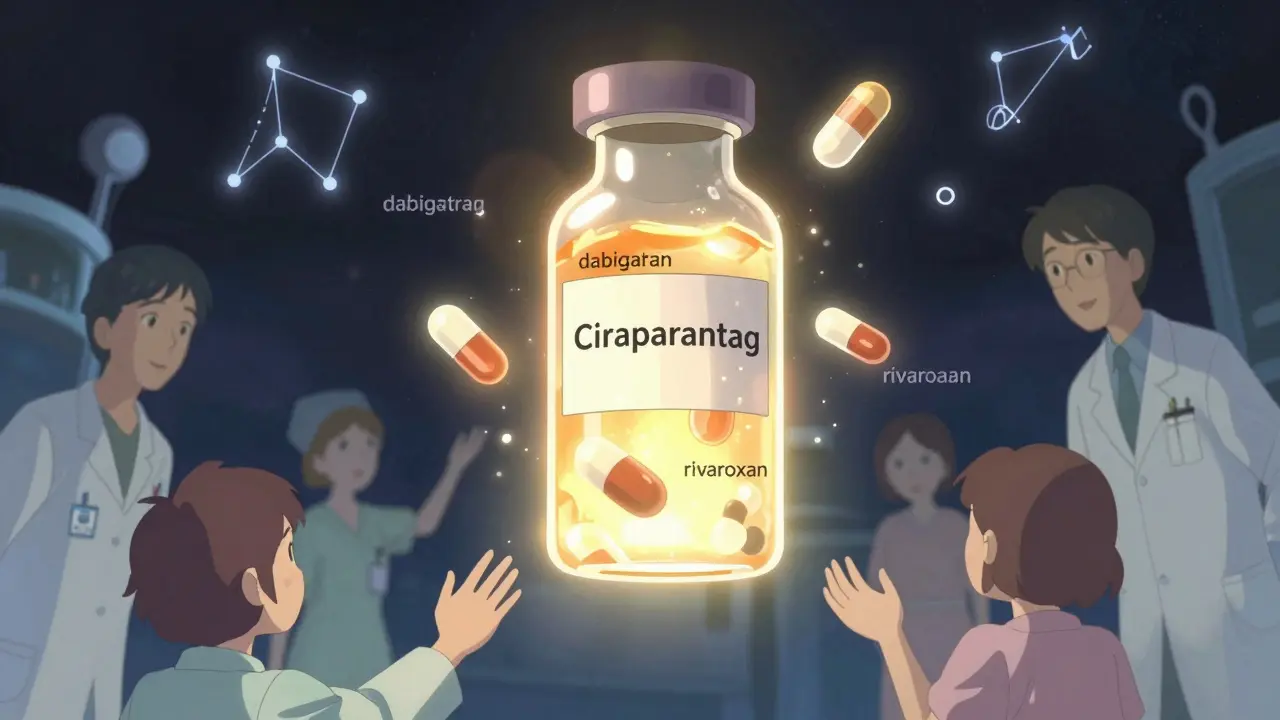
One drug is on the horizon: ciraparantag. It’s a synthetic molecule that can reverse nearly all anticoagulants - heparin, low-molecular-weight heparin, and all DOACs. Phase III trials are wrapping up. If approved by late 2025, it could be a game-changer.
Imagine one vial for every bleeding emergency on blood thinners. No more guessing which drug the patient took. No more stocking multiple expensive agents. Just one universal key.
Until then, we’re stuck with trade-offs. Speed vs. safety. Cost vs. access. Specificity vs. simplicity.
What Should You Remember?
- If someone is on dabigatran and bleeds - use idarucizumab. It’s fast, safe, and simple.
- If they’re on apixaban or rivaroxaban and have a major bleed - andexanet alfa is ideal if available. If not, use 4F-PCC with vitamin K.
- If they’re on warfarin - give 4F-PCC and vitamin K. Never one without the other.
- Vitamin K alone is not an emergency solution. It’s for recovery.
- Cost matters. PCC is 70-80% cheaper than the newer agents. In many cases, it’s just as effective.
Frequently Asked Questions
Can you reverse a blood thinner without a specific agent?
Yes, but it’s riskier. For warfarin, 4F-PCC plus vitamin K is the standard. For DOACs like apixaban or rivaroxaban, PCC is often used off-label when specific agents aren’t available. Emergency teams in rural hospitals do this regularly. It’s not ideal, but it saves lives. The key is to give vitamin K with PCC to prevent rebound bleeding.
How long does it take for idarucizumab to work?
Reversal begins within 5 minutes of the first infusion. Full reversal of dabigatran’s anticoagulant effect is typically complete within 10 to 15 minutes. This is why it’s the preferred choice in trauma and stroke cases - speed matters.
Why is andexanet alfa so expensive?
It’s a complex biologic - a modified human protein made through advanced cell culture. Manufacturing is costly, and the drug requires a two-part dosing system (bolus + infusion), which adds to logistical expenses. The price reflects R&D costs, not just production. Many insurers require prior authorization.
Do reversal agents work on all blood thinners?
No. Each agent is targeted. Idarucizumab only works on dabigatran. Andexanet alfa only works on factor Xa inhibitors (apixaban, rivaroxaban, edoxaban). PCC works on warfarin and sometimes DOACs. Vitamin K only works on warfarin and similar drugs. There’s no universal reversal agent yet - but ciraparantag might change that soon.
Is there a risk of clotting after reversal?
Yes. That’s the biggest trade-off. When you reverse anticoagulation, you’re turning off the body’s natural brake on clotting. This raises the risk of stroke, heart attack, or pulmonary embolism. Andexanet alfa carries the highest risk - 14% in trials. Idarucizumab has the lowest - 5%. That’s why doctors monitor patients closely for 24-72 hours after reversal.
Final Thought: It’s Not About the Best Drug - It’s About the Right Drug, in Time
There’s no perfect reversal agent. Each has strengths and flaws. The best choice depends on the drug the patient took, the severity of the bleed, the hospital’s resources, and how fast you can act.
What matters most isn’t having the newest, most expensive drug. It’s having a plan. Knowing which agent to reach for. Knowing when to use PCC. Knowing vitamin K isn’t optional. And knowing that in the chaos of an emergency, the right decision - even if it’s not the ideal one - can still save a life.
Comments
Honestly i just take my pill and hope for the best. never thought about what happens if i fall. kinda terrifying but also kinda normal i guess? we live in a world where medicine is magic until it isnt.
AMERICA STILL HAS THE BEST DRUGS 🇺🇸🔥 IDARUCIZUMAB IS A GODSEND AND ANDEXANET IS THE FUTURE 💪💊 WHY ARE WE STILL USING PCC LIKE IT’S 2010?? 🤦♀️ #AMERICANMEDICINEWINS #HEALTHCAREEXCELLENCE
The pharmaceutical industry is running a scam. These drugs are designed to keep you dependent. Vitamin K is cheap and natural but they want you to pay $13,500 for a synthetic decoy. Wake up. The system is rigged. They dont care if you live or die as long as the profit margin is high.
In India, we still rely heavily on PCC and vitamin K due to cost and accessibility. The newer agents are impressive scientifically, but in rural hospitals, we make do. Survival is not about having the latest tool, but knowing how to use what you have.
Yo this post is fire 🔥 I work in med admin and i can tell you PCC is the unsung hero. Andexanet? Fancy but overkill. Idarucizumab? Sweet for dabigatran. But most of us? We're out here playing 4F-PCC Jenga with vitamin K as the base. It works. It saves lives. And it dont break the bank. Real talk.
The real issue isn't the reversal agents-it's that we're prescribing DOACs like they're aspirin. People don't understand the risks. They think 'no lab monitoring' means 'no consequences.' This is just the inevitable fallout of marketing-driven medicine.
I appreciate how you broke this down. I’m a med student and this is the first time I’ve seen it all laid out so clearly. Thank you for not just listing facts but explaining why the choices matter.
You know what’s beautiful? That even with all the fancy tech and expensive drugs, the core of emergency medicine is still: know your tools, act fast, and never give up. 💪❤️ And vitamin K? Yeah it’s old school-but it’s still got heart. Keep sharing this kind of stuff. It helps people feel less alone in the chaos.
I’m a nurse in a small ER. We don’t have andexanet. We’ve used PCC for apixaban bleeds three times this year. All three patients walked out. Not because we had the perfect tool-but because we had a team that knew how to think. This isn’t about the drug. It’s about the person behind the chart.
So let me get this straight… we have a $13,500 drug that works faster but kills 14% of people via clots, and a $2,500 drug that works almost as well with half the risk… and people still call this progress? 🤡 I mean… congrats on capitalism.
Vitamin K alone in an emergency is a death sentence
Actually PCC is way overrated. Studies show it doesn’t even fully reverse DOACs. And you’re telling me we’re just going to keep using it because it’s cheap? That’s not medicine, that’s triage. And why is no one talking about ciraparantag? This whole post is just corporate PR dressed up as education.
The fact that you need a two-hour infusion for andexanet alfa is a clinical nightmare. It’s not a reversal agent-it’s a logistics project.
I really like how you balanced the science with the real-world constraints. Too many posts act like hospitals are all like Grey’s Anatomy with magic drugs on standby. The truth is messier-and more human.
PCC + vit K for DOACs? Bro that’s not off-label, that’s just common sense. We’ve been doing it since 2015. The guidelines are lagging behind real practice. Also, idarucizumab is a 5g IV push? That’s not a drug, that’s a whole damn pharmacy in one bag. No wonder it’s expensive. But yeah, it works. So I guess we just accept the price tag like we do with everything else in this system.