

You feel a sudden weakness in your arm. Your speech slurs for ten seconds. Then, just as quickly, it stops. You breathe a sigh of relief and think you’re fine. But here is the hard truth: you might be walking around with a ticking time bomb in your brain. This isn’t a scare tactic; it’s medical reality. What you experienced could have been a Transient Ischemic Attack (TIA), often called a "mini-stroke," which is a temporary blockage of blood flow to the brain that resolves without permanent damage. While it feels like a false alarm, ignoring it is one of the most dangerous decisions you can make.
The difference between a TIA and a full-blown Stroke is permanent brain tissue death caused by prolonged lack of oxygen comes down to time and tissue damage. A TIA is a warning shot. A stroke is the bullet hitting its mark. Understanding this distinction isn't just academic-it’s the difference between living independently and facing lifelong disability. Let’s break down exactly what happens in your brain, how to spot the signs before they vanish, and why speed saves lives.
Why "Mini-Stroke" Is a Dangerous Misnomer
We need to stop using the term "mini-stroke." It sounds manageable, almost cute even. It implies that because the symptoms were small or short-lived, the threat was minor too. That is medically inaccurate and potentially deadly. A TIA is not a "little" stroke; it is a major neurological event that simply didn’t last long enough to kill brain cells permanently-at least, not yet.
Think of it like a fire alarm that goes off but then silences itself. The smoke might have cleared, but the wiring fault is still there. If you ignore the alarm, the next time it triggers, the house burns down. According to data from the American Stroke Association, one in five people who experience a TIA will have a full stroke within 90 days. The risk is highest in the first 48 hours, with up to 5% of patients suffering a stroke within just two days. Calling it a "mini-stroke" gives people a false sense of security that delays the urgent care they desperately need.
TIA vs. Stroke: The Biological Difference
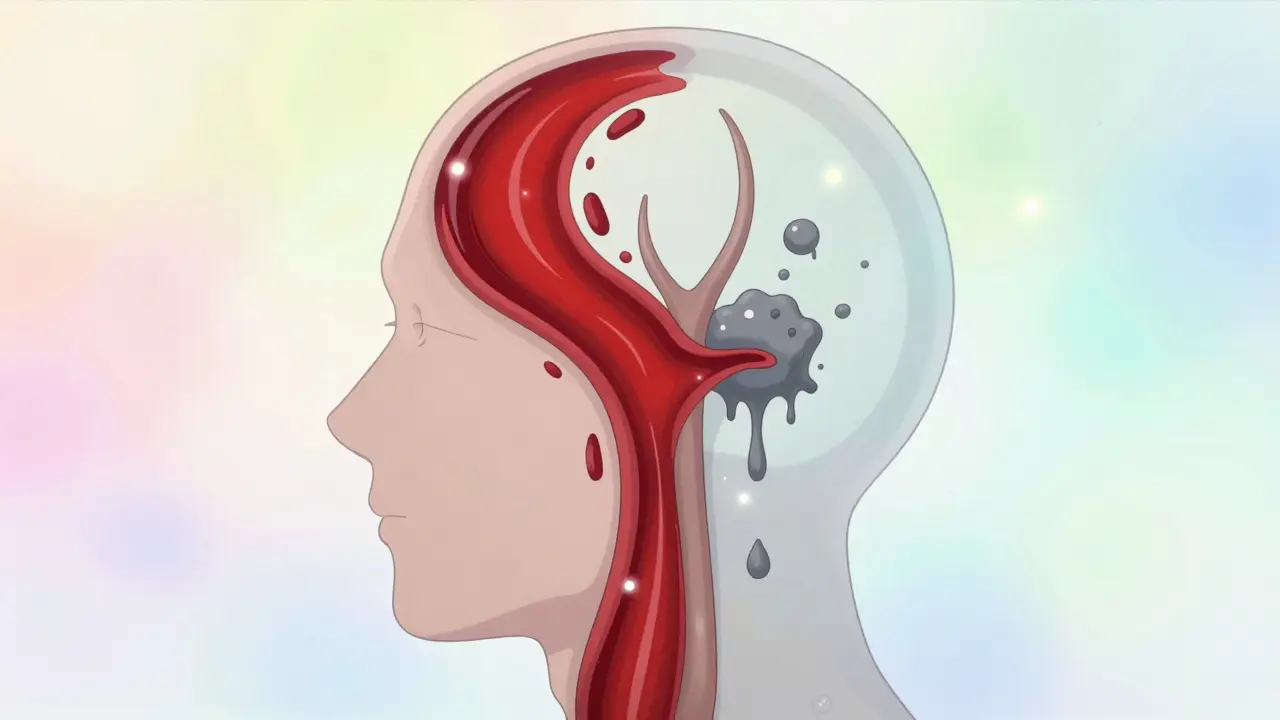
To understand why TIAs are so critical, we have to look at what’s happening inside the skull. Both conditions are types of ischemic events, meaning they involve a blockage in blood flow. Usually, this is a clot traveling from the heart or neck arteries into the brain.
In a Ischemic Stroke, that blockage stays put long enough to starve brain cells of oxygen. These cells begin to die within minutes, leading to permanent infarction-tissue death. On an MRI scan, this shows up as a dark spot where brain matter has been destroyed.
In a Transient Ischemic Attack, the blockage dissolves on its own or moves along before significant cell death occurs. Historically, doctors defined a TIA by time: if symptoms lasted less than 24 hours, it was a TIA. Today, that definition is obsolete. Modern neurology uses a tissue-based definition. If you have stroke-like symptoms that resolve, but an MRI shows no dead tissue, it’s a TIA. If the MRI shows any infarction, it’s a stroke, regardless of how long the symptoms lasted. In fact, studies show that about 35% of patients diagnosed with a TIA actually had minor strokes when scanned with advanced diffusion-weighted MRI. This means many people who thought they were safe were already dealing with brain damage.
Recognizing the Warning Signs: BE FAST
You cannot tell the difference between a TIA and a stroke based on symptoms alone. They look identical. The only difference is duration and outcome. That’s why you must treat every episode as a stroke until proven otherwise. Use the BE FAST mnemonic is a tool used to identify stroke symptoms including Balance loss, Eyes/vision changes, Face drooping, Arm weakness, Speech difficulty, and Time to call emergency services.
- B - Balance: Sudden loss of balance, coordination, or dizziness. You might stumble while walking straight.
- E - Eyes: Sudden trouble seeing in one or both eyes. Vision might go black, blur, or double.
- F - Face: Ask the person to smile. Does one side of the face droop? Is the smile uneven?
- A - Arms: Ask them to raise both arms. Does one arm drift downward? Is there weakness or numbness?
- S - Speech: Ask them to repeat a simple sentence. Is their speech slurred? Are they saying things that don’t make sense?
- T - Time: If you see any of these signs, note the time and call 911 immediately. Do not wait to see if it passes.
TIAs typically resolve within 10 to 60 minutes. About 56% of cases clear up within an hour. But remember: the fact that it clears up doesn’t mean it’s over. It means the clock is ticking louder.
The ABCD2 Score: How Doctors Measure Your Risk
When you arrive at the hospital, doctors won’t just guess your risk. They use a standardized tool called the ABCD2 Score is a clinical assessment tool used to estimate the risk of stroke after a transient ischemic attack. Developed to help triage patients, it assigns points based on five factors. The higher your score, the more urgent your treatment needs to be.
| Factor | Criteria | Points |
|---|---|---|
| Age | 60 years or older | 1 point |
| Blood Pressure | Systolic ≥140 mmHg or Diastolic ≥90 mmHg | 1 point |
| Clinical Features | Unilateral weakness (arm/leg) | 2 points |
| Clinical Features | Speech impairment without weakness | 1 point |
| Duration | Symptoms lasted 60+ minutes | 2 points |
| Duration | Symptoms lasted 10-59 minutes | 1 point |
| Diabetes | Patient has diabetes | 1 point |
If you score 4 points or higher, your risk of having a stroke within two days jumps to 8.1%. Patients with high scores usually require hospital admission for immediate monitoring and treatment. Those with lower scores might be sent home, but only after thorough evaluation and a strict follow-up plan.
Urgent Evaluation: Why Timing Saves Brains
The golden rule of TIA management is speed. Current guidelines from the American Heart Association state that TIA is a medical emergency requiring evaluation within 24 hours. Ideally, this should happen within 60 minutes of symptom resolution. Why such urgency? Because early intervention prevents the next event.
Here is what happens during that urgent evaluation:
- Imaging: You’ll get a non-contrast CT scan immediately to rule out bleeding (hemorrhagic stroke). Then, an MRI with diffusion-weighted imaging is performed within 24 hours. This sensitive test can detect tiny areas of brain injury that a CT might miss, helping doctors determine if it was truly a TIA or a minor stroke.
- Vascular Assessment: Doctors check your carotid arteries in your neck using ultrasound. Narrowing here (stenosis) is a common cause of TIAs. If blockage is severe, surgery or stenting might be needed.
- Heart Monitoring: An EKG and possibly a Holter monitor are used to check for atrial fibrillation (AFib), an irregular heartbeat that throws clots into the brain.
Studies show that patients evaluated in specialized TIA clinics have a 90-day stroke risk of just 1.2%, compared to 10.3% for those who receive delayed care. That’s a massive difference driven entirely by how fast you act.

Treatment Strategies to Prevent the Next Event
Once the diagnosis is confirmed, the focus shifts to prevention. You aren’t treated for the TIA itself-you’re treated to stop the stroke that’s likely coming. The standard protocol involves three pillars:
Antiplatelet Therapy: Unless you have AFib, you’ll likely start aspirin (325 mg) within 24 hours. For high-risk patients, doctors may prescribe dual antiplatelet therapy (aspirin plus clopidogrel) for 21 to 30 days. This combination reduces the risk of subsequent stroke by up to 60%.
Statin Medication: High-intensity statins, like atorvastatin 80 mg daily, are prescribed regardless of your cholesterol levels. Statins stabilize plaque in your arteries, preventing clots from forming and breaking off.
Blood Pressure Control: Keeping your blood pressure below 140/90 mmHg is critical. Uncontrolled hypertension is a leading driver of both TIAs and strokes.
If you have atrial fibrillation, you’ll be switched to anticoagulants (blood thinners) instead of antiplatelets. This change can take time to become effective, so timing is crucial.
Common Myths and Realities
Misinformation costs lives. Let’s clear up some persistent myths.
"If the symptoms went away, I’m fine." False. As discussed, the risk of a major stroke is highest in the first 48 hours. The disappearance of symptoms is not a cure; it’s a pause button.
"I should drive myself to the hospital." Never. Symptoms can return suddenly, leaving you unable to control your vehicle. Call an ambulance. Paramedics can start life-saving assessments en route.
"TIAs only happen to old people." While the median age for TIA is 69, younger adults are increasingly affected due to rising rates of hypertension, smoking, and drug use. No one is immune.
How long do TIA symptoms typically last?
Most TIA symptoms resolve within 10 to 60 minutes. About 56% of cases clear up within an hour. However, the traditional definition allowed for symptoms lasting up to 24 hours. Regardless of duration, any sudden neurological deficit requires immediate medical attention.
Can a TIA cause permanent brain damage?
By definition, a TIA does not cause permanent brain infarction (tissue death). However, advanced MRI scans show that up to 35-48% of patients diagnosed with TIA actually have minor areas of brain injury, reclassifying them as minor strokes. Therefore, even "silent" TIAs can have subtle long-term cognitive effects.
What is the biggest risk factor for having a stroke after a TIA?
The biggest risk factor is time. The risk of stroke is highest in the first 48 hours after a TIA, with up to 5% of patients experiencing a stroke within two days. Other major risk factors include high ABCD2 scores, untreated atrial fibrillation, and significant carotid artery narrowing.
Should I go to the ER if my symptoms disappear completely?
Yes. You should call 911 or go to the nearest emergency department immediately, even if symptoms have resolved. A TIA is a medical emergency. Early evaluation allows doctors to start preventive treatments that can reduce your stroke risk by up to 80%.
How does treatment for TIA differ from stroke treatment?
Acute stroke treatment often involves thrombolytic drugs (like tPA) to dissolve clots within 4.5 hours, or mechanical thrombectomy to remove large clots. TIA treatment focuses on secondary prevention: starting antiplatelet medications (aspirin/clopidogrel), high-intensity statins, and managing blood pressure to prevent a future event.