

Imagine picking up a prescription for a brand-name heart medication and leaving the pharmacy with a completely different pill in your hand. It looks smaller, costs a fraction of the price, and has a different name on the bottle. Would you take it? Most people do, because they trust that their pharmacist knows what they are doing. But how does the pharmacist know that this new pill will work exactly like the expensive one prescribed by your doctor?
The answer lies in a system most patients never see but every pharmacist relies on daily: therapeutic equivalence codes. These codes are the backbone of generic drug substitution in the United States. They tell healthcare providers whether a generic version is safe and effective enough to replace a brand-name drug without risking patient health. Without this system, the $370 billion in annual savings from generics would vanish, and access to affordable medicine would crumble.
What Are Therapeutic Equivalence Codes?
Therapeutic equivalence codes are a standardized classification system used by the U.S. Food and Drug Administration (FDA) to indicate whether generic drug products can be substituted for reference listed drugs. Think of them as a traffic light system for pharmacists. Green means go-you can swap the drug safely. Yellow or red means stop and think-there might be issues.
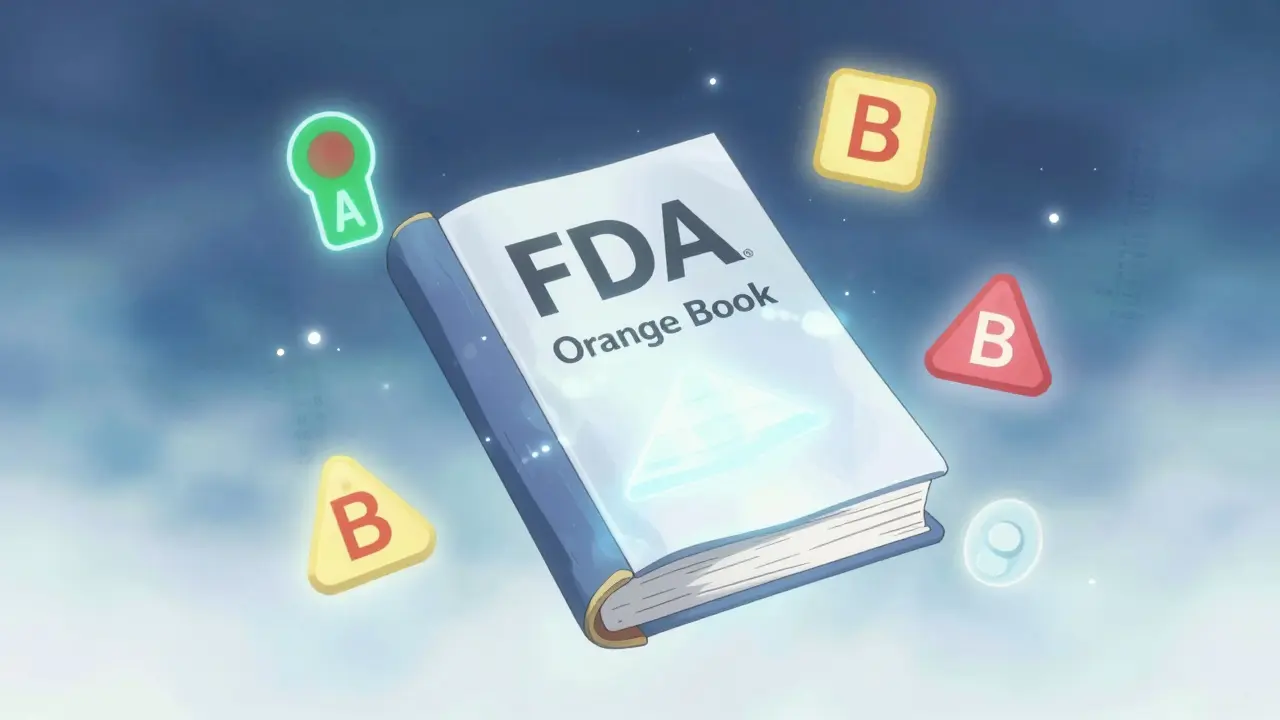
This system lives inside a document officially called Approved Drug Products with Therapeutic Equivalence Evaluations, commonly known as the Orange Book. The Orange Book was first published in 1980 following the Hatch-Waxman Amendments of 1984. Its job is simple: list all approved drug products and rate their therapeutic equivalence. When a pharmacist fills a prescription, they check this book (usually via digital databases) to see if the generic they have in stock matches the brand-name drug in terms of safety and effectiveness.
The FDA assigns these codes based on three pillars:
- Pharmaceutical equivalence: The drugs must have the same active ingredient, strength, dosage form, and route of administration.
- Bioequivalence: The generic must deliver the same amount of active ingredient into the bloodstream at the same rate as the brand-name drug.
- Clinical effect and safety profile: The generic must produce the same therapeutic result and side effects under the conditions specified in the labeling.
If a product meets all three criteria, it gets an "A" rating. If there are doubts or missing data, it gets a "B" rating. This distinction is crucial for understanding why some generics are swapped automatically while others require extra caution.
Decoding the Letters: A vs. B Ratings
The TE code system uses letters to communicate complex scientific evaluations quickly. The first letter tells you the most important thing: can you substitute this drug?
| Code Prefix | Meaning | Substitution Status | Common Examples |
|---|---|---|---|
| A | Therapeutically equivalent | Yes, generally acceptable | AB, AB1, AB2 |
| B | Not shown to be therapeutically equivalent | No, requires further investigation | BC, BD, BX |
AB Rating is the gold standard for generic substitution, indicating that the product meets necessary bioequivalence requirements and is considered therapeutically equivalent to the reference listed drug. About 90% of generic drugs in the U.S. market carry an "A" rating. Specifically, an "AB" code means the generic has passed rigorous bioequivalence studies. You might also see suffixes like AB1, AB2, AB3, or AB4. These numbers appear when multiple reference listed drugs exist for the same strength. For example, if two different companies hold patents for the same brand-name drug formulation, the FDA assigns different suffixes to help track which generic matches which reference.
On the other hand, B Ratings indicate products where the FDA has not established therapeutic equivalence due to insufficient data or specific challenges. This doesn't necessarily mean the drug is unsafe, but it means the FDA needs more information before giving it a clean bill of health for automatic substitution. Common B codes include:
- BC: Extended-release dosage forms where bioequivalence is harder to prove.
- BD: Active ingredients with documented bioequivalence problems.
- BX: Insufficient data to determine therapeutic equivalence.
- BT: Topical products with bioequivalence issues.
Dr. Duxin Sun, a professor of pharmaceutics at the University of Michigan, noted in a 2022 article that current TE codes for topical, inhaled, and complex injectable products may not adequately reflect therapeutic equivalence. This is why many complex generics still sit in the "B" category despite potentially being clinically useful.
Why Pharmacists Check the Orange Book Daily
You might wonder why a pharmacist spends time checking codes when the law allows substitution. The reality is that state laws vary, and patient safety depends on precision. According to a 2022 survey by the National Community Pharmacists Association, 87% of independent pharmacists reported that TE codes significantly streamline the generic substitution process. Another study found that pharmacists spend an average of 2.7 minutes per prescription verifying TE status.
Here’s how it works in practice. In 49 U.S. states, pharmacists are permitted to automatically substitute an "A"-rated generic for a brand-name drug without asking the doctor. This is called automatic substitution. However, if a drug has a "B" rating, the rules change. Thirty-eight states mandate that pharmacists notify prescribers when substituting a "B"-rated product. Some physicians even write "Dispense As Written" (DAW) on prescriptions to block substitution entirely, often out of caution regarding "B" codes.
Confusion around "B" codes is real. An American Medical Association survey revealed that 42% of physicians expressed confusion about how to interpret these codes. In some cases, pharmacists incorrectly refuse to substitute a "B"-rated product that might actually be appropriate for a specific patient, leading to unnecessary costs. Conversely, assuming all "B" codes are unsafe could limit access to needed medications. This nuance is why pharmacists consult the Orange Book weekly-it helps them navigate these gray areas safely.

The Economics of Generic Substitution
Therapeutic equivalence isn’t just a scientific concept; it’s an economic engine. Generic drugs account for 90% of prescriptions filled in the U.S. but only 23% of total drug spending. This gap generates approximately $370 billion in annual savings, according to the Association for Accessible Medicines 2023 report. The TE code system makes this possible by providing the regulatory certainty insurers and pharmacies need to switch patients from expensive brands to cheaper generics.
Without clear TE codes, insurance companies wouldn’t know which generics to cover. Patients would face higher copays, and hospitals would struggle with budget constraints. The FDA’s Office of Generic Drugs Strategic Plan 2023-2027 aims to modernize TE evaluations to keep this system efficient. One goal is reducing "B"-rated products for complex generics by 30% by 2027, ensuring more drugs can enter the high-confidence "A" category.
However, the rise of complex generics poses a challenge. Between 2018 and 2022, the FDA reported a 22% increase in "B"-rated applications for complex generics. These include inhalers, patches, and extended-release pills where traditional blood-level tests don’t fully capture how the drug works in the body. Dr. Elizabeth Friedman, Director of the Office of Generic Drugs at FDA, emphasized that therapeutic equivalence depends on pharmaceutical equivalence, demonstrated bioequivalence, and the same clinical effect. For complex drugs, proving that last part is difficult.
Future Directions: Modernizing the System
The landscape of generic drugs is evolving, and so is the TE code system. The FDA released draft guidance in 2022 titled "Evaluation of Therapeutic Equivalence," proposing updates to address challenges with complex drug products. The agency seeks public comment on using enhanced evaluation methodologies, such as real-world evidence, alongside traditional bioequivalence studies.
Industry analysts predict that the TE code system will incorporate more diverse data sources. For instance, instead of relying solely on short-term blood tests, the FDA might look at long-term patient outcomes for certain complex drugs. This shift could help move more "B"-rated products into the "A" category, expanding access to affordable generics.
Meanwhile, the FDA continues to expand its Product-Specific Guidances (PSGs). As of August 2023, there were 1,850 PSG documents providing detailed bioequivalence recommendations for specific drug products. These guides help manufacturers design studies that meet FDA standards, increasing the likelihood of receiving an "A" rating upon approval.
For patients, this means greater transparency and potentially lower costs. For healthcare providers, it means clearer guidelines on which generics are truly interchangeable. The TE code system remains a vital tool in balancing innovation, affordability, and safety in modern medicine.
What does an AB rating mean on a generic drug?
An AB rating means the generic drug is therapeutically equivalent to the brand-name reference listed drug. It has met all necessary bioequivalence requirements, meaning it delivers the same amount of active ingredient into your bloodstream at the same rate. Pharmacists can usually substitute AB-rated generics automatically without needing permission from your doctor.
Can I substitute a B-rated generic for my prescription?
Generally, no. A B-rated generic indicates that the FDA has not yet established therapeutic equivalence due to insufficient data or specific challenges. While it might be safe, it cannot be automatically substituted in most states. Your pharmacist may need to contact your doctor for approval or choose a different generic with an A rating.
Where can I find therapeutic equivalence codes for my medication?
You can find TE codes in the FDA's Orange Book, officially titled "Approved Drug Products with Therapeutic Equivalence Evaluations." It is available online through the FDA website. Pharmacists use digital versions of this database daily to verify substitution eligibility. Patients can also ask their pharmacist to check the TE code for their specific medication.
Why do some generics have suffixes like AB1 or AB2?
Suffixes like AB1, AB2, AB3, and AB4 are used when multiple reference listed drugs exist for the same strength under the same heading. This happens when different companies hold patents or approvals for similar brand-name formulations. The suffix helps track which generic matches which specific reference product, ensuring precise substitution.
Do over-the-counter drugs have therapeutic equivalence codes?
No, over-the-counter (OTC) drugs are explicitly excluded from TE code assignments according to the FDA's Drugs@FDA glossary. TE codes apply only to multisource prescription products. OTC drugs follow different regulatory pathways for establishing safety and efficacy.