

Many people carry a label in their medical records: sulfa allergy. But what does that really mean? And more importantly-what should you actually avoid?
It’s common to hear someone say, "I’m allergic to sulfa," and assume that means every drug with "sulf" in the name is off-limits. That’s not just misleading-it’s dangerous. Too many patients are denied safe, effective medications because of outdated assumptions. In fact, most people who think they have a sulfa allergy don’t have one at all. A 2022 study found that only 0.3-0.5% of the population has a true IgE-mediated allergy to sulfonamide antibiotics. The rest? They had a rash, a stomach ache, or a reaction that wasn’t allergic at all-but the label stuck.
What Is a Sulfonamide Allergy, Really?
Sulfonamide antibiotics are a group of drugs first introduced in the 1930s. They include sulfamethoxazole (often paired with trimethoprim as Bactrim or Septra), sulfadiazine, and sulfacetamide. These drugs work by blocking bacterial growth, and they’ve saved millions of lives. But they can also trigger allergic reactions in a small number of people.
True allergic reactions usually show up within hours to days after taking the drug. Symptoms include hives, swelling, difficulty breathing, or a severe skin rash like Stevens-Johnson syndrome. These are rare. Far more common are non-allergic side effects: nausea, dizziness, or a mild skin rash that appears after several days. That’s not an allergy-it’s a side effect. Yet, once it’s written down as "sulfa allergy," it’s hard to remove.
Here’s the problem: when a patient is labeled with a sulfa allergy, doctors often avoid all sulfonamide drugs-even ones that are completely safe. That pushes patients toward broader-spectrum antibiotics like fluoroquinolones, which carry black box warnings for tendon rupture and aortic aneurysm. A 2021 study showed that patients with a "sulfa allergy" label were 78.4% more likely to get a different antibiotic-and 32.7% of those were unnecessarily broad-spectrum.
The Big Misconception: All "Sulfa" Drugs Are the Same
Here’s the key fact you need to know: not all drugs with "sulf" in the name are the same. There’s a huge difference between sulfonamide antibiotics and nonantimicrobial sulfonamides.
Antibiotic sulfonamides have two specific chemical features: an arylamine group at the N4 position and a nitrogen-containing ring at the N1 position. These are what make them allergenic in rare cases.
Nonantimicrobial sulfonamides? They don’t have those groups. They’re chemically different. That means they don’t trigger the same immune response.
Examples of nonantimicrobial sulfonamides:
- Hydrochlorothiazide - a common blood pressure pill
- Furosemide - a water pill used for heart failure and swelling
- Acetazolamide - used for glaucoma and altitude sickness
- Celecoxib - a pain reliever (Celebrex)
These drugs are not cross-reactive with sulfonamide antibiotics. Multiple large studies confirm this. A 2020 study in the Journal of Allergy and Clinical Immunology found that patients with a documented sulfa antibiotic allergy had only a 1.1% chance of reacting to hydrochlorothiazide-same as people without any sulfa allergy history.
Another study of over 10,000 patients showed that only 1.3% of those with a "sulfa allergy" had a reaction to a nonantimicrobial sulfonamide. That’s barely higher than the background rate in the general population.
What You Can Still Take (and What You Should Avoid)
Let’s cut through the confusion. Here’s what’s safe-and what’s not.
Safe to Take (Even With a Sulfa Allergy Label)
- Hydrochlorothiazide - for high blood pressure
- Furosemide - for fluid retention
- Acetazolamide - for glaucoma or mountain sickness
- Celecoxib - for arthritis pain
- Sumatriptan - for migraines
- Sulfonylureas like glipizide - for diabetes
All of these are nonantimicrobial sulfonamides. They lack the chemical structure that triggers allergic reactions to antibiotics. The FDA now requires these drugs to state clearly in their labeling: "This product does not contain the structural elements associated with sulfonamide antibiotic allergies."
What to Avoid (Only If You Have a True Allergy)
- Sulfamethoxazole/trimethoprim (Bactrim, Septra)
- Sulfadiazine
- Sulfacetamide (eye drops)
- Sulfasalazine (used for ulcerative colitis and rheumatoid arthritis)
- Dapsone - used for leprosy and Pneumocystis pneumonia prophylaxis
Dapsone is the exception. It shares structural similarities with antibiotic sulfonamides. Studies show a 13.2% reaction rate in people with prior sulfonamide antibiotic allergies. So if you’ve had a serious reaction before, talk to your doctor before taking dapsone.
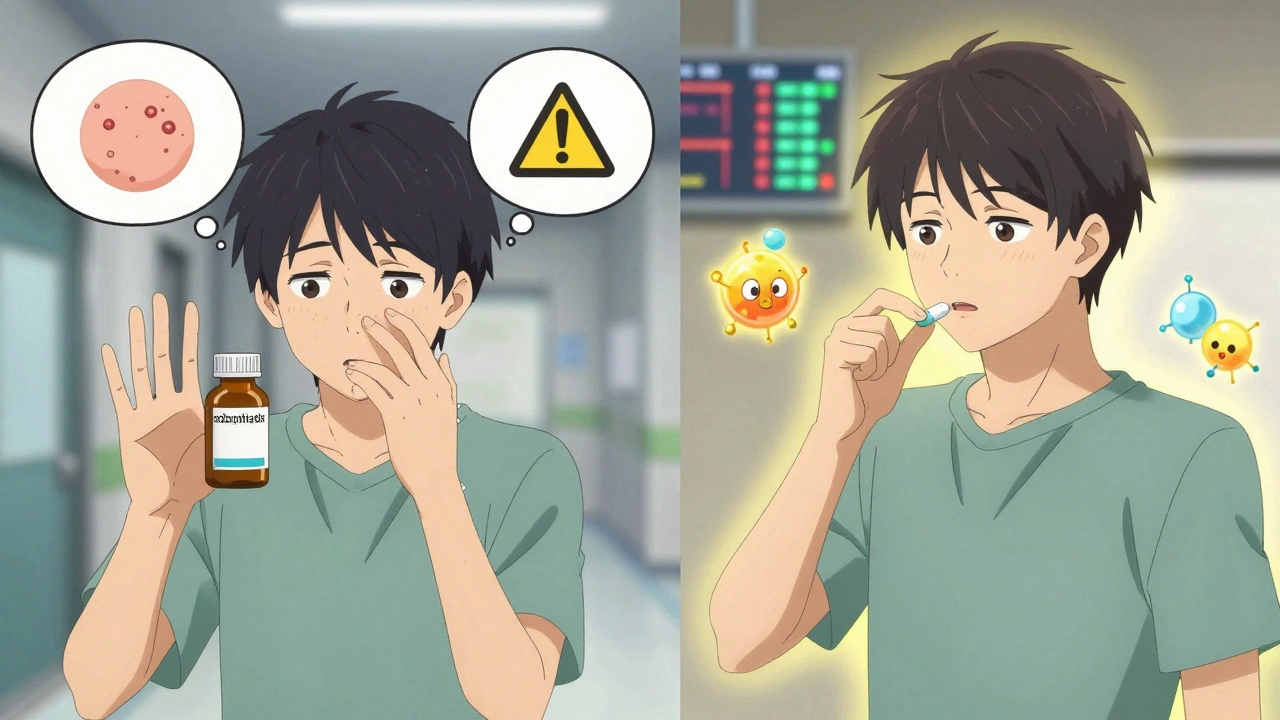
What About Sulfates, Sulfites, and Sulfur?
Here’s another myth that needs to die: sulfa allergy has nothing to do with sulfur, sulfates, or sulfites.
Sulfur is an element. Sulfates (like magnesium sulfate) are salts. Sulfites are preservatives in wine and dried fruit. None of these are chemically related to sulfonamides. But a 2020 survey found that 42.7% of primary care doctors mistakenly believed patients with sulfa allergies couldn’t take sulfites. That’s wrong-and it’s causing unnecessary fear.
If you’re allergic to sulfites, you might react to wine or dried apricots. That’s a completely different system. If you’re allergic to sulfonamide antibiotics, it’s a reaction to a specific drug structure. They’re not connected.
What If You’re Not Sure If It Was Really an Allergy?
Many people were told they had a sulfa allergy as a child after getting a mild rash. Maybe it was a viral infection. Maybe it was a reaction to something else. But the label stuck.
The good news? You can get it checked.
For low-risk reactions-like a rash that appeared after five days, with no fever, swelling, or breathing trouble-doctors can safely do an oral challenge. You take a small dose of a nonantimicrobial sulfonamide (like hydrochlorothiazide) under supervision. Studies show a 99.2% success rate. No reaction. No risk.
For high-risk reactions-like anaphylaxis, blistering skin, or Stevens-Johnson syndrome-see an allergist. Skin testing and graded challenges are available and highly accurate. A 2022 study found that 94.7% of patients with a "sulfa allergy" label were able to safely tolerate a challenge.
And here’s the best part: once you’re cleared, your medical record gets updated. No more unnecessary restrictions. No more avoiding blood pressure meds. No more being stuck with riskier antibiotics.

Why This Matters Beyond Your Own Health
Every time a patient is wrongly labeled with a sulfa allergy, it doesn’t just affect them-it affects everyone.
Doctors use broader antibiotics because they’re afraid of the label. That drives antibiotic resistance. The CDC reports that inappropriate antibiotic use due to sulfa allergy labels increases resistance in E. coli by 8.3% and in Staphylococcus aureus by 12.7%.
It also costs money. A 2022 analysis estimated that mislabeling sulfa allergies costs the U.S. healthcare system $1.2 billion a year in extra drugs, longer hospital stays, and complications from inappropriate alternatives.
Electronic health records now have tools to help. Systems like Epic have built-in alerts that flag when a "sulfa allergy" label might be blocking a safe, appropriate drug. But these tools only work if the label is accurate.
What You Should Do Right Now
If you’ve been told you have a sulfa allergy, here’s what to do:
- Check your medical record. Look at the exact wording. Was it "rash after taking Bactrim"? Or just "sulfa allergy"? Vague labels are the problem.
- Ask yourself: Did you have a true allergic reaction? Did you have trouble breathing? Swelling? Blistering skin? Or just a mild rash days later?
- Ask your doctor about de-labeling. If your reaction was mild and happened long ago, you may be able to get tested and have the label removed.
- Don’t avoid nonantimicrobial sulfonamides without proof. Hydrochlorothiazide, furosemide, celecoxib-they’re safe for you.
- Teach others. If you’ve been cleared, tell your family. Many people still believe the myth.
There’s no shame in being told you had an allergy. But there’s real harm in holding onto a label that doesn’t fit. You deserve better care. And so does everyone else who might need an antibiotic someday.
Comments
Wow. This is one of those posts that makes you realize how much we’ve been misinformed by default. I had a mild rash after Bactrim at 12, and for 25 years I avoided every drug with 'sulf' in it-even hydrochlorothiazide. Turns out, my doctor never asked what the reaction was. Just wrote 'sulfa allergy' and moved on. Time to call my PCP and get this re-evaluated.
It’s wild how medical labels become identity markers. We don’t say 'I’m allergic to penicillin' and then refuse every antibiotic-because we know penicillin is a class. But 'sulfa allergy'? Suddenly it’s a blanket curse. The truth is, we’ve been conditioned by fear, not science. This isn’t just about drugs-it’s about how medicine treats patient stories as facts instead of hypotheses waiting for evidence.
WAIT. 😱 So are you saying Big Pharma is hiding this?? Like… they profit off people taking MORE expensive antibiotics?? And the EHR systems are just letting this slide?? I’m not even mad… I’m just… 😳🤯
One must exercise caution in interpreting epidemiological data without regard to confounding variables. The cited studies, while statistically significant, do not account for regional variations in diagnostic practices or the potential for recall bias in self-reported allergies. Furthermore, the assumption that all nonantimicrobial sulfonamides are structurally homogeneous is chemically reductive. The presence of trace impurities in generic formulations may introduce unpredictable immunogenicity. Thus, blanket de-labeling without controlled provocation testing remains premature.
you’ve been lied to. and it’s costing you. stop letting a 12-year-old rash decide your health. go get tested. your heart will thank you. 🙌
I used to be the person who avoided every sulf-containing med until I had a near-fatal reaction to a fluoroquinolone because I was scared of Bactrim. Now I take hydrochlorothiazide like it’s water. This post saved my life. Thank you for writing this. I’m telling my mom. And my sister. And my boss. Everyone needs to know.
Excellent breakdown. I’m a pharmacist and I see this every day. Patients refuse life-saving diuretics because of a rash they got in college. The real tragedy? Many don’t even know they’re being denied safe alternatives. The FDA labeling update is a step forward, but we still need better clinician education. I’ve started printing handouts for my patients: 'Sulfa Allergy? Here’s What’s Actually Safe.' It’s been a game-changer.
Man, I used to think sulfa meant sulfur, so I avoided Epsom salt baths. 🤦♂️ Now I know better. Thanks for clearing this up. I’m gonna tell my cousin who’s scared to take Celebrex. She’s been in pain for years because of this myth. You’re doing good work here.
THIS IS WHY WE CAN’T HAVE NICE THINGS. 🇺🇸 Our healthcare system is run by lazy doctors and greedy drug companies. They’d rather give you a dangerous antibiotic than check your file. Meanwhile, I’m stuck with a $400 co-pay for a brand-name drug because they won’t risk the 'sulfa' label. I’m not mad. I’m just disappointed. 😔
Okay so I just looked up my record… it says 'rash after sulfa'... but I didn't even take sulfa? I think I was sick with mono? And now I can't take my blood pressure med? This is insane. I'm calling my doc tomorrow. Also... I think I mispelled 'sulfa' like 12 times in my notes. Oops. 😅