
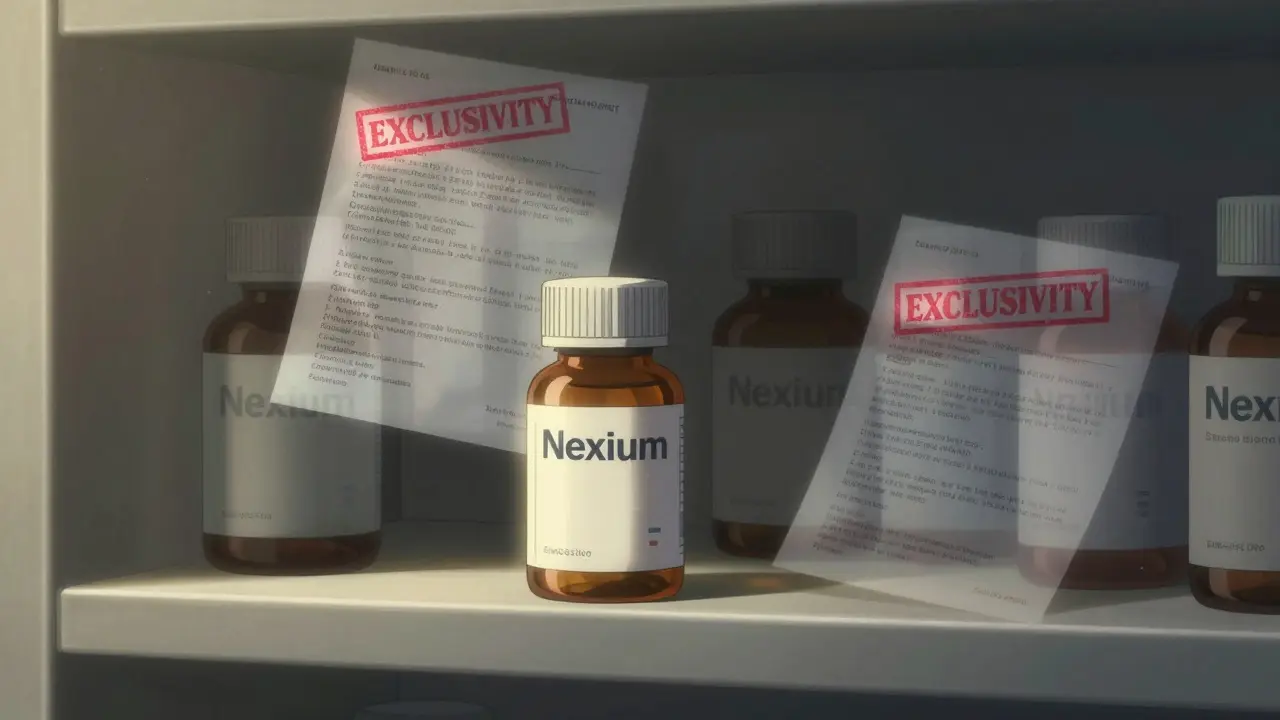
When a new drug hits the market, the clock starts ticking on its monopoly. The primary patent gives the manufacturer 20 years of protection from the day it’s filed - but that’s not the whole story. By the time a drug reaches patients, years have already passed in clinical trials. That leaves maybe 10-12 years of real market exclusivity before generics can step in. So how do big pharma companies stretch that window? The answer lies in secondary patents.
What Exactly Are Secondary Patents?
Secondary patents aren’t about the active ingredient. They’re about everything else: how the drug is made, how it’s taken, or even what it’s used for. Think of them as legal extensions wrapped around the core patent. While the original patent protects the molecule itself - say, the chemical structure of a blood pressure drug - secondary patents can cover things like a new tablet coating, a specific dose, a different salt form, or even a new medical use.For example, AstraZeneca didn’t just patent esomeprazole as a new drug. They patented it as the single-enantiomer version of omeprazole (the active ingredient in Prilosec). That switch from a mix of two mirror-image molecules to just one - the more effective one - got them nearly eight more years of exclusivity. Patients didn’t get a dramatically better drug, but the company kept competitors out.
The U.S. Food and Drug Administration (FDA) keeps a public list called the Orange Book. It only includes certain types of secondary patents - mainly those tied to formulation or method of use. But companies often file dozens more that never make the list. These are called "reserve patents," and they’re used as legal landmines. If a generic company tries to enter the market, the brand-name company can sue over one of these hidden patents, delaying the generic for years.
The 12 Types of Secondary Patents (And How They Work)
There are 12 recognized categories of secondary patents in pharmaceuticals. Each one is a different tool in the toolbox:- Polymorphs: Different crystal structures of the same drug. GlaxoSmithKline’s Paxil (paroxetine) had its original patent expire in 2001 - but a patent on Form G, a specific crystal shape, blocked generics until 2005.
- Enantiomers: Separating mirror-image molecules. Esomeprazole (Nexium) is the classic case - a single enantiomer of omeprazole.
- Salts and esters: Changing the chemical form to improve absorption or stability. Many drugs are patented as hydrochloride or sulfate salts.
- Formulations: New delivery methods - extended-release pills, patches, liquids, or inhalers. A once-daily version of a twice-daily drug can be enough to justify a new patent.
- Combinations: Mixing two drugs into one pill. Even if both drugs are generic, the combo can be patented.
- Prodrugs: Inactive versions that turn into the active drug inside the body. These are harder to reverse-engineer.
- Method of use: Patenting a new disease to treat. Thalidomide was originally a sedative. Decades later, it got a patent for treating leprosy. Then another for multiple myeloma.
- Manufacturing processes: New ways to make the drug. These aren’t listed in the Orange Book, but they’re still used to sue generics.
- Metabolites: Patents on the breakdown products of a drug in the body.
- Selection patents: Picking one specific compound from a known group.
- Markush claims: Broad chemical formulas that cover thousands of variations.
- Dosing regimens: Patenting a new schedule - like "take one pill every 72 hours" instead of daily.
Some of these are legitimate innovations. Others? They’re barely changes at all. A 2016 Harvard study found that only 12% of secondary patents led to any real clinical improvement. The rest? They’re legal maneuvers.
How Much Extra Time Do They Really Buy?
The numbers don’t lie. According to a 2012 study in PLOS ONE, drugs with secondary patents get an extra 4 to 5 years of exclusivity on average. For drugs without a strong primary patent, that number jumps to 9-11 years.Take Humira, AbbVie’s blockbuster arthritis drug. Its primary patent expired in 2016. But by filing 264 secondary patents - covering everything from injection devices to dosing schedules - they blocked generics until 2023. That’s seven extra years of monopoly pricing. Annual sales hit $20 billion during that stretch.
Compare that to a drug with no secondary patents. Once the primary patent expires, generics flood in within months. Prices drop 80-90%. But with secondary patents? Generic entry is delayed by an average of 2.3 years. That’s not just a delay - it’s a financial windfall.
And it’s not just big companies doing this. The top 10 pharma firms hold 73% of all secondary patents. Pfizer alone had over 14,200 active secondary patents as of 2023. Meanwhile, smaller drugs earning under $100 million a year rarely have more than one or two. It’s a strategy reserved for the cash cows.
The Global Divide: Where It Works and Where It Doesn’t
Not every country plays by the same rules.In the U.S., the Hatch-Waxman Act of 1984 created the framework for this system. It lets companies list patents in the Orange Book and gives them 30 months of automatic litigation delay if a generic challenges them. That’s a built-in delay tactic.
But India? Not so much. Their 2005 patent law includes Section 3(d), which says you can’t patent a new form of an old drug unless it shows significantly better efficacy. When Novartis tried to patent a crystalline form of Gleevec (imatinib), the Indian patent office denied it. The courts agreed. That decision sent shockwaves through the industry.
Brazil requires health ministry approval before a patent can be enforced. The EU demands "significant clinical benefit" for certain secondary patents. In both cases, companies can’t just file a patent and assume it’ll hold.
This isn’t just legal technicality - it’s a matter of access. The UN Development Programme found that secondary patents are the main reason essential medicines remain unaffordable in 68 low- and middle-income countries. A drug that’s generic in India might still be under patent in the U.S., costing 10 times more.
Who Pays the Price?
The cost isn’t just financial - it’s personal.Pharmacy benefit managers like Express Scripts say secondary patents raise their costs by 8.3% every year. That’s passed on to insurers, employers, and ultimately patients. A 2021 survey of doctors found that patients are often confused when a drug they’ve been taking for years suddenly gets replaced with a "new and improved" version - right before generics become available.
Generic manufacturers report spending $15-20 million per product just to fight patent lawsuits. And even then, they only win 38% of the time. That’s a high price to pay for a chance to sell a $10 pill instead of a $1,000 one.
But it’s not all bad. Some secondary patents do deliver real value. A new formulation of a chemotherapy drug reduced side effects by 37% in clinical trials. A once-weekly insulin shot improved adherence for diabetics. These aren’t gimmicks - they’re meaningful improvements.
The problem isn’t innovation. It’s the abuse of innovation. When companies file 100+ patents on one drug just to delay competition, they’re not protecting research - they’re protecting profits.
What’s Changing?
The tide is turning.The 2022 Inflation Reduction Act in the U.S. lets Medicare challenge certain secondary patents. The European Commission is targeting "patent thickets" as barriers to access. Courts are getting stricter. In 2023, the Federal Circuit narrowed the scope of antibody patents - a move that could limit future secondary filings.
Pharma companies are adapting. They’re now combining secondary patents with regulatory exclusivity (like data protection) and even filing patents in countries with looser rules. But the pressure is mounting.
Dr. Roger Longman of Windhover Information predicts that by 2027, companies will need to prove that their secondary patents offer real clinical benefits - not just legal loopholes. That’s a big shift. Right now, the system rewards clever lawyers as much as clever scientists.
For now, the system still works - for the companies that know how to play it. But the balance is shifting. Patients, payers, and policymakers are asking: Is this innovation - or just insurance for billion-dollar profits?
What’s the difference between a primary and secondary patent?
A primary patent protects the active pharmaceutical ingredient (API) itself - the core chemical compound. It’s filed early in development and gives 20 years of protection from the filing date. A secondary patent protects something about the drug that’s not the ingredient: how it’s formulated, how it’s taken, or what condition it treats. These are filed later, often after approval, and can extend exclusivity by years - sometimes even decades.
Why do pharmaceutical companies use secondary patents?
They use secondary patents to delay generic competition and extend monopoly pricing. Once a drug’s primary patent expires, generics can enter the market and slash prices. Secondary patents create legal barriers that force generic manufacturers to litigate - often for years - before they can sell their versions. This buys companies more time to recoup R&D costs and maintain high profits.
Are secondary patents legal?
Yes - in many countries, including the U.S. and EU. But they’re heavily regulated. The U.S. allows them under the Hatch-Waxman Act, but requires them to be listed in the FDA’s Orange Book to trigger legal delays. Other countries, like India and Brazil, have stricter rules. India’s Section 3(d) blocks patents on new forms of known drugs unless they show significantly improved efficacy.
Do secondary patents improve patient outcomes?
Sometimes. A few secondary patents lead to real benefits - like easier dosing, fewer side effects, or new uses for old drugs. But studies show most don’t. A 2016 Harvard study found only 12% of secondary patents delivered clinically meaningful improvements. The rest are often minor tweaks - like changing a pill coating - designed to delay generics, not help patients.
How do secondary patents affect drug prices?
They keep prices high. Without secondary patents, generics usually enter within months of primary patent expiry, driving prices down 80-90%. With them, generic entry is delayed by an average of 2.3 years - sometimes much longer. During that time, brand-name drugs maintain monopoly pricing. For example, Humira’s secondary patents kept prices near $20 billion annually for years longer than they otherwise would have.
Can generic manufacturers challenge secondary patents?
Yes - and they do. In 2022, 92% of listed secondary patents were challenged by generic companies through Paragraph IV certifications. But winning is hard. Only 38% of these challenges succeed in court. The process costs generic makers $15-20 million per drug and can delay market entry by years. Many small generic firms can’t afford to fight.
Is there a limit to how many secondary patents a drug can have?
No legal limit exists. A single drug can have over 100 secondary patents. Humira had 264. Drug Patent Watch documented that in 2023, the average blockbuster drug is covered by 10-15 secondary patents. This creates a "patent thicket" - a dense web of overlapping claims that makes it nearly impossible for generics to navigate without litigation.
What’s being done to stop abuse of secondary patents?
Governments are pushing back. The U.S. Inflation Reduction Act now lets Medicare challenge certain secondary patents. The European Commission is targeting patent thickets. Courts are applying stricter standards for obviousness. India and Brazil already block many of them. The World Health Organization calls secondary patents a major barrier to affordable medicines. Experts predict future reforms will require proof of clinical benefit before granting new secondary patents.
What Comes Next?
The future of secondary patents isn’t written yet. Companies will keep using them - they’re too profitable to ignore. But pressure is building. Patients are demanding lower prices. Governments are rethinking how patents work. Courts are getting tougher.The real question isn’t whether secondary patents should exist. It’s whether they should be allowed to protect minor changes - or only real improvements. If the system shifts toward the latter, innovation might thrive. If it stays the same, the cost of medicine will keep rising - and access will keep falling.
Comments
man i just read this whole thing and honestly? it’s wild how we let this happen. like, we’re not stopping innovation - we’re just letting lawyers rewrite the rules so the same drug costs 10x longer. it’s not about science anymore, it’s about who can file the most patents before breakfast. and don’t even get me started on how the public pays for it all while CEOs cash in. we need a reset, not more loopholes.
It’s fascinating, really, how the pharmaceutical industry has turned patent law into a strategic chess game rather than a tool for innovation. The fact that companies can patent something as trivial as a new tablet coating - or a dosing schedule of ‘every 72 hours’ - and then use that to block generics for years is both brilliant and deeply troubling. I’ve seen studies showing that only 12% of these secondary patents lead to any meaningful clinical improvement, which makes you wonder: is this really about patient care, or is it about maintaining shareholder value at all costs? The system is rigged, and it’s the people who pay the highest price - literally - who have the least power to change it. I’m not saying we should eliminate secondary patents entirely, but we absolutely need a regulatory overhaul that prioritizes therapeutic value over legal maneuvering.
in india we saw this firsthand with gleevec. novartis tried to patent the same drug in a different crystal form and got shut down hard. the courts said: if it doesn’t make you feel better or live longer, it’s not a new invention. simple. smart. and honestly? i wish more countries had that rule. here in the us, you can patent a blue pill instead of a red one and call it innovation. it’s not. it’s just money.
There is a profound ethical tension here between incentivizing innovation and ensuring equitable access to life-saving medicines. While it is understandable that pharmaceutical companies require returns on their substantial R&D investments, the current paradigm - wherein secondary patents are weaponized to extend monopolies - fundamentally undermines the public trust. The data is unequivocal: the vast majority of these patents confer no clinical benefit. The system, as it stands, functions less as a mechanism for scientific progress and more as a financial engineering tool. We must recalibrate patent standards to require demonstrable therapeutic advancement, not merely procedural or cosmetic alterations. Otherwise, we risk commodifying health itself.
omg so this is why my insulin went from $50 to $600?!! 😭 like i get that research costs money but y’all really patenting the *time* you take the pill?? like… come on. we’re not in a sci-fi movie where the drug has to be activated by a moon phase. i’m diabetic. i need this to be affordable. not a legal thriller. also, who’s the genius who came up with ‘form G’? did they just name it after their cat? 🐱
Wow. Just wow. So the real innovation here isn’t in medicine - it’s in legal loopholes. The fact that a company can file 264 patents on one drug and call it ‘strategic IP’ is either genius or a cry for help. Either way, the patient is the one who gets stuck with the bill. And don’t even get me started on how generic manufacturers have to spend millions just to fight this. It’s like playing monopoly with human lives. 🤡
So I just read this and I’m crying?? 😭😭😭 I have a friend with MS who pays $12k/month for her med because of secondary patents. She’s not rich. She’s not lazy. She just needs to live. And companies are hiding behind ‘patent thickets’ like they’re building a castle out of paperwork? No. No. No. We need to fix this. Like, yesterday. And yes, I’m angry. And yes, I’m sharing this. 💥
so let me get this straight - we pay 10k for a drug because some lawyer figured out how to patent a different color of the pill? wow. what a world. next they’ll patent the smell. or the packaging. or the fact that it dissolves in your mouth instead of your stomach. congrats, big pharma. you turned medicine into a magic trick where the rabbit is your bank account
This is a very well-researched and detailed breakdown. The systemic abuse of secondary patents is one of the most under-discussed crises in public health. The fact that the U.S. allows 30-month litigation delays under Hatch-Waxman essentially creates a government-sanctioned monopoly extension. It’s not just unethical - it’s structurally unsound. We need transparency, not just in the Orange Book, but in the entire patent filing ecosystem. And we need to empower the FDA to reject patents that lack clinical merit. This isn’t about being anti-pharma. It’s about being pro-patient.
People act like this is a scandal but honestly its just capitalism working as intended. If you can make a billion off a pill, why wouldn’t you? The real problem is that we let people think medicine should be cheap. It’s not a utility. It’s a luxury. And if you can’t afford it? Well. That’s not my problem.