

Imagine this: you’re halfway through a two-week trek in Thailand, your backpack is soaked from sudden rain, and you realize your insulin pen has been sitting in your daypack for 12 hours in 95°F heat. You didn’t pack a cooler. You didn’t check the label. Now you’re worried-will it still work? This isn’t a hypothetical. It happens to thousands of travelers every year. And the consequences aren’t just inconvenient-they can be life-threatening.
Most people think medications are just pills or injections that last until the bottle’s empty. But that’s not true. Every medication has a shelf life-a window of time it stays effective and safe. And when you’re traveling, especially for weeks or months, that window shrinks fast if you don’t manage heat, cold, light, and moisture.
Why Medications Lose Effectiveness on the Road
Medications aren’t like canned food. They’re chemical compounds that break down under stress. Heat, humidity, sunlight, and even freezing temperatures can alter their structure. When that happens, they don’t work as well-or worse, they become harmful.
Take insulin, for example. If it’s kept above 86°F (30°C) for more than 24 hours, it can lose up to 63% of its potency, according to the European Medicines Agency. That means your blood sugar could spike, even if you’re taking the same dose. EpiPens? One study found that leaving one in a hot car for 90 minutes at 102°F (39°C) reduced its effectiveness by 40%. That’s not a gamble you want to take.
Even common OTC meds like aspirin break down. Over time, heat turns aspirin into vinegar and salicylic acid-both of which can irritate your stomach. And light-sensitive drugs like epinephrine? Just 15 minutes in direct sunlight can cut their potency by 18%.
The problem isn’t just temperature. Moisture is just as dangerous. Storing pills in your bathroom? Bad idea. Humidity turns tablets into mush and capsules into sticky blobs. The Enlyte.com 2023 Medication Travel Report found that 22% of all medication failures during travel came from humidity exposure-mostly from bathroom storage.
What Temperature Is Safe? It Depends on the Drug
Not all medications need the same care. The majority-about 78%-are fine at room temperature: between 68°F and 77°F (20°C to 25°C). Some can handle brief excursions up to 86°F (30°C), as long as it’s not for more than a few days. But here’s the catch: you can’t assume. You have to check.
Here’s how most medications break down:
- Room temperature (78%): Most pills, antibiotics, blood pressure meds, and diabetes tablets. Keep them dry, away from sun.
- Cold chain (12%): Insulin, EpiPens, some biologics (like Humira), and certain vaccines. Must stay between 36°F and 46°F (2°C to 8°C). Never freeze.
- Freezer-stable (5%): A few specialty drugs, like certain cancer treatments. Must stay between -4°F and 5°F (-20°C to -15°C). Never thaw unless instructed.
- Light-sensitive (varies): Epinephrine, nitroglycerin, some antibiotics. Always keep in opaque containers.
And here’s a real-world comparison:
| Medication | Recommended Storage | Max Safe Exposure | Efficacy Loss After 12 Hours at 95°F (35°C) |
|---|---|---|---|
| Insulin (Humalog) | 36°F-46°F (2°C-8°C) | 24 hours at 86°F (30°C) | 22% |
| Epinephrine (EpiPen) | 68°F-77°F (20°C-25°C) | 6 hours at 86°F (30°C) | 15% |
| Acetaminophen (Tylenol) | 68°F-77°F (20°C-25°C) | 72 hours at 95°F (35°C) | 3% |
| Adalimumab (Humira) | 36°F-46°F (2°C-8°C) | 14 days at 77°F (25°C) | 30% |
Notice how insulin and Humira are far more fragile than Tylenol? That’s why you can’t treat all meds the same. You need to know what you’re carrying.
How to Pack Medications for Long Trips
Here’s what works, based on real traveler experiences and pharmacy guidelines:
- Keep meds in original containers. Always. TSA and international customs require it. If you’re caught with unlabeled pills in a pill organizer, you risk confiscation-especially in countries like Thailand or Australia. The label has your name, the drug name, and the prescribing doctor. That’s your legal protection.
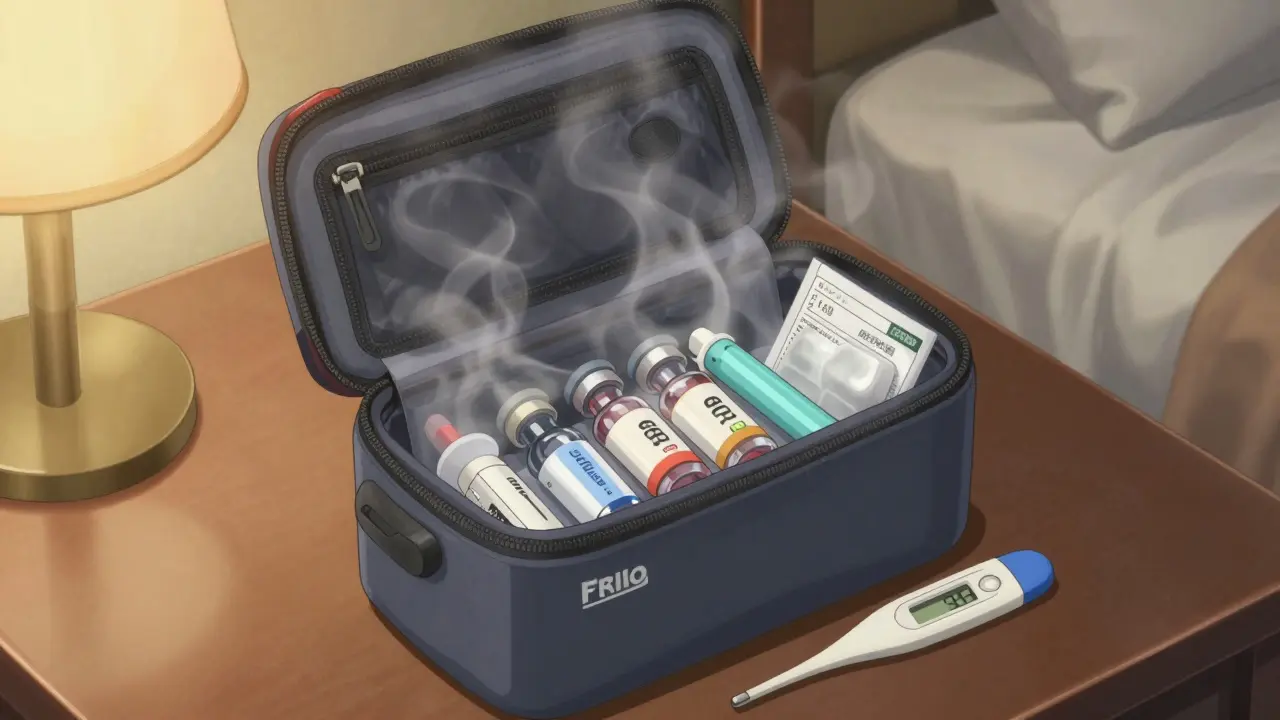
- Use a medical-grade cooler for cold-chain meds. Standard insulated bags? They last 12-24 hours. A Frio cooler wallet or Bocapharmacy’s medical cooler? They last 48-72 hours. These use gel packs that activate with water and maintain 38°F-42°F without freezing. No ice needed. No melting. No mess.
- Never pack meds in checked luggage. Bags get tossed, left in hot cargo holds, or delayed for days. Always carry meds in your carry-on. Bring a printed copy of your prescription too.
- Use light-blocking containers. If your meds are light-sensitive, keep them in their original foil blister packs or opaque pill cases. Don’t transfer them to clear plastic.
- Avoid bathrooms. Store meds in your hotel room, not the bathroom. Humidity ruins pills. A small ziplock with a silica gel pack in your suitcase works better.
- Bring a temperature monitor. Devices like TempTraq or a simple digital thermometer with a probe can log temps. Place it next to your meds. If it spikes above 86°F, you’ve got a problem. These tools detect 98.7% of excursions, according to a 2022 Journal of Travel Medicine study.
What to Do Before You Leave
Don’t wait until the day before your trip. Start planning 14-21 days ahead. Here’s what to do:
- Ask your pharmacist: "How long can this stay out of the fridge?" "Is there a travel-friendly version?" Some insulin pens now come with 28-day room-temperature stability. Ask about it.
- Get a letter from your doctor. Especially if you’re carrying injectables or controlled substances. It helps with customs and TSA screening.
- Check international rules. Some countries ban common U.S. meds. For example, melatonin is illegal in the UK. Codeine is tightly restricted in Japan. Research your destination.
- Bring extra. Pack 10-20% more than you think you’ll need. If your flight is delayed, or your cooler fails, you’ll be glad you did.
What’s New in 2026? Tech That Actually Helps
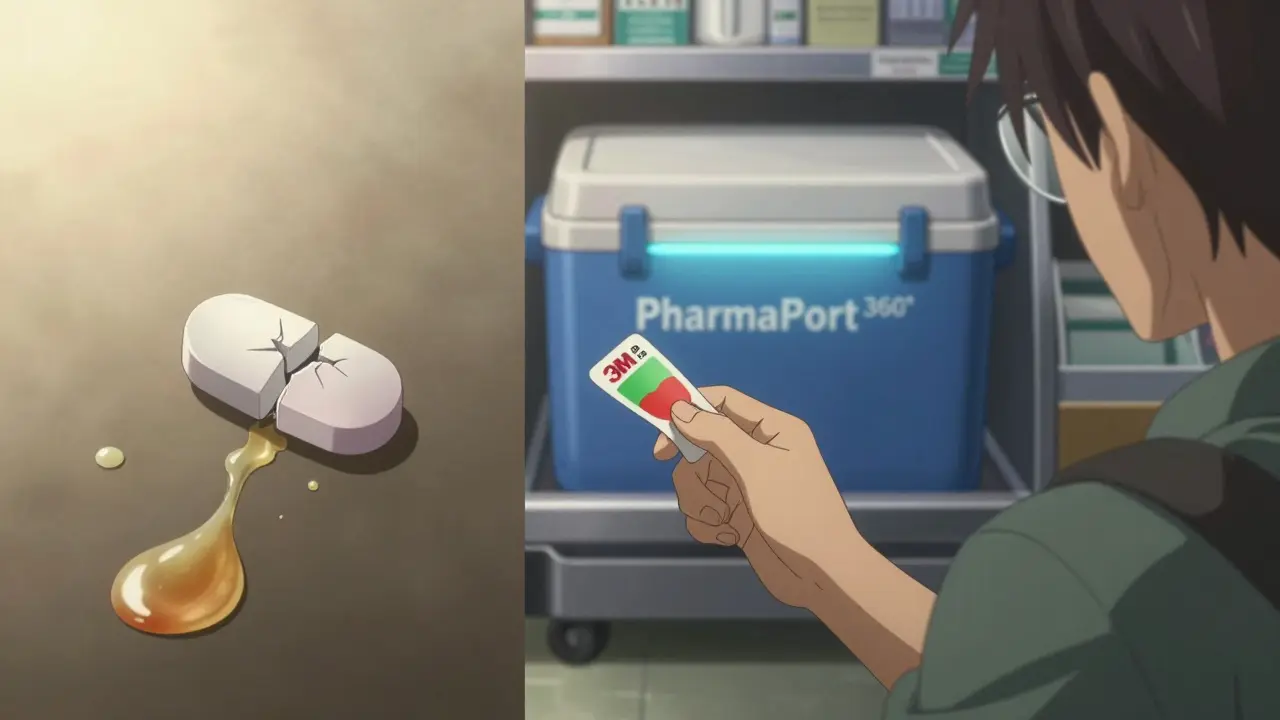
Things have gotten easier. In May 2023, the FDA approved temperature-indicating labels. Now, 3M’s TempTrend labels change color if your meds overheat. No device needed. Just look at the label.
Softbox Systems launched the PharmaPort 360° in September 2023. It keeps meds at the right temperature for 120 hours-five days. That’s enough for a long-haul flight and a few days on the road without recharging.
And by 2026, 85% of temperature-sensitive medications will have travel-stable formulations. That means more insulin, EpiPens, and biologics will work without cooling. But until then? You still need to be careful.
Real Traveler Stories
One Reddit user, "MedTraveler2023," kept insulin stable for 14 days across Southeast Asia using a Frio wallet. "It stayed at 38°F even when the outside hit 95°F," they wrote. "No problems. No panic."
Another person on GoodRx left their EpiPen in a car at 102°F for 90 minutes. They tested it later at CVS. The dose was 40% weaker. They almost didn’t survive a future allergic reaction.
And families traveling with kids? 78% use phone alarms to remind them to take meds. That’s not just smart-it’s lifesaving when routines get thrown off.
What Happens If Your Meds Go Bad?
It’s not always obvious. You might not feel sick right away. A heart med that’s 20% weaker? You might just feel more tired. An asthma inhaler that’s lost potency? You might think your condition got worse.
But here’s the truth: degraded meds don’t just stop working-they can become dangerous. Broken-down chemicals can cause allergic reactions, stomach bleeding, or even organ stress.
If you suspect your meds have been compromised, don’t use them. Contact a local pharmacy or clinic. Ask for a replacement. Many travel insurance plans cover emergency refills.
And if you’re ever unsure? When in doubt, throw it out. Better safe than sorry.
Can I put my insulin in the airplane’s fridge?
No. Airlines don’t offer refrigeration for passenger medications. Even if a flight attendant offers, they’re not trained to handle pharmaceuticals. Always carry your own cooling solution. TSA allows medical coolers through security-just declare them.
Do I need to declare medications at airport security?
Yes. TSA requires you to declare all medications, especially liquids, injectables, or refrigerated items. Bring printed instructions and your prescription. If you don’t, they may confiscate your meds. It’s not optional-it’s policy.
What if I run out of meds while traveling?
Contact your travel insurance provider-they often have networks for emergency refills. You can also visit a local pharmacy with your original prescription and doctor’s letter. Many countries will fill U.S. prescriptions with a note from a local doctor. Never try to buy meds on the street.
Can I use a regular cooler with ice for my meds?
Not recommended. Ice can freeze your meds, which ruins many biologics. Also, melting ice creates water that can damage pills. Use gel packs instead-they stay cold without freezing or leaking. Gel packs are 37% more consistent than ice, according to TSA’s 2022 assessment.
Are there travel-friendly versions of my meds?
Yes, for many. Insulin pens now last 28 days at room temperature. Some EpiPens have extended stability. Ask your pharmacist: "Is there a version of this that doesn’t need refrigeration?" If there is, they’ll likely have it in stock.
Comments
Wow, this is actually one of the most thorough guides I’ve read on travel meds. I’ve been carrying insulin for 8 years across 17 countries and never thought about humidity as the silent killer-bathroom storage was my default. Learned that silica gel packs in a ziplock are way better than I thought. Also, the 2026 stat about travel-stable formulations? Game changer. I’ll be upgrading my Frio wallet soon.
Also, never thought about how Tylenol survives 72 hours at 95°F while Humira tanks. That table alone saved me from a dumb mistake. Thanks for writing this.
You people are still using Frio wallets? Pathetic. I’ve been using a custom-built phase-change material cooler since 2021. It maintains 37.4°F for 96 hours. No water activation. No guesswork. Just science. And yes, I built it myself. The FDA-approved labels? Useless. They only trigger after damage is done. Real professionals use real thermistors and data loggers. If you’re not monitoring temps with a USB-connected probe, you’re not serious about safety.
Also, your ‘10-20% extra’ advice? Inadequate. I always bring 50% more. Because if you’re flying through Dubai and your flight gets delayed 14 hours? You’re not getting a refill. You’re dead. And don’t get me started on ‘travel-friendly’ insulin. Most of it’s just marketing fluff. Check the actual stability curves, not the brochures.
Bro. I just got back from Bali. Had my EpiPen in a pouch strapped to my chest under my shirt. 98°F. Humidity like a sauna. No cooler. No panic.
Just. Kept. It. Close.
❤️🔥
OH MY GOD. OH MY GOD. OH MY GOD.
Did you SEE that part about insulin losing 63% potency??!!??
I had a friend who DID THIS. She was in Thailand. Left her insulin in her daypack. She thought it was fine. She took her dose. Her blood sugar hit 480. She collapsed in a noodle shop. Had to be airlifted. She’s lucky she’s alive.
AND THEN she tried to blame the pharmacy! ‘They didn’t warn me!’
WELL. NOW WE’RE WARNED.
EVERYONE. LISTEN. THIS ISN’T A ‘NICE TO KNOW.’ THIS IS A ‘LIFE OR DEATH’ THING.
STOP BEING LAZY.
STOP PUTTING MEDS IN THE BATHROOM.
STOP TRUSTING ‘TRAVEL-FRIENDLY’ LABELS WITHOUT CHECKING THE FINE PRINT.
IF YOU DON’T DO THIS RIGHT, YOU’RE NOT JUST RISKY-YOU’RE A LIABILITY TO OTHERS.
PLEASE. FOR THE LOVE OF ALL THAT IS MEDICAL. READ THIS AGAIN. AND AGAIN. AND AGAIN.
Thank you for this meticulously researched and clearly structured guide. The inclusion of data from the European Medicines Agency, the 2023 Medication Travel Report, and the 2022 Journal of Travel Medicine study elevates this from anecdotal advice to evidence-based practice. The temperature tolerance table is particularly valuable for clinical decision-making during travel.
I would only add, for international travelers, that the World Health Organization’s 2024 Guidelines on Temperature-Sensitive Medication Transport further reinforce the recommendation against ice-based cooling due to freezing risks and microbial contamination potential. The use of phase-change gel packs remains the gold standard, as referenced in your source material.
Additionally, I would encourage all travelers to carry a digital copy of their medication list on a secure, encrypted device-not just a printed prescription. Many countries now accept digital documentation via QR codes linked to verified pharmacy databases.
Well done. This is precisely the kind of resource that saves lives.
okay so i just got back from 3 weeks in peru and i did ALL of this and it WORKED. i had my insulin in a frio wallet, kept it in my carry-on, used silica packs, and even put a tiny thermometer next to it (bought it on amazon for $8 lol).
the best part? i forgot i was even worried about it. i just went and enjoyed my trip. no panic. no drama.
ps: i did NOT put my meds in the bathroom. i know better now. 🙃
thank you for writing this. i’m sharing it with my whole family.
Actually, I think you’re all missing the real issue here. You’re obsessing over coolers and temperature labels like it’s a puzzle to solve. But what about the people who can’t afford a Frio wallet? Or who don’t have insurance to cover emergency refills? Or who live in countries where pharmacies don’t even carry insulin?
You’re all so busy lecturing people about ‘proper storage’ that you ignore the fact that for millions, the real problem is access. Not temperature. Not humidity. Not labels.
One woman I met in Laos was using expired insulin because it was all she could find. She didn’t care about ‘potency loss.’ She cared about breathing. And you? You’re talking about 37.4°F precision like it’s a luxury.
This isn’t about being smart. It’s about being privileged.
Okay but like… this whole thing feels like overkill. I’ve been traveling for 15 years. I’ve had insulin, epipens, asthma inhalers, you name it. I throw them in my purse. I’ve never had a problem. Not once.
Maybe you’re just scared of your own shadow.
Also, TSA doesn’t care. I’ve never declared anything. They just look at the bottle and shrug.
Stop scaring people with 2026 stats and ‘lifesaving’ drama. It’s just pills. Chill.