
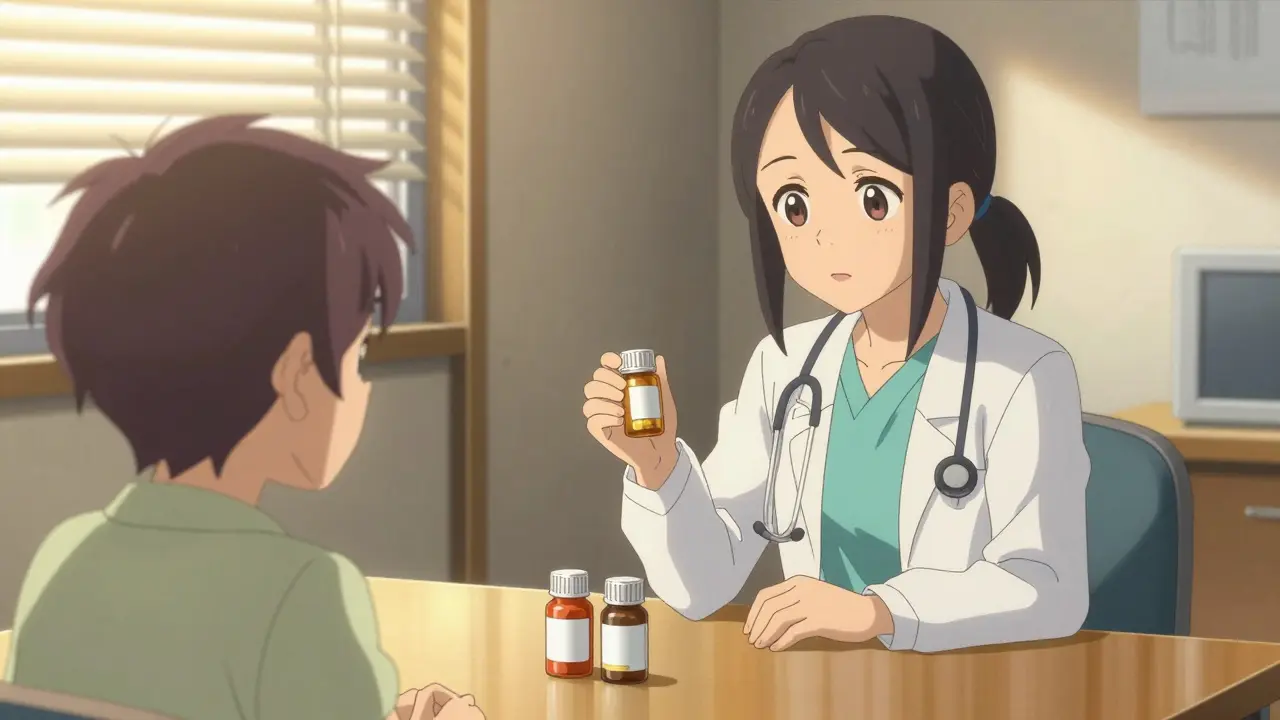
When a patient walks out of the clinic with a new prescription, they’re not just getting a pill-they’re getting a promise. A promise that the medicine will work. That it won’t break their budget. That they can stick with it. But too often, that promise falls apart before they even get to the pharmacy. Why? Because the provider didn’t explain why they’re prescribing a generic.
Generic drugs aren’t second-rate. They’re not cheaper because they’re weaker. They’re cheaper because they don’t need to pay for ads, fancy packaging, or years of marketing. The FDA requires them to have the same active ingredient, strength, and route of delivery as the brand-name version. And they must prove they work the same way in the body-within a tight range of bioequivalence. That’s not luck. That’s science.
Yet, patients still hesitate. They’ve heard rumors. They’ve seen a different color pill. They remember the last time their medication looked different and they felt off. And honestly? Who can blame them? If you’ve been on the same brand for years, switching to something that looks unfamiliar feels risky-even when it’s not.
This is where providers step in-not as salespeople, but as advocates. The American College of Physicians made it clear in 2022: doctors should prescribe generic medications whenever possible. Not because it’s cheaper for the system, but because it’s better for the patient. Studies show patients are 266% more likely to abandon a brand-name drug than a generic one, mostly because of cost. Nine out of ten generic copays are under $20. Nearly four in ten brand-name copays are over $20. That’s not a small difference. That’s a barrier to taking your medicine every day.
It’s not just about price, though. It’s about trust. Patients trust their doctors more than they trust any ad, any website, or any pharmacist’s flyer. When a provider says, “This generic is just as safe and effective,” it carries weight. A 2015 review found that patient mistrust of generics drops sharply when their doctor endorses them. That’s the multiplier effect. One conversation can undo years of misinformation.
But here’s the catch: most providers don’t have time. A typical primary care visit lasts 13 to 16 minutes. You’ve got to check blood pressure, review lab results, answer questions about sleep, and now you’re supposed to explain bioequivalence? It feels impossible. But the truth is, you don’t need a 10-minute lecture. You need one clear, confident sentence: “This is the same medicine as the brand, but it costs less. The FDA makes sure of it.”
And if they look confused? Add this: “It might look different-different shape, color, or even the name on the pill-but the active part is exactly the same. That’s why it works the same.”
Pharmacists do this every day. They’re trained to explain why the pill changed. But patients don’t always talk to their pharmacist. Or they forget what was said. Or they’re too overwhelmed to ask follow-up questions. That’s why the provider’s word matters most. It’s the first and most trusted voice.
Some patients worry about switching back and forth between different generics. That’s real. The FDA allows multiple manufacturers to make the same generic, so over time, a patient might get a different version each refill. The pill might change color again. They might think, “This isn’t the same.” And if no one explains that’s normal, they might stop taking it altogether. A good provider anticipates this. They say upfront: “You might get a different-looking pill from time to time. That’s okay. It’s still the same medicine.”
There are exceptions, of course. For drugs with a narrow therapeutic index-like warfarin, lithium, or some seizure meds-small changes in blood levels can matter. That’s why the American Academy of Family Physicians opposes mandatory generic substitution in those cases. But even here, the goal isn’t to avoid generics. It’s to choose wisely. If a patient is stable on a brand, keep them there. If they’re stable on a generic, don’t switch them. But if they’re struggling with cost or adherence, switching to a generic version of an NTI drug can still be safe-with close monitoring.
And then there’s the administrative mess. Prior authorizations for brand-name drugs when a generic exists? They delay care by more than two days on average. The AAFP wants those removed for generics. Why? Because every day a patient doesn’t start their medicine is a day their condition worsens. A simple check in the EHR that flags “generic available” and “no prior auth needed” can cut that delay to zero.
Even the price of generics isn’t always predictable. In 2023, the American Society of Health-System Pharmacists warned that some essential generic drugs-like certain antibiotics or heart medications-have seen sudden price spikes. That’s not the norm. But it’s real. So advocacy isn’t just about pushing generics blindly. It’s about knowing when they’re the right choice-and when they’re not. A good provider checks for price trends. They know which generics are stable and which are risky. They don’t assume all generics are cheap. They check.
What about biosimilars? Those are the next frontier. They’re not exact copies like traditional generics-they’re complex biologic drugs, like insulin or rheumatoid arthritis treatments. But the same principle applies: they’re significantly cheaper and just as effective. Yet patients are even more skeptical. “It’s not the same drug,” they say. Again, the provider’s explanation is key. “This is a highly tested version of the same medicine. It works the same way. It’s been used safely by thousands.”
The bottom line? Generic medications are used in 90% of all prescriptions in the U.S. But they make up only 23% of total drug spending. That’s the power of generics. They’re not just a cost-saving tool. They’re a lifeline. For a diabetic who can’t afford insulin. For a parent choosing between meds and groceries. For an elderly patient on five prescriptions who can’t pay for all of them.
Advocating for generics isn’t about cutting corners. It’s about cutting waste. It’s about aligning science with compassion. It’s about saying, “I care enough about your health to make sure you can actually take this medicine every day.”
You don’t need to be a pharmacist. You don’t need to memorize bioequivalence ranges. You just need to say it clearly, calmly, and confidently. And if you’re unsure? Ask your pharmacist. They’ve seen the data. They’ve answered the questions. They can help you explain it better.
Because in the end, adherence isn’t about the pill. It’s about the person holding it. And if you don’t help them understand why it’s safe, they won’t take it. And if they don’t take it, the medicine doesn’t work. No matter how good it is.
Comments
I’ve seen patients stop meds because the pill changed color. Not because they’re dumb-because no one told them it’s the same. I used to skip the talk too, until my grandma asked why her blood pressure pill went from blue to white. Turns out, she thought the new one was fake. One sentence changed everything.
Bro, generics are the unsung heroes of global health. FDA bioequivalence standards? 90%+ therapeutic equivalence. The real issue? Pharma’s FUD campaign-fear, uncertainty, doubt. Patients don’t need a lecture, they need a relatable analogy: ‘It’s like buying store-brand aspirin instead of Bayer. Same acetylsalicylic acid, 1/10th the price.’
And yeah, NTI drugs? Yeah, tread carefully. But even here, with TDM (therapeutic drug monitoring), switching is safe. We’re overcomplicating it. The data’s clear: adherence spikes when cost drops. Period.
Generics? Brilliant. UK’s NHS has been doing this for decades. Cheaper, same results. Why are Americans still scared of a different-shaped pill? It’s madness.
Who really controls the FDA? Big pharma owns them. The generics are just placebo pills with the same color. You think they’d let real medicine be cheap? Think again. My cousin took a generic for depression and went nuts. They don’t want you healed. They want you dependent.
It’s fascinating how the cultural stigma around generics persists despite overwhelming empirical evidence. The cognitive dissonance exhibited by patients who trust pharmaceutical advertising more than their own physicians is, frankly, a symptom of late-stage capitalist medical alienation.
One might argue that the provider’s role transcends mere prescription-it becomes a hermeneutic act of epistemic reclamation.
In my work across rural clinics in Latin America, I’ve seen how a single phrase-‘This is the same medicine, just without the marketing’-can turn despair into hope. One woman in Guatemala cried when she realized she could afford her insulin again. No fancy jargon. No charts. Just truth, spoken gently.
Providers aren’t salespeople. We’re translators. Between science and fear. Between cost and survival. And sometimes, that’s all it takes: a quiet voice saying, ‘You’re not alone in this.’
Wait-so you’re telling me the FDA actually ENFORCES bioequivalence? That’s a myth. I’ve seen generics that look nothing like the brand. And don’t even get me started on the ‘active ingredient’ loophole-some generics use different salts or fillers that change absorption rates. You think that’s science? It’s corporate greed with a lab coat.
And why are we even talking about this? The real problem is that insurance companies force generics on patients. They don’t care about adherence-they care about profit margins. Doctors are just pawns in a rigged game.
Also, biosimilars? Please. They’re not even close. Biologics are like a symphony. You can’t copy a symphony with a kazoo and call it the same thing.
Y’all are overthinking this. Just say: ‘This pill works the same, costs less, and your insurance won’t hate you.’ Boom. Done. My cousin took a generic for high blood pressure, saved $150/month, and didn’t even notice a difference. Stop making it complicated. People just need to hear it straight.