
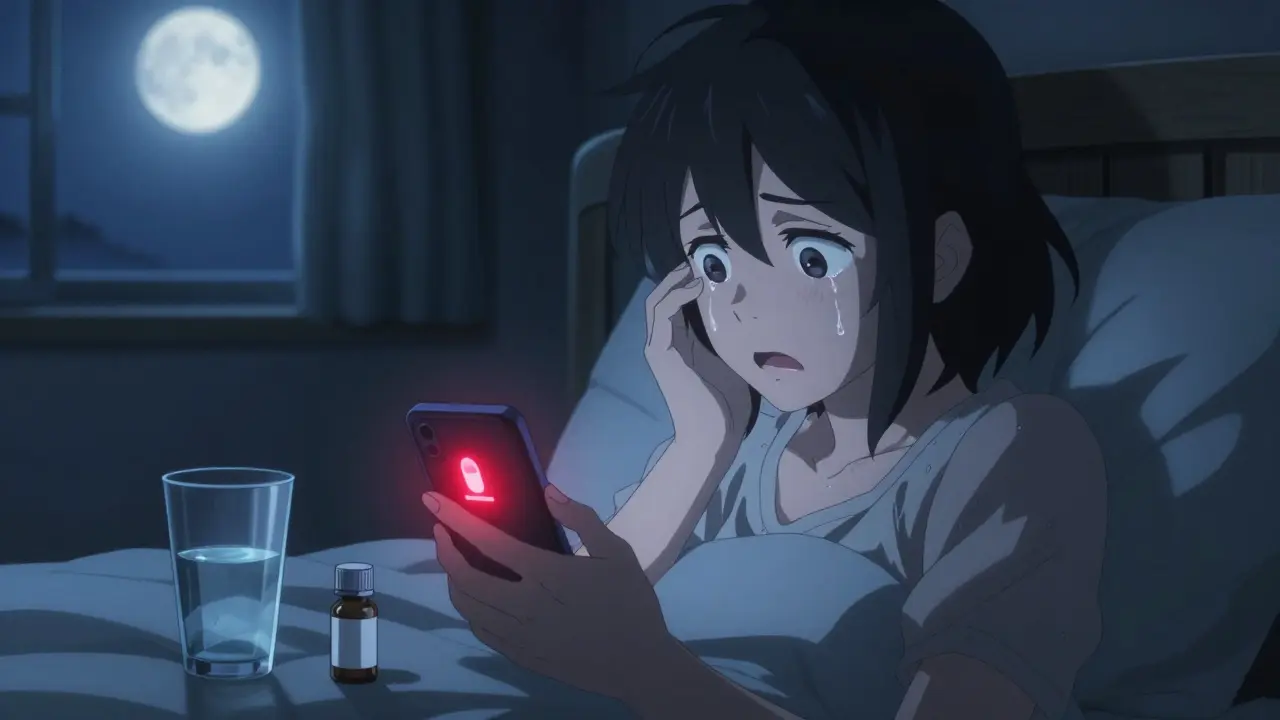
When a drug safety alert hits, your body reacts before your mind catches up
You get the notification. A red banner. A text message. An email from your pharmacy. Drug safety alert. Your heart jumps. Your hands get cold. Your thoughts spiral: Did I take the wrong dose? Is this going to kill me? Should I stop now? You’re not alone. Nearly 7 in 10 people who receive a drug safety alert experience an immediate panic response - not because they understand the risk, but because their nervous system is hijacked by fear.
Here’s the truth: most drug safety alerts don’t mean you need to stop your medication immediately. Many are precautionary. Some are based on rare side effects seen in only 1 in 10,000 patients. But panic doesn’t care about statistics. It screams louder than data. And if you react without thinking, you could make a decision that harms you more than the alert ever could.
Why panic makes bad decisions worse
When your brain gets startled by an alert, it doesn’t think. It survives. The amygdala - your brain’s alarm system - takes over. It shuts down the prefrontal cortex, the part that weighs pros and cons, reads fine print, and remembers your doctor’s advice. Your heart races to 110-130 beats per minute. Your breathing gets shallow and fast. Your vision narrows. You see only one path: act now, any way you can.
Studies show that under this kind of stress, people lose up to 67% of their ability to evaluate options. That’s not just being nervous - it’s a biological reset. Your brain isn’t broken. It’s doing exactly what evolution designed it to do: prioritize survival over logic. But in today’s world, where alerts are frequent and complex, that survival mode is dangerous.
Take the case of a 58-year-old man in Birmingham who got an alert about a potential liver risk with his blood pressure med. He panicked, stopped taking it cold turkey, and ended up in the ER with a spike in blood pressure. The alert? A single case report from Japan. His risk was less than 0.02%. But his panic cost him three days in hospital.
First step: Stop. Breathe. Ground yourself
The fastest way to bring your thinking brain back online is to interrupt the panic cycle. You don’t need to wait for a crisis to learn how. Practice these techniques daily - not just when the alert comes.
- 5-4-3-2-1 Grounding: Name 5 things you can see, 4 you can touch, 3 you can hear, 2 you can smell, 1 you can taste. Do this slowly. It takes 60 seconds. It rewires your brain from panic to presence.
- Paced Breathing (4-7-8): Inhale for 4 seconds. Hold for 7. Exhale for 8. Repeat 3 times. This lowers your heart rate from 120 to 75 bpm in under 90 seconds, according to Pacific Coast Mental Health. Your body can’t stay in fight-or-flight mode if you’re breathing like this.
- Temperature Shift: Splash cold water on your face. Or hold an ice cube in your hand for 20 seconds. The shock resets your vagus nerve - the main control line for your calm response.
These aren’t fluff. They’re neuroscience-backed tools used in trauma units and ERs. Use them the moment you see the alert. Don’t wait. Don’t read the full message yet. Just stop. Breathe. Ground.
Then, get the facts - not the fear
Once your breathing slows and your vision clears, it’s time to act - but not react. Ask yourself: What exactly is the alert saying? And where did it come from?
Drug safety alerts usually come from one of three places:
- Regulatory agencies: Like the UK’s MHRA or the FDA. These are the most reliable. They investigate real data - not rumors.
- Pharmacies or insurers: Often automated. They may flag alerts based on broad criteria. Check if it’s a general warning or targeted to your specific case.
- News or social media: Avoid these. They amplify risk without context.
Look for these details in the alert:
- What’s the actual risk? (e.g., “Possible link to rare liver injury in patients over 70”)
- How common is it? (e.g., “Occurs in 1 in 50,000 users”)
- Is this based on new data or old studies?
- Does it apply to you? (Age, dosage, other meds, health conditions)
Don’t guess. Don’t assume. Go to the MHRA website or your doctor’s portal. Copy-paste the alert text into a search engine with “MHRA” or “FDA” in front of it. You’ll find the original report. Most are written in plain language.

Use a decision filter: Does this align with my values?
After you’ve calmed down and gathered facts, ask yourself: What matters most here?
Is your priority avoiding a rare side effect? Or keeping your condition stable? Is your goal to be extra cautious - or to avoid unnecessary disruption to your life?
Research from the Abundance Therapy Center found that people who used a simple value-based filter - “Does this decision match my core health goals?” - made 52% fewer regrettable choices after alerts.
For example:
- If your value is stability, you might choose to keep taking your medication while monitoring for symptoms.
- If your value is avoiding risk at all costs, you might choose to pause and consult your doctor immediately.
There’s no right answer - only the right answer for you. But without this filter, you’ll either overreact or ignore the alert entirely. Both are dangerous.
Build your alert response kit - before you need it
Waiting until the alert hits to figure out what to do is like waiting for a fire to start before buying a fire extinguisher.
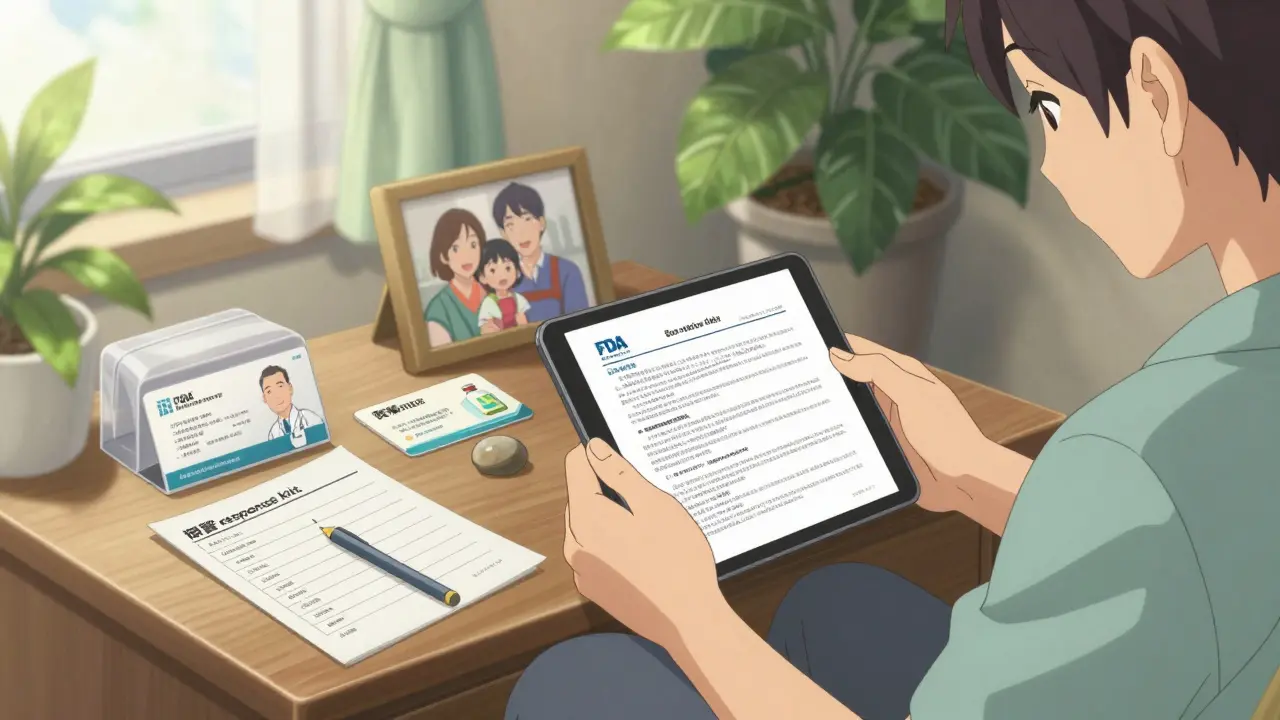
Create a simple “alert response kit” - physical or digital - and keep it handy.
- A printed copy of the 5-4-3-2-1 technique and 4-7-8 breathing steps
- A list of your current medications, dosages, and your doctor’s contact info
- A link to the MHRA alerts page (mhra.gov.uk/alerts)
- A small object you can hold - a smooth stone, a mint, a stress ball - to use during grounding
Keep it on your nightstand, in your wallet, or saved as a note on your phone. When the alert comes, you won’t be scrambling. You’ll have a plan.
Practice makes automatic
People who handle alerts well aren’t calm because they’re naturally zen. They’re calm because they practiced.
Clearview Mental Health found that after 30 days of just 15 minutes a day of practicing grounding and breathing, people applied these techniques 83% faster during real alerts. Their brains rewired. Panic didn’t disappear - but it lost its grip.
Try this: Once a week, simulate an alert. Close your eyes. Imagine you just got a drug safety notice. Now, go through your grounding steps. Breathe. Use your kit. Talk out loud: “Okay, what’s the real risk?”
Do this for a month. You’ll be amazed at how differently you respond when the real alert comes.
When to call your doctor - and when to wait
Not every alert needs a doctor’s visit. But some do.
Call your doctor immediately if:
- You’re experiencing symptoms mentioned in the alert (e.g., yellow skin, dark urine, unexplained fatigue)
- The alert says “stop immediately” and it’s from the MHRA or FDA
- You’re pregnant, elderly, or on multiple medications
Wait and monitor if:
- The alert is vague or generic
- The risk is extremely rare
- You feel fine and have no new symptoms
Always document what you did. Write down: the alert date, what you read, what you decided, and why. This helps your doctor understand your thought process - and it protects you if something comes up later.
What’s changing - and why it matters
Drug safety systems are getting smarter. Starting in 2025, the EU’s DORA law requires companies to design alert systems that account for human panic. Some apps now use biofeedback - if your heart rate spikes after an alert, they automatically send you a calming breathing exercise.
By 2026, over 65% of enterprise alert systems will include built-in psychological support. That’s not sci-fi - it’s happening now. But until then, you’re still the most important part of the system.
You are not a machine. You’re a human with a nervous system that reacts to fear. The goal isn’t to eliminate panic. It’s to build a bridge between your fear and your wisdom.
Final thought: You’ve got this
Drug safety alerts are meant to protect you. But panic can turn protection into harm. You don’t need to be perfect. You just need to be prepared.
Take one breath. Check the facts. Ask what matters. Then act - calmly, clearly, and confidently.
You’re not just managing a drug alert. You’re managing your own well-being. And that’s the most important prescription of all.
Should I stop my medication right away when I get a safety alert?
No, not automatically. Most drug safety alerts are precautionary and based on rare or theoretical risks. Stopping medication suddenly can be more dangerous than the alert itself - especially for conditions like high blood pressure, epilepsy, or depression. Always check the source, assess your personal risk, and consult your doctor before making changes.
How do I know if an alert is trustworthy?
Look for alerts from official sources: the UK’s Medicines and Healthcare products Regulatory Agency (MHRA), the U.S. FDA, or your pharmacy’s official portal. Avoid alerts from news sites, social media, or unsolicited emails. If you’re unsure, search the alert text with “MHRA” or “FDA” to find the original report.
Can breathing really help me think better during an alert?
Yes. Controlled breathing - like the 4-7-8 technique - lowers your heart rate, reduces stress hormones, and reactivates your prefrontal cortex, the part of your brain responsible for clear thinking. Studies show it can restore rational decision-making within 90 seconds, even during intense panic.
What if I forget what to do when the alert happens?
That’s why preparation matters. Create a simple “alert response kit” - a printed card with your grounding steps, your doctor’s number, and your meds list. Keep it where you’ll see it. Practice the techniques once a week. After 30 days, your body will remember even when your mind panics.
Are these techniques only for people with anxiety disorders?
No. These techniques work for anyone. You don’t need a diagnosis to benefit from grounding, breathing, or decision filters. Everyone’s brain reacts to fear the same way - these tools just help you take back control. In fact, most people who use them successfully have never had anxiety before - they just learned how to respond.
How often do drug safety alerts happen?
On average, people receive 67 alerts per week across their devices - from pharmacy notifications to health app warnings. Most are low-risk or false alarms. The key isn’t to eliminate alerts - it’s to respond to them with clarity, not fear.
Comments
So let me get this straight... I'm supposed to breathe like a yoga instructor just because my phone beeped? I'll stick to calling my doctor. But hey at least the article didn't tell me to hug a tree.
lol
I love how this is basically a self-help book disguised as a medical guide. Like yeah sure I'll do 5-4-3-2-1 while my heart is trying to escape my chest. Meanwhile my blood pressure med is still sitting there judging me.
Also why is everyone suddenly an expert on the vagus nerve? I didn't even know I had one until this article.
Bro this is so true i was just like oh no my meds got flagged and i almost stopped takin it then i remembered my uncle in delhi took the same thing for 12 years and he is still alive and kicking so i just laughed and kept going
also the 4-7-8 thing works like magic i tried it during a traffic jam yesterday and my anger went from 10 to 2 in 90 sec
ps i dont even have anxiety but i still do this like its my daily ritual now
Wow. Just wow. 🤦♀️ So you're telling me that people who panic when they get a drug alert are just... not meditating enough? 🙄 You're telling me to breathe like I'm on a spa retreat while my body is screaming that I might be poisoned? 🤮
Also I'm pretty sure the FDA doesn't care if I 'ground myself' with a stress ball. They care if I'm dead. 😘
This is actually one of the most practical pieces of health advice I've read in years. The grounding techniques are backed by neuroscience, not just wellness influencers. The key is consistency - practicing these when you're calm so they work when you're not. I've been using the 4-7-8 method for six months now, and even my wife noticed I don't yell at the TV during commercials anymore. Small changes, big impact. Also, keep your alert kit updated. Mine’s on my phone lock screen. Simple. Effective.
I mean come on. This is just a bunch of woke fluff wrapped in a lab coat. In America we don't breathe our way out of medical emergencies - we call 911. And if you're too scared to stop a pill because some guy in London wrote a report? You're not 'grounded', you're just lazy.
Also why is every other comment talking about the vagus nerve like it's the new iPhone? We got real problems here - like drug prices, not panic breathing.
🇺🇸 #MakeMedicineGreatAgain
Man I lived in India for a year and I saw people take meds like candy and still live to 90. I mean they don't even read the leaflets. But here? We're doing yoga poses because our phone says 'possible liver risk' 🤷♂️
Still... the breathing thing? Kinda works. I tried it after my coffee spilled on my laptop. Didn't fix the laptop. But I didn't scream either. Small win.
The real question isn't how to stop panic - it's why we've outsourced our health decisions to algorithms and pharmacy bots. We've turned medicine into a notification. We've forgotten that healing is a relationship, not a push alert. The body doesn't need more breathing exercises. It needs to be trusted. Not managed.
This is why western medicine is broken. You spend 10 minutes telling people to breathe instead of telling them to stop taking the damn pill if the alert says so. In India we don't need 5-4-3-2-1. We just ask our aunty. She knows everything.
Also why is everyone talking about MHRA like it's the Pope? We have AYUSH. It's better.
I don't care how many studies say breathing helps. If my doctor told me to stop, I'd stop. Period. This article is just making people feel better about ignoring real warnings. That's dangerous.
I'm a nurse. I've seen people die because they panicked and stopped their meds. I've also seen people die because they ignored alerts. This article? It's not perfect but it's the most balanced thing I've read all year. The 'alert response kit' idea? Genius. I'm printing it for my patients tomorrow.
I'm not a doctor, but I've been on 6 different meds in the last 5 years. I used to panic every time I got an alert. Now I keep a sticky note on my fridge with the 5-4-3-2-1 steps and my doctor's number. I don't even think about it anymore. It's just... automatic. I'm not zen. I'm just prepared. And honestly? That's enough.