

CCB Safety Calculator
This tool helps you determine which calcium channel blocker is safest based on your specific health conditions and medications.
Calcium channel blockers (CCBs) are one of the most commonly prescribed classes of heart and blood pressure medications. But for many people, especially those taking multiple drugs, these medications can become dangerous not because of the drug itself, but because of what else they’re taking. The real risk isn’t always in the pill you know about-it’s in the pill you forgot, the grapefruit juice you drink every morning, or the antibiotic your doctor just prescribed. Understanding how CCBs are processed in your body is the key to avoiding serious, even life-threatening, side effects.
How Calcium Channel Blockers Work
CCBs stop calcium from entering heart and blood vessel cells. This relaxation of blood vessels lowers blood pressure and reduces the heart’s workload. There are two main types: dihydropyridines (DHPs) like amlodipine, nifedipine, and felodipine, and non-dihydropyridines (non-DHPs) like verapamil and diltiazem. DHPs mostly affect blood vessels, making them ideal for high blood pressure. Non-DHPs also slow the heart’s electrical activity, so they’re used for arrhythmias and angina too.
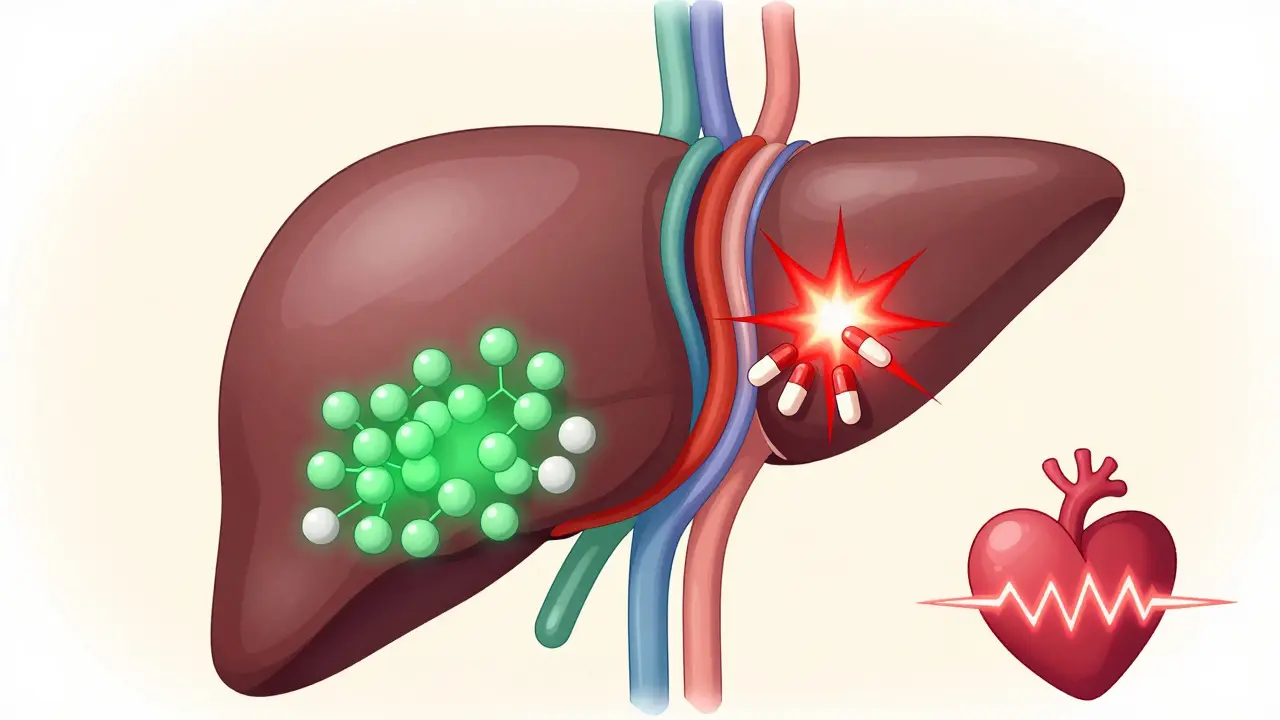
But here’s the catch: these drugs don’t just sit in your bloodstream. They’re heavily processed by your liver, and that’s where things get risky. About 90% of DHPs and 70% of verapamil are broken down by a single liver enzyme: CYP3A4. This enzyme handles a huge number of medications. When something interferes with it, CCB levels can spike dangerously.
Why Drug Interactions Happen
Your body doesn’t treat every CCB the same. Amlodipine, for example, has a long half-life-30 to 50 hours-so it builds up slowly. That means even if CYP3A4 slows down a bit, the effect is gradual. Verapamil, on the other hand, has a half-life of just 4 to 12 hours. It gets cleared quickly, so if CYP3A4 gets blocked, levels can double or triple within hours.
Worse, some non-DHPs don’t just get broken down by CYP3A4-they also block it. Diltiazem and verapamil are both substrates and inhibitors. That means they compete with other drugs for the same enzyme. If you take diltiazem with simvastatin, the statin’s levels can jump 400%. That’s not a small bump-it’s a direct path to muscle damage, kidney failure, or rhabdomyolysis.
Even worse, verapamil blocks another system called P-glycoprotein. This transporter pushes drugs like digoxin out of your cells. When verapamil shuts it down, digoxin builds up in your heart. A 50-75% increase in digoxin levels can trigger dangerous heart rhythms. This isn’t theoretical. The European Heart Journal documented 17 cases of complete heart block from this exact interaction.
Who’s at Highest Risk?
Age matters. People over 65 have 3.2 times more severe interactions than younger adults. Why? Their livers and kidneys don’t work as well. The liver’s ability to break down drugs drops by 30-40% after age 65. Kidneys clear less than half the amount they did at 30. So even if a drug is mostly metabolized by the liver, the kidneys still need to clear the leftover pieces-and if they’re weak, those pieces pile up.
Renal impairment is a silent danger. If your eGFR (a kidney function test) is below 60 mL/min, you’re already at higher risk. For verapamil, this means a 50% dose reduction. But amlodipine? No adjustment needed. That’s why doctors now recommend amlodipine as the first choice for older patients on multiple medications.
And then there’s grapefruit juice. One glass can block CYP3A4 for 24 hours. A 2023 Mayo Clinic patient forum showed 68% of CCB-related emergency visits were tied to grapefruit. Most patients didn’t even realize it was a problem. If you’re on a CCB, skip the juice. Period.
Which CCB Is Safest?
Not all CCBs are created equal when it comes to interactions. Here’s the breakdown:
| CCB | Half-Life | CYP3A4 Dependency | Enzyme Inhibition | Renal Adjustment Needed? | Interaction Risk Level |
|---|---|---|---|---|---|
| Amlodipine | 30-50 hours | High (90%) | Minimal | No | Low |
| Nifedipine | 2-5 hours (IR) | High (90%) | Minimal | No | Medium |
| Diltiazem | 4-8 hours | High (85%) | Moderate | Yes (if eGFR < 30) | High |
| Verapamil | 4-12 hours | High (70%) | Strong | Yes (50% reduction if eGFR < 60) | Very High |
When you’re on multiple medications, amlodipine is the safest bet. It has the lowest interaction potential. Only 12% of patients on moderate CYP3A4 inhibitors need a dose change with amlodipine. With diltiazem? That number jumps to 45%. Verapamil? Nearly half of patients on common antibiotics or antifungals will need a dose adjustment-or a switch.
Real-World Consequences
People don’t always know they’re at risk. On Drugs.com, 73% of negative reviews about CCBs mention interaction-related side effects. The most common complaint? Sudden dizziness, fainting, or low blood pressure. Many of these cases involve combinations that seem harmless: a CCB + an antibiotic, a CCB + a sleep aid, or a CCB + an over-the-counter supplement like St. John’s Wort.
One Reddit user from Birmingham shared how her 72-year-old father ended up in the ER after starting clarithromycin for a chest infection. He was on verapamil for atrial fibrillation. Within three days, his blood pressure dropped to 82/50. He needed IV fluids and a pacemaker. His doctor hadn’t flagged the interaction. Neither had the pharmacist.
That’s why new protocols are in place. The Cleveland Clinic now screens every new CCB prescription for interactions. In 2023, they found 23% of patients were at high risk. For those patients, they start with amlodipine at 2.5 mg-not 5 mg. And they check blood pressure within 2 hours of starting any new interacting drug.

What You Should Do
If you’re on a CCB, here’s what to do right now:
- Make a full list of every medication, supplement, and OTC product you take-including herbal teas and vitamins.
- Check if you drink grapefruit juice or eat grapefruit. If yes, stop. No exceptions.
- Ask your doctor or pharmacist: “Is this drug processed by CYP3A4?” If the answer is yes, ask if your CCB is too.
- If you’re over 65 or have kidney issues, ask if amlodipine is a better option.
- Monitor for dizziness, fainting, swelling in ankles, or unusually slow heartbeat. Report these immediately.
Pharmacists now spend an average of 12.7 minutes per CCB prescription reviewing interactions. That’s more time than most doctors spend. Don’t assume someone else is checking. Be your own advocate.
The Future of CCB Use
By 2027, personalized dosing based on genetics and liver function will be standard. A $15 million study is already showing that 27% of people have genetic variants that make them slow metabolizers of CYP3A4. These patients need half the dose-or a different drug entirely.
Tools like CCB-Check, now integrated into electronic health records, are cutting hospitalizations by 31%. But they’re only as good as the data entered. If your doctor doesn’t know you take turmeric supplements or drink a daily glass of grapefruit juice, the system won’t catch it.
The bottom line? Calcium channel blockers are effective. But their safety depends entirely on what else is in your system. The right choice isn’t always the most prescribed-it’s the one with the fewest conflicts.
Can I still drink grapefruit juice if I’m on a calcium channel blocker?
No. Grapefruit juice blocks the CYP3A4 enzyme in your gut and liver, which can cause calcium channel blockers like amlodipine, verapamil, and diltiazem to build up to toxic levels. Even a single glass can increase drug levels by 200-300%, leading to dangerously low blood pressure, fainting, or heart rhythm problems. This risk applies to all CCBs, not just some. Switch to orange juice or water instead.
Is amlodipine safer than verapamil for older adults?
Yes, especially if you take other medications. Amlodipine has a long half-life, doesn’t inhibit liver enzymes, and doesn’t affect kidney clearance. Verapamil, on the other hand, slows down the metabolism of many drugs and increases levels of digoxin and statins. For people over 65 on 3+ medications, amlodipine is the preferred choice because it has fewer interactions and doesn’t require dose changes for mild kidney issues.
Why do some calcium channel blockers need dose adjustments with kidney problems?
Although most CCBs are broken down by the liver, their metabolites are cleared by the kidneys. If your kidneys aren’t working well (eGFR below 60), these metabolites build up. Verapamil’s metabolites can cause excessive slowing of the heart, so a 50% dose reduction is needed. Amlodipine’s metabolites are inactive and easily cleared, so no adjustment is needed-even with moderate kidney disease.
Can I take a calcium channel blocker with a statin like simvastatin?
It depends on which CCB you’re on. Diltiazem and verapamil can increase simvastatin levels by up to 400%, raising your risk of muscle damage. Amlodipine is safe with simvastatin. If you’re on a non-DHP CCB and need a statin, switch to pravastatin or rosuvastatin-these don’t rely on CYP3A4. Never combine simvastatin with diltiazem or verapamil without close monitoring.
What should I do if I start a new medication while on a calcium channel blocker?
Always check with your pharmacist before starting any new drug, supplement, or OTC product. Even antibiotics, antifungals, or cold medicines can interfere. If you’re on verapamil or diltiazem, ask specifically if the new drug is a CYP3A4 inhibitor. If yes, your CCB may need to be changed or your dose lowered. Monitor for dizziness, swelling, or slow heartbeat for the first 3 days after starting the new drug.
Comments
Just wanted to say this post saved my dad’s life. He was on verapamil and started taking clarithromycin for a sinus infection. No one warned him about the grapefruit juice he drank every morning. He ended up in the ER with a heart rate of 38. Turned out his pharmacist had flagged it, but the doctor overruled it. We switched to amlodipine and now he’s fine. Always double-check. Always.
Also-grapefruit juice isn’t just a ‘maybe.’ It’s a hard no. Period.
Interesting how we treat pharmacokinetics like it’s some arcane ritual. The liver isn’t a magic box-it’s a factory with one overworked line. CYP3A4 is the bottleneck, and we’re throwing every damn thing at it. Verapamil doesn’t just block the enzyme, it sits in the chair, kicks its feet up, and says ‘I’m staying.’
It’s not about avoiding drugs. It’s about understanding systems. We treat meds like pills, not processes. And that’s why people die.
So… let me get this straight. The same enzyme that breaks down my blood pressure med also breaks down my coffee, my allergy pills, my ‘natural’ turmeric capsules, and my 2-year-old’s gummy vitamins?
And the solution is… don’t drink grapefruit juice? Bro. I’m not surprised we’re all dying in our 60s. This is a system designed by people who think ‘read the label’ is a sufficient safety protocol.
While I appreciate the clinical rigor of this piece, I must point out that the assertion that ‘amlodipine is safest’ is statistically misleading. The data presented does not account for polypharmacy complexity in patients with comorbidities such as CHF, renal transplant, or hepatic cirrhosis. Furthermore, the 12% vs. 45% interaction statistic lacks confidence intervals. Without proper statistical validation, this becomes anecdotal advocacy masquerading as evidence.
Bro, I’ve been on amlodipine for 5 years. Took simvastatin for a while too. No issues. Then I started taking melatonin and CBD oil ‘for sleep’-and boom, dizzy as hell. Had to stop everything. My pharmacist said, ‘Yeah, that’s CYP3A4.’
So now I just do water, walking, and 8 hours of sleep. No supplements. No grapefruit. No drama. Just amlodipine and chill. 🙌
Man, I used to think my grandpa was just being paranoid when he’d yell at me for eating grapefruit. ‘That stuff’ll kill ya!’ he’d say. Now I read this and I’m like… dude, he was a GENIUS. He didn’t know CYP3A4, but he knew the juice was trouble. That’s intuition built on experience. We need more grandpas in the medical system.
Let me be clear: this is not a medical issue. This is a corporate conspiracy. Pharma companies design drugs to interact. Why? So you need MORE drugs. Verapamil? Made to interact. Amlodipine? Made to look safe. The real villain isn’t grapefruit-it’s the FDA’s approval process. They don’t test interactions. They test single drugs in healthy 25-year-olds. That’s not medicine. That’s a clinical theater performance.
From a pharmacodynamic standpoint, the CYP3A4-mediated inhibition cascade is a classic example of non-linear pharmacokinetics with time-dependent saturation kinetics. The dual substrate-inhibitor profile of verapamil and diltiazem introduces a feed-forward loop wherein drug accumulation accelerates exponentially under co-administration with inhibitors like ketoconazole or erythromycin. This necessitates a pharmacogenomic stratification protocol, particularly in populations with CYP3A5*3 polymorphism prevalence exceeding 80% in South Asian cohorts.
Y’all need to stop waiting for doctors to save you. I’m 58, on three meds, and I check every interaction on Drugs.com before I take anything. I even made a spreadsheet. My pharmacist thinks I’m weird. I think she’s underpaid.
Also-grapefruit juice? No. Orange juice? YES. Water? YES. Sleep? YES. Movement? YES.
You got this. 💪
They told us to avoid grapefruit juice. But what about pomelo? Or Seville oranges? Or bergamot tea? Or those ‘natural’ supplements that say ‘no grapefruit’ but contain furanocoumarins? The system is rigged. They don’t want you to know. Big Pharma doesn’t profit from ‘just take amlodipine.’ They profit from ‘take this, then that, then this pill to fix the side effect of that pill.’
Wow. So much text. So many charts. So much fear. I’m just gonna keep taking my pills and hope for the best. If I pass out, I pass out. At least I didn’t have to read 20 pages to take a blood pressure pill.
Knowledge is power. Understanding how your body works is not complicated-it’s beautiful. You don’t need to be a doctor to care for yourself. You just need to care. Ask questions. Listen. Stay curious. Your life matters more than the next quick fix.
Start today. One pill. One question. One conversation.
Okay, so if verapamil is a double agent-both substrate and inhibitor-then why is it still on the market? Why isn’t there a warning label bigger than the pill bottle? And why do we still have doctors who don’t check interactions? I’m not mad. I’m just… disappointed.
Also, amlodipine is the MVP. No debate.
This post is too long. You people overthink everything. Just take the pill. Stop reading. Stop worrying. The world is fine. You’re fine. Just don’t drink the juice if it says so on the bottle. Done.
Actually, the 2027 personalized dosing claim is misleading. The $15M study referenced is from 2022 and was pilot-phase with n=187. The 27% slow metabolizer rate was in a predominantly Caucasian cohort. In African populations, CYP3A4*1B allele frequency is low, and CYP3A5*1 is dominant-meaning the same genetic test may be irrelevant. Precision medicine isn’t here yet. It’s a marketing slogan.