

When cancer patients take more than one drug at a time - which is true for about 70% of treatment plans today - getting the right dose of each component isn't just about matching the brand-name version. It's about making sure every single drug in that mix behaves the same way in the body as the original. That’s where bioequivalence becomes critical, and why it’s one of the biggest hurdles for generic cancer drugs.
Most people think generics are just cheaper copies. And for many drugs, that’s true. But cancer meds? It’s not that simple. A generic version of paclitaxel might cost 80% less than the brand, and studies show it works just as well. But when you combine it with leucovorin and oxaliplatin in a regimen like FOLFOX, things get messy. Each drug has its own absorption rate, metabolism path, and interaction risk. If one generic component behaves slightly differently - even within regulatory limits - it can throw off the whole balance.
What Bioequivalence Really Means in Cancer Treatment
Bioequivalence isn’t just about whether two pills contain the same active ingredient. It’s about whether they deliver that ingredient to the bloodstream at the same speed and in the same amount. For most drugs, regulators use two numbers: AUC (how much drug gets absorbed overall) and Cmax (how high the peak concentration goes). If the generic’s AUC and Cmax are between 80% and 125% of the brand’s, it’s considered bioequivalent.
But cancer drugs often have a narrow therapeutic index. That means the difference between a dose that works and one that’s toxic is tiny. Methotrexate, for example, is used in low doses for rheumatoid arthritis and high doses for leukemia. At high doses, even a 5% difference in absorption can mean the difference between remission and severe organ damage. That’s why experts like Dr. James McKinnell at Johns Hopkins argue that for combination cancer drugs, the standard 80-125% range is too loose. He pushes for 90-111% - tighter, safer, more precise.
Why Combination Drugs Break the Rules
The FDA and EMA approve generics one drug at a time. But cancer treatment doesn’t work that way. Patients don’t take three separate pills and hope they play nice together. They take a fixed combination - or a coordinated regimen - where the timing and interaction between drugs matter.
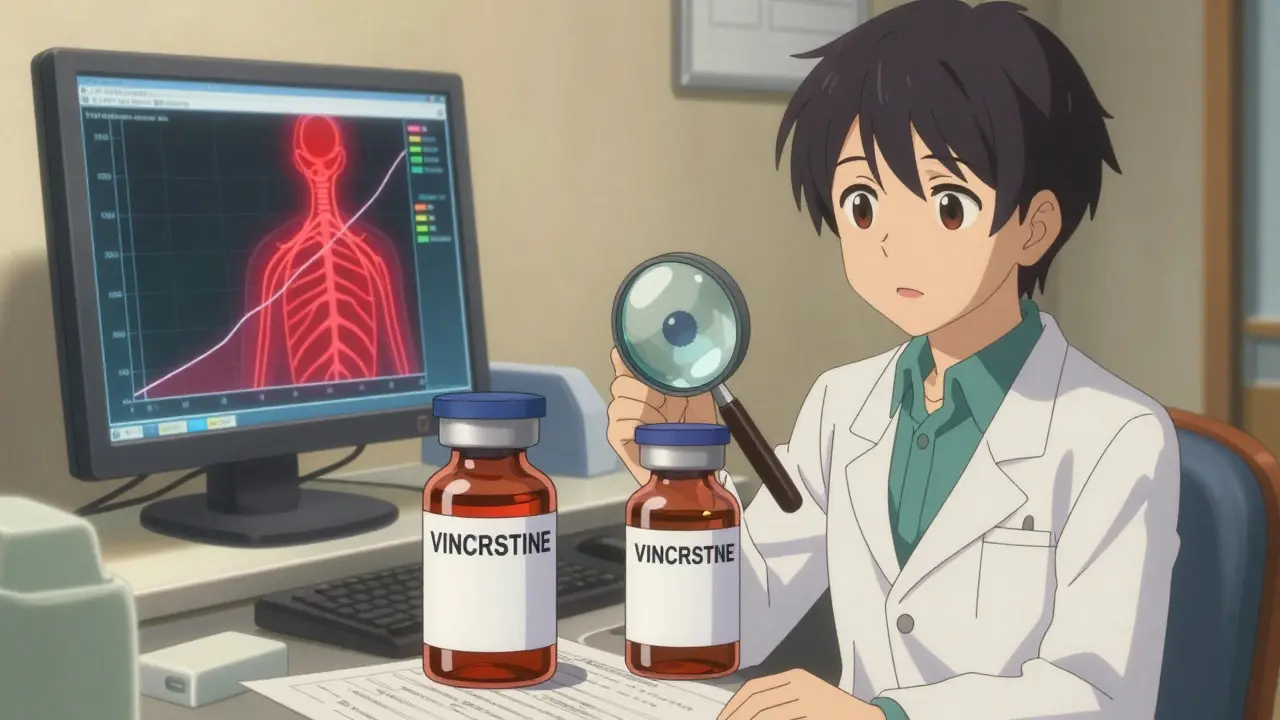
Take R-CHOP for lymphoma: rituximab (a biologic), cyclophosphamide, doxorubicin, vincristine, and prednisone. Rituximab can’t even be called a “generic” - it’s a biosimilar. And biosimilars require full clinical trials. But the other four? They’re small molecules, and regulators let them slide through with simple bioequivalence studies. The problem? If one generic vincristine has a slightly different coating, it releases slower. That changes how it interacts with doxorubicin. The result? More nerve damage. Less tumor kill. That’s not theory - it’s documented.
A 2023 survey of oncology pharmacists found that 57% had seen cases where swapping out just one generic component in a combination led to unexpected side effects or reduced effectiveness. One case on the ASCO forum involved a patient who developed severe neuropathy after switching to a generic vincristine. The brand version had a different excipient that affected how quickly it entered the bloodstream. The generic? It peaked too high. Too fast. The patient’s nerves couldn’t handle it.
Biologics vs. Small Molecules: Two Different Battles
Not all cancer drugs are created equal. There are two main types: small-molecule chemo (like capecitabine or cisplatin) and biologics (like trastuzumab or rituximab). They face completely different bioequivalence rules.
Small molecules can be tested in healthy volunteers. You give them the brand, then the generic, measure blood levels over 24 hours, and call it done. But biologics? They’re huge, complex proteins. Their structure can change slightly depending on how they’re made - even if the sequence is identical. That’s why biosimilars need full clinical trials comparing safety, immune response, and effectiveness. And even then, they’re not called “bioequivalent.” They’re “biosimilar.”
The cost difference is stark. A cycle of branded trastuzumab might cost $15,000. A biosimilar? Around $8,000. That’s a huge saving. But when you combine it with chemo drugs, you’re mixing a biosimilar with three generics. Each one has its own approval path. No one tests the whole combo together. So you’re trusting that each piece, made by a different company, behaves exactly as expected when mixed.
Real-World Consequences: What Happens When It Goes Wrong
Health systems want to save money. Patients want to live. But when a hospital switches a generic component without checking interactions, someone can get hurt.
A study at MD Anderson followed 1,247 patients with metastatic colorectal cancer. Half got branded Xeloda (capecitabine) with oxaliplatin. Half got the generic. After two years, survival rates were nearly identical: 28.4 months vs. 27.9 months. Side effects? The same. That’s the success story.
But then there’s the other side. A 2023 report from the Gulf Cancer Consortium found that 42% of oncologists in the region had concerns about substituting generics in combination regimens. Why? Because in cancer, you don’t get a second chance. If a patient’s drug levels drop 15% due to a formulation change, the tumor might not die. If it spikes 20%, their liver might fail. And there’s no way to predict that from a standard bioequivalence study.
Patients know this too. A 2024 survey by Fight Cancer found that 63% of patients worried about generic substitution in combination therapy. Over 40% said they’d ask for the brand if they could afford it - even though 82% admitted generics saved them money.

How the System Is Trying to Fix It
Regulators aren’t ignoring the problem. In 2024, the FDA launched the Oncology Bioequivalence Center of Excellence. Their mission? To develop better ways to test combination drugs. They’re now pushing for food-effect studies on all oral components - because what works on an empty stomach might not work with breakfast. They’re also embracing computer modeling. Physiologically based pharmacokinetic (PBPK) models can simulate how different formulations interact inside the body, without needing hundreds of human trials.
The EMA is even stricter. For high-risk combinations, they now require clinical endpoint studies - meaning you have to prove the combo works just as well in actual patients, not just in blood tests.
Hospitals are adapting too. UCSF built a decision support tool that flags when a substitution might be risky. It checks for narrow therapeutic index drugs, biologics, and known interactions. Since it launched, inappropriate substitutions dropped by 63%.
Some places, like the Gulf Cooperation Council, use a scoring system. They rate generics on 12 factors: manufacturing quality (30%), regulatory approval (25%), cost (20%), supply reliability (15%), and patient trust (10%). It’s not perfect - but it’s better than just picking the cheapest option.
What This Means for Patients and Providers
If you’re on a combination regimen, don’t assume all generics are equal. Ask your oncologist or pharmacist: “Is this a fixed-dose combo, or are the drugs being mixed from separate generics?” If it’s the latter, there’s more risk.
For providers, the message is clear: don’t swap components blindly. Use tools. Check the FDA’s Orange Book. Look for “A” ratings - but know that those ratings don’t exist for most combination regimens. When in doubt, stick with the brand or use a pre-approved generic combo. Don’t rely on individual bioequivalence studies.
And if you’re worried about cost? Talk to your care team. Some hospitals have patient assistance programs. Some manufacturers offer copay cards. Sometimes, the savings from a generic aren’t worth the risk - especially when survival is on the line.
The bottom line? Generic cancer drugs have saved billions. But combination therapies are a different beast. We can’t apply the same rules we use for blood pressure pills or antibiotics. Cancer treatment demands precision. And until we test the whole combo - not just the pieces - we’re playing Russian roulette with someone’s life.
Are generic cancer drugs as effective as brand-name drugs?
For single-agent therapies, yes - when bioequivalence is proven. Generic paclitaxel, docetaxel, and capecitabine have shown equivalent survival and side effect rates in large studies. But for combination regimens, effectiveness depends on whether each component was tested as part of the full combo. Substituting individual generics can lead to unpredictable interactions, especially with narrow therapeutic index drugs.
Why can’t generic cancer drug combos be tested like regular generics?
Standard bioequivalence tests are done in healthy volunteers with one drug at a time. Cancer combos involve multiple drugs, each with different absorption rates, metabolism pathways, and interactions. Testing them separately doesn’t capture how they behave together. A generic version of drug A might be fine on its own, but when paired with a different generic of drug B, the combined effect can be too strong - or too weak.
Do biosimilars have the same bioequivalence issues as small-molecule generics?
No - they’re regulated differently. Biosimilars (like trastuzumab or rituximab generics) require full clinical trials to prove safety, potency, and immune response match the original. They don’t rely on blood level tests alone. But the problem comes when biosimilars are mixed with small-molecule generics. No one tests the whole combination. So even if each part is approved, the combo might not behave as expected.
Can I request the brand-name version if I’m on a combo regimen?
Yes - and you should. Many insurance plans allow exceptions for high-risk combinations, especially if your doctor documents a medical necessity. If you’ve had side effects after a switch, or if your regimen includes drugs with a narrow therapeutic index (like methotrexate or vincristine), ask for the branded version. Patient advocacy groups report that 41% of patients who requested brands got them.
What should I ask my oncology pharmacist about my cancer meds?
Ask: 1) Are all my drugs from the same manufacturer? 2) Are any of them generic components in a combo? 3) Has this specific combination been tested together? 4) Is there a fixed-dose combo available? 5) What’s the risk if one component is switched? Pharmacists trained in oncology now have tools to answer these questions - don’t be afraid to ask.
Comments
Been on a combo regimen for my dad’s colon cancer. We switched generics last year and he started having weird nerve tingles. Didn’t connect it until his oncologist asked if we changed anything. Turns out, the new vincristine generic had a different coating. He’s back on brand now. Scary how little they test these combos together.
As an oncology pharmacist, I can confirm: the FDA’s 80-125% range is a joke for cancer drugs. We’ve had patients with unexplained toxicity after generic swaps-even when each drug passed bioequivalence. We now flag any combo with methotrexate, vincristine, or cytarabine as high-risk. No one’s auditing this properly.
I’ve been researching this for my thesis on oncology pharmacoeconomics, and honestly, the system is broken. The regulatory framework was built for single-agent drugs in healthy volunteers. Cancer patients aren’t healthy. They’re not taking one pill-they’re taking three or four, each with different pharmacokinetics, different food interactions, different metabolic pathways. And we’re still approving them one at a time? It’s like testing a car engine by checking each bolt individually and assuming the whole thing runs fine. PBPK modeling exists. Why aren’t we using it universally? The FDA’s new center is a step, but it’s too slow. Patients are dying while we wait for paperwork.
man i had no idea this was such a mess. my sister just started chemo and they switched her meds to generics last month. she’s been so tired and puking more than usual. i thought it was just the chemo… but now i’m wondering if it’s the generic capecitabine. gosh, why don’t they test the whole combo?? like, duh??
In India, we see this every day. Hospitals switch generics to cut costs, and patients suffer silently. No one reports it. No one has the resources to track it. We need global standards-not just for the US or EU. Cancer doesn’t care about borders. Why should our safety standards?
My uncle’s on FOLFOX. His docs said the generics were ‘just as good.’ But he had a weird reaction after the switch-rash, nausea, lost 15 lbs in a month. Turned out the generic leucovorin had a different salt form. He’s back on brand now. Funny how ‘bioequivalent’ doesn’t mean ‘same in the body.’
Oh great. So now we’re supposed to trust some generic pill from a factory in Bangladesh that’s cheaper than my coffee? Meanwhile, the brand version costs $2,000 a month but actually works. My mom’s on R-CHOP. I’d rather pay extra than watch her die because someone decided to save $100 on a vial.
YES. YES. YES. 🙌 I work in a clinic and we just got hit with a 30% cost cut-so we switched generics. We had three patients with severe neuropathy in 6 weeks. One had to stop chemo. We went back to branded vincristine and doxorubicin immediately. Now we have a checklist: if it’s a combo with a narrow therapeutic index? NO GENERIC. EVER. We even printed it on sticky notes and put them on every med cart. It’s not glamorous, but it saves lives.
so let me get this straight… we let people take 4 different generics from 4 different companies, each approved on a test done on a 22-year-old college kid who’s never had cancer, and then we act surprised when the patient’s liver explodes? wow. what a brilliant system. next they’ll say ‘just pray harder’ and call it a clinical trial. #capitalism
The issue of bioequivalence in combination cancer regimens requires a paradigm shift from component-level approval to system-level validation. Current regulatory frameworks are insufficient for polypharmacy scenarios where pharmacokinetic interactions are non-linear and patient-specific. The adoption of physiologically based pharmacokinetic modeling, coupled with real-world evidence from electronic health records, may offer a more robust and scalable solution. Institutional protocols should mandate pre-approval of combination regimens as a unit, rather than as individual agents.