
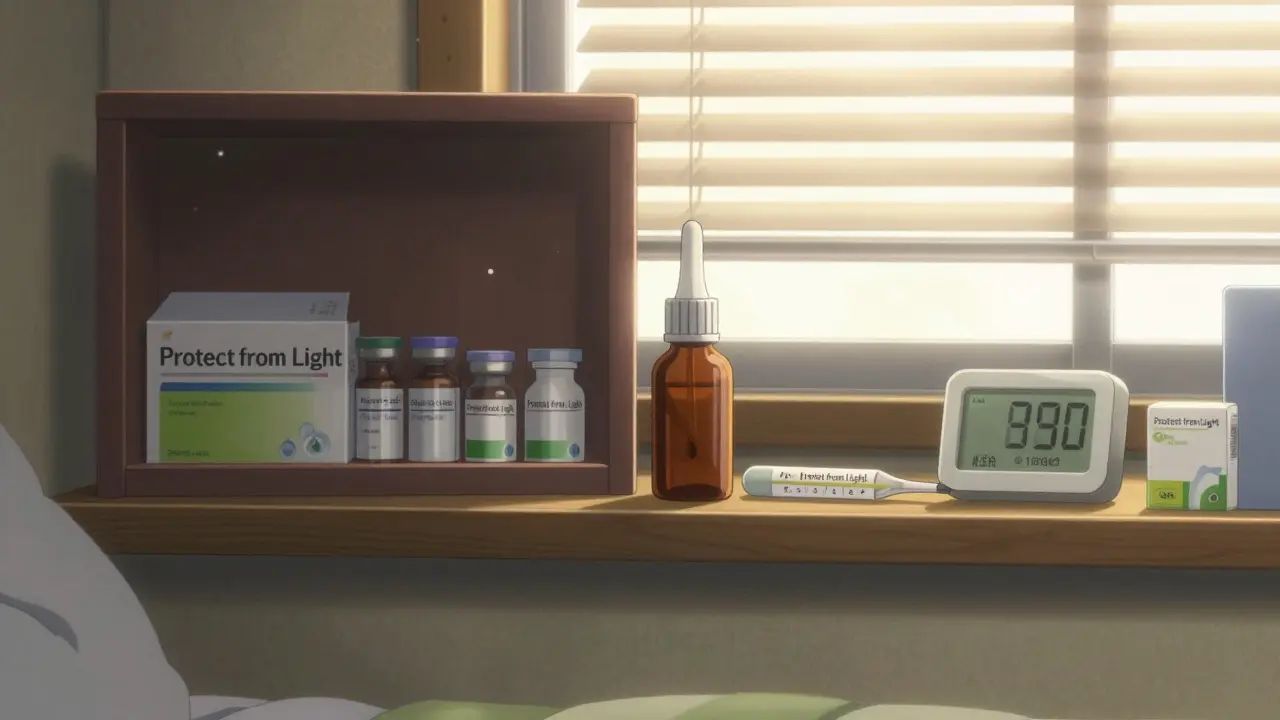
Many people don’t realize that the medicine they keep on their bathroom shelf could be losing its power-sometimes by half-before they even use it. If you’re taking eye drops, antibiotics, chemotherapy drugs, or even something as common as vitamin D drops, light exposure might be silently ruining them. It’s not just about keeping them dry or cool. Light, especially sunlight and even bright indoor lighting, can trigger chemical changes that make your meds less effective-or worse, turn them into something harmful.
Why Light Destroys Medications
Medications aren’t like food. They don’t spoil because they’re old. They break down because of light, heat, or moisture. Light-sensitive drugs contain molecules that react when exposed to certain wavelengths-especially UV and blue light. This is called photodegradation. Once it happens, the active ingredient changes structure. What was supposed to lower your eye pressure might now do nothing. A hormone pill meant to prevent pregnancy could fail. Antibiotics might not kill the infection, leading to worse illness or antibiotic resistance. The U.S. Pharmacopeia (USP) lists 470 injectable drugs that require light protection. But it’s not just injections. Eye drops, creams, and even oral pills can be affected. Studies show some eye drops lose up to 40% of their potency after just 7 days in clear containers. Tretinoin cream turns yellow. Insulin can clump. Aspirin smells like vinegar when it degrades. These aren’t myths-they’re documented chemical reactions.What Counts as Light-Sensitive?
Not every pill needs special care. But if your medication falls into one of these categories, treat it like a fragile item:- Eye drops (especially latanoprost, bimatoprost, travoprost)
- Antibiotics (tetracycline, doxycycline, ciprofloxacin)
- Chemotherapy drugs (5-fluorouracil, melphalan)
- Hormonal medications (birth control pills, estrogen patches)
- Anti-seizure drugs (phenytoin, carbamazepine)
- Vitamin D and other fat-soluble supplements
- Biologics (insulin, certain injectables for arthritis or diabetes)
How to Store Them Correctly
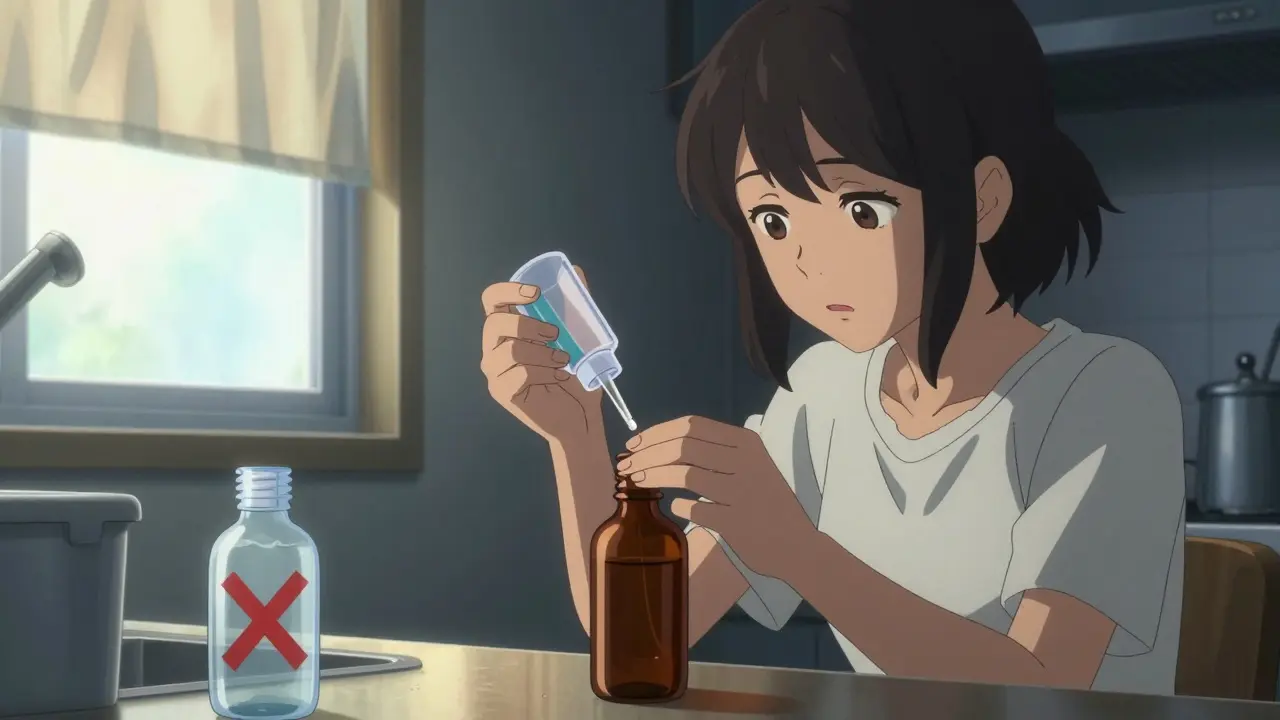
The best way to protect light-sensitive meds is to leave them in their original packaging. That amber bottle or opaque tube isn’t there for looks-it’s engineered to block harmful light. Here’s how to handle them:- Keep them in the original container. Don’t transfer eye drops to a clear plastic box or a pill organizer. Even if it’s labeled “for travel,” most aren’t UV-proof. Bausch + Lomb’s patented eye drop containers include an internal UV-blocking layer. Generic containers don’t.
- Use amber or opaque containers if you must repack. If your pharmacy gave you a clear bottle, ask for an amber one. Look for containers that block light below 470 nanometers. USP standards require less than 10% light transmission in that range. Amber glass blocks 98% of UV light. High-quality opaque plastic blocks about 85%. The difference matters.
- Store in a cool, dry place. Temperature matters too. Most meds should be kept between 59°F and 77°F (15°C-25°C). Avoid bathrooms. The steam and heat from showers make things worse. A kitchen cabinet away from the stove or sink is better. For insulin or certain biologics, refrigerate at 36°F-46°F (2°C-8°C) until opened.
- Keep eye drops refrigerated after opening. Many manufacturers say you can store opened eye drops at room temperature (40°F-77°F). But keeping them cold slows degradation. If you do refrigerate them, let them sit for 5 minutes before use to avoid discomfort.
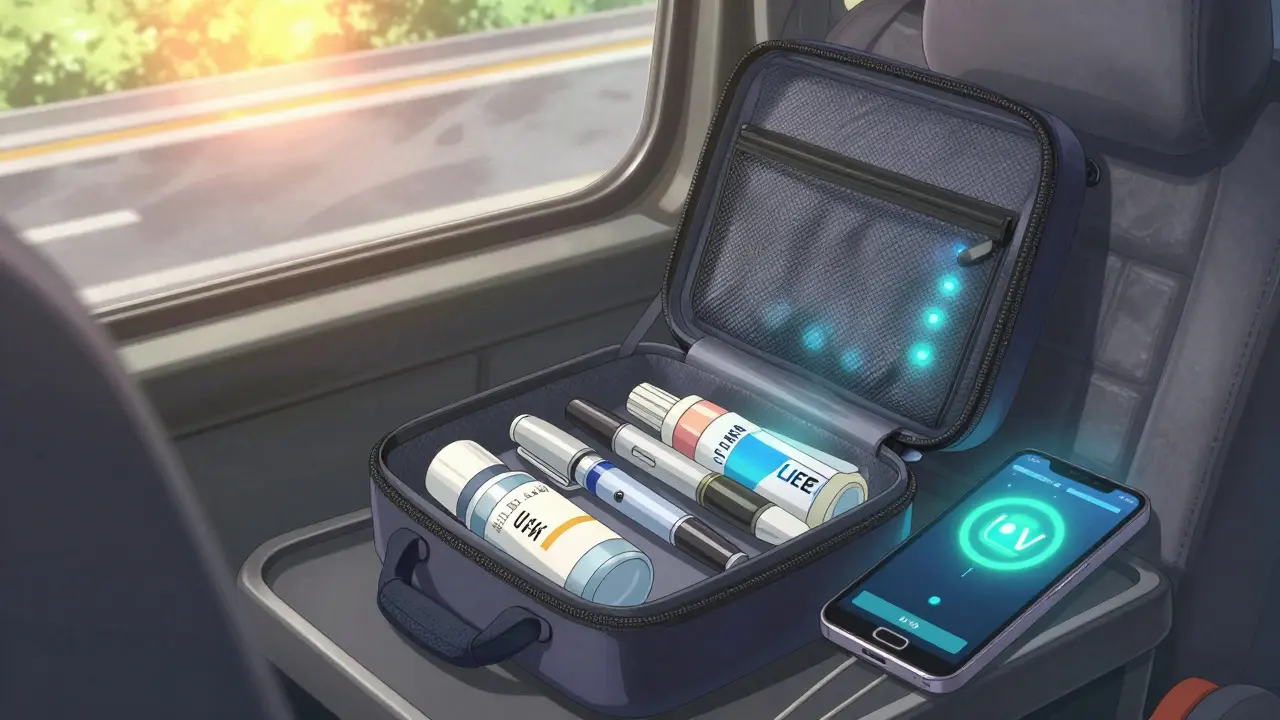
- Use UV-blocking travel cases. If you’re flying or road-tripping, use an insulated medication bag with a UV-blocking lining. These maintain stable temperatures and block light for 8-12 hours. Don’t rely on a regular purse or glove compartment-summer car interiors can hit 140°F.
What Not to Do
Here are the top mistakes people make-and why they’re dangerous:- Storing in the bathroom. A 2022 survey found 68% of patients keep meds in the bathroom. Humidity and light combine to break down drugs faster. One Reddit user threw out $120 worth of tretinoin cream after it turned yellow in a cabinet above the sink.
- Leaving them on the windowsill. Even a sunny windowsill can degrade meds in days. That’s not a storage spot-it’s a lab experiment.
- Using clear pill organizers. These are great for remembering doses, but terrible for light-sensitive drugs. If you use one, only fill it daily and keep the original bottle in a dark drawer.
- Ignoring expiration dates. Light exposure shortens shelf life. An eye drop that should last 6 weeks after opening might only last 3 if stored improperly.
Signs Your Medication Has Gone Bad
You don’t need a lab to tell if your medicine is compromised. Look for these red flags:- Color change: Creams turning yellow or brown, liquids becoming cloudy or discolored
- Unusual odor: Aspirin smelling like vinegar, insulin developing a sour smell
- Texture change: Tablets cracking, ointments separating, eye drops forming particles
- Reduced effectiveness: Your glaucoma pressure isn’t dropping, your acne isn’t improving, your insulin isn’t controlling blood sugar
Storage Options Compared
| Storage Type | Light Protection | Temperature Control | Cost per Unit | Convenience | Best For |
|---|---|---|---|---|---|
| Amber Glass Bottle (Original) | 98% UV blocked | None | $0.08-$0.20 | High | Most eye drops, oral meds |
| Opaque Plastic Bottle | 85% UV blocked | None | $0.15-$0.35 | High | Travel, children’s meds |
| Aluminum Foil Pouch | 100% blocked | None | $0.10-$0.25 | Low | High-risk drugs like chemotherapy |
| UV-Blocking Medication Box | 95% blocked | Passive insulation | $19.99-$59.99 | Medium | Multiple meds, travel |
| Smart Container (Beta) | 95% blocked + UV sensor | Active cooling | $80-$120 | Medium | Insulin, biologics |
Real User Experiences
One user on the American Foundation for the Blind forum shared that switching to an amber storage box extended the life of their latanoprost eye drops from 4 weeks to the full 6 weeks. Another, a nurse, reported that her elderly mother’s blood pressure meds stopped working after being stored in a sunny hallway. After moving them to a dark cabinet, readings normalized within days. Amazon reviews for UV-blocking storage boxes average 4.3 out of 5 stars. Common praise: “Kept my insulin stable during summer road trips.” Common complaints: “Can’t see how much is left” and “Child-resistant caps are too hard for arthritic hands.”What’s Changing in 2025
The FDA is pushing for clearer labeling. New drug packages will include a universal “protect from light” icon-similar to the EU’s design. Smart containers with built-in UV sensors are in beta testing and could hit the market in late 2025. These will alert your phone if your insulin or eye drops got too much light. Meanwhile, manufacturers are adding photostabilizers directly into new drug formulas. By 2028, 25% more medications will be light-sensitive due to advances in biologics and targeted therapies. That means proper storage won’t just be smart-it’ll be essential.What to Do Today
1. Check every bottle. Look for “protect from light” on the label. 2. Find the original container. If you threw it out, get a replacement amber bottle from your pharmacy. 3. Move your meds. Out of the bathroom. Out of the kitchen window. Into a dark, cool cabinet. 4. Use a thermometer and hygrometer. Keep your storage area between 59°F-77°F and humidity below 60%. 5. When in doubt, toss it. If it looks, smells, or acts weird-don’t risk it. You don’t need expensive gear to protect your meds. Just awareness. A dark cabinet, the original bottle, and a little attention can save you from ineffective treatment-and maybe even a hospital visit.Can I store eye drops in the fridge?
Yes, many eye drops can be stored in the refrigerator after opening, especially if they’re labeled for room temperature use. Keeping them cold (between 40°F-46°F) slows down chemical breakdown and can extend their usable life. Let them sit at room temperature for 5-10 minutes before use to avoid discomfort. Always check the manufacturer’s instructions-some drops shouldn’t be frozen.
Is it okay to transfer eye drops to a different bottle?
No. Transferring eye drops to a clear or non-UV-blocking container removes the protective barrier and exposes them to light. Studies show this can reduce potency by up to 35% within two weeks. Even if the new bottle looks clean, it won’t block harmful wavelengths. Always use the original amber or opaque container.
What if my medication turns yellow or cloudy?
Stop using it immediately. Discoloration means the active ingredient has degraded. Yellow tretinoin cream, cloudy insulin, or milky eye drops are signs of chemical breakdown. Using them may not work-or could cause irritation or infection. Return the medication to your pharmacy for safe disposal and ask for a replacement.
Do all medications need light protection?
No. Most oral tablets and capsules are stable under normal lighting. But drugs like eye drops, biologics, antibiotics, and hormone therapies are especially vulnerable. Always check the label. If it says “protect from light,” “store in original container,” or has a sun symbol, treat it as light-sensitive.
How long do light-sensitive medications last after opening?
It depends on the drug and storage. Most eye drops last 4-6 weeks after opening if kept properly. Insulin lasts 28 days at room temperature. But if exposed to light or heat, that time can drop by half. Always follow the expiration date on the bottle or package insert. When in doubt, ask your pharmacist-don’t guess.
Comments
Let’s cut through the noise: 78% of meds have a light-protection warning, yet 90% of patients ignore it. Photodegradation isn’t theoretical-it’s quantifiable. Latanoprost loses 40% potency in 7 days under ambient light. That’s not a drop-it’s a clinical failure. Amber glass blocks >98% UV below 470nm. Clear plastic? 15%. You’re not being careful-you’re gambling with your health. The FDA’s 2025 labeling push won’t fix this. People need to stop treating meds like snacks.
I used to keep my glaucoma drops in the bathroom because it was convenient. Then my vision got worse-not because the disease progressed, but because the drops turned yellow. I switched to an amber box and kept them in the fridge. My pressure stabilized within two weeks. This isn’t just advice-it’s survival. Please, don’t wait until it’s too late.
My mom used to put her insulin in the sun to warm it up before injecting. She didn’t know it was breaking down. Now she uses a UV box. Her A1c dropped from 8.9 to 6.7. Simple fix. Life changing.
I read this article and immediately checked my medicine cabinet. Turns out my tretinoin had been sitting above the sink for six months. It had turned slightly orange. I tossed it. Got a new prescription in amber. I feel like I just saved myself from months of wasted effort and irritated skin. Small changes matter.
They say light ruins meds. But who really controls what happens in your home? Pharmacies don’t warn you properly. The FDA is asleep. Big Pharma wants you to keep buying new bottles because you’re storing them wrong. That UV-blocking box? It’s overpriced. But they’ll sell you a $60 gadget instead of fixing the damn packaging. This isn’t about storage-it’s about control. They want you dependent.
Been a nurse for 18 years. Saw a guy on chemo take his 5-FU out of the fridge, leave it on the dashboard for 3 hours, then inject it. He got sepsis. Not from infection-from degraded meds. The bottle said ‘protect from light and heat.’ He didn’t even read it. We need to stop assuming people know this stuff. It’s not common sense. It’s science. And science doesn’t care how busy you are.
I used to think this was overkill until my dad’s blood pressure meds stopped working. He had them in a sunny window. We moved them to a dark drawer. His numbers dropped back to normal in 48 hours. No doctor visit. No new script. Just darkness. Sometimes the simplest fix is the one nobody talks about.
You don’t need a fancy box. You don’t need to spend $80. Just use the original bottle. Put it in a drawer. Don’t leave it by the window. If you can’t see it, it’s probably safe. This isn’t rocket science. It’s basic respect for the chemistry in your medicine. Do the bare minimum. Your body will thank you.
Wait-so you’re telling me the government knows this and still lets them sell clear bottles? And pharmacies don’t even offer amber ones by default? And they charge extra for UV boxes? This is a scam. They’re poisoning us slowly. They want us to get sick so we buy more. The FDA is in on it. I’ve seen the documents. They’ve known since 1998. They just don’t care. I’m not taking anything anymore until they fix this.
Let me tell you something: light doesn’t just degrade meds-it *rearranges* them. It’s not just potency loss-it’s molecular sabotage. UV light turns tretinoin into formaldehyde precursors. Insulin aggregates into amyloid-like fibrils. Aspirin hydrolyzes into acetic acid-yes, vinegar. These aren’t side effects. They’re chemical warfare on your body. And nobody’s talking about the long-term neurotoxicity of ingesting degraded compounds. You think your ‘expired’ eye drop is harmless? It’s not. It’s a time bomb in a plastic bottle.
I used to think this was all hype. But then I started reading about photodegradation in pharmacology textbooks. It’s fascinating, really. Molecules absorb photons, electrons jump orbitals, bonds break, new compounds form. It’s like watching a tiny, invisible fire inside your medicine. And we treat it like a snack. We don’t think about the energy that’s been poured into these compounds-by chemists, by manufacturers, by nature. We owe them more than a bathroom shelf.
This is the kind of info that changes lives. I used to toss my vitamin D drops after 6 weeks like the label said. Then I started keeping them in the fridge in their original bottle. They lasted 10 weeks without any change in color or clarity. I feel stronger. My blood levels stayed stable. Sometimes the best health hack is just… not being lazy.