

Running out of medication isn’t just inconvenient-it can be dangerous. But paying too much for prescriptions month after month? That’s a silent drain on your finances. If you’re juggling multiple prescriptions, dealing with rising drug prices, or just tired of guessing when your next refill is due, you’re not alone. Setting up a simple medication budgeting system with auto-refill alerts can cut your out-of-pocket costs by up to 15% and keep your pills on schedule without the stress.
Start with What You’re Actually Spending
Before you set up anything, you need to know where your money’s going. Grab your last three months of pharmacy receipts or log into your insurance portal. List every prescription you take, the name, dosage, how often you refill it, and how much you pay each time. Don’t forget over-the-counter meds you buy regularly-things like pain relievers, antacids, or allergy pills. These add up fast.For example, if you take metformin 500mg twice daily, and your copay is £18 every 30 days, that’s £216 a year. Add in your blood pressure med at £22 every month, and your asthma inhaler at £35 every 90 days? You’re already spending over £500 a year on just three meds. That’s more than your monthly gym membership. Once you see the numbers in black and white, it hits differently.
Choose Your Budgeting Method
There are three ways to handle this: annual budgeting, rolling forecasts, or zero-based budgeting. For most people, annual budgeting works fine. Just add up your yearly medication costs and divide by 12. That’s your monthly pill budget. Stick to it like you would your rent or groceries.If your meds change often-maybe you’re on a new treatment or your doctor switches you around-try a rolling forecast. Every three months, look at what you actually spent and adjust the next quarter’s budget. No guesswork. Just real numbers.
Zero-based budgeting sounds fancy, but all it means is starting from zero each month. Ask yourself: “What do I *need* to spend on meds this month?” Not what you spent last month. Not what you think you’ll need. What’s absolutely necessary? This forces you to question every refill. Is that extra painkiller really needed? Can you switch to a generic? It’s more work, but it saves the most.
Link Your Refills to Your Budget
Most pharmacies-CVS, Walgreens, Boots, your local independent-offer free auto-refill programs. Sign up for them. But don’t just turn it on blindly. Link it to your budget. If your monthly pill budget is £80, make sure your auto-refill settings don’t trigger early refills that push you over that limit.Here’s how to do it right: Call your pharmacy or log into their app. Find the refill settings. Set your alerts to trigger when you have 7-10 days left, not 30. That way, you get your meds before you run out, but you’re not stockpiling. You’ll also avoid paying for a refill you don’t need because you already had one sitting on the shelf.
Pro tip: If you take a high-cost drug-like insulin, biologics, or specialty cancer meds-ask your pharmacist about patient assistance programs. Many drugmakers offer coupons, co-pay cards, or even free medication for low-income patients. You won’t know unless you ask.
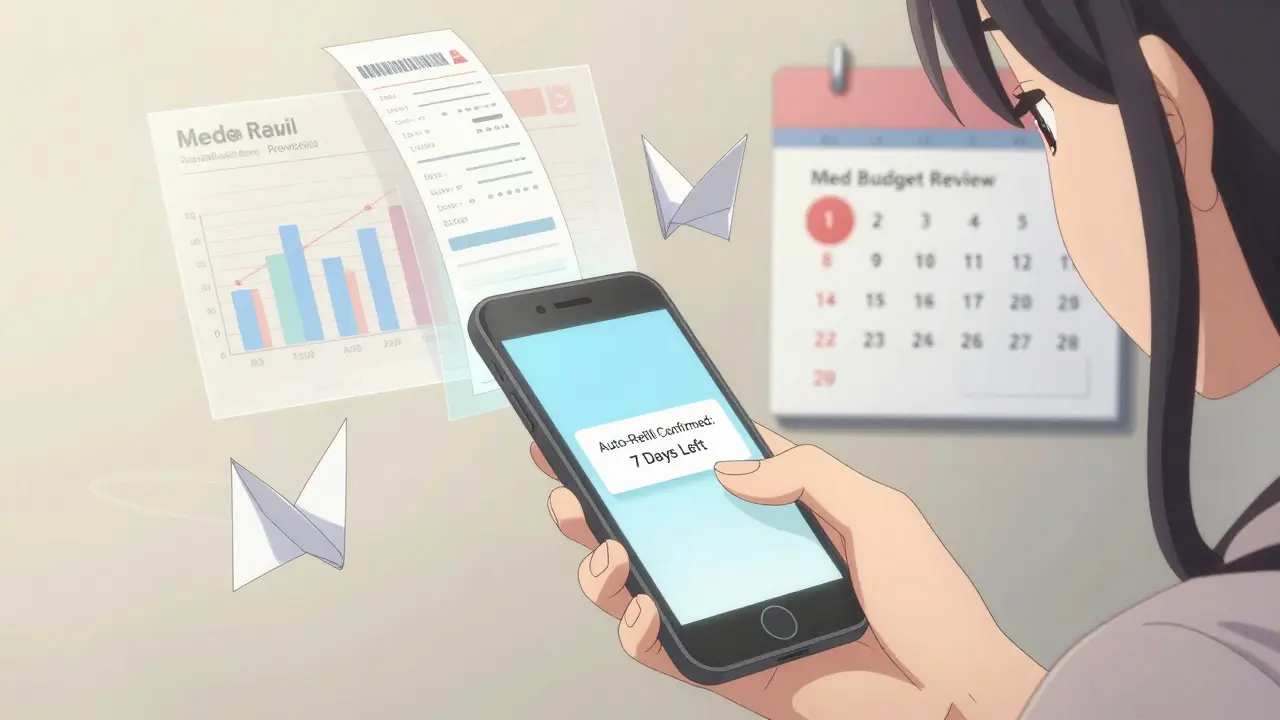
Use Tech to Automate the Rest
Your phone can do more than just remind you to take your pills. Use apps like Medisafe, MyTherapy, or even Google Calendar to set refill alerts that sync with your budget. Create a recurring event titled “Check Medication Budget” every first of the month. When it pops up, open your banking app, pull up your pharmacy spending for the last 30 days, and compare it to your planned budget. If you went over, figure out why. Was it a new prescription? A price hike? Did you refill too early?Some insurance companies offer apps that track your drug spending in real time. UnitedHealthcare’s app, for example, shows you exactly how much you’ve spent on prescriptions this year and compares it to your plan’s deductible. If you’re on Medicare, log into MyMedicare.gov. It gives you a full year’s history of every drug you’ve filled, with prices and pharmacy details.
Watch Out for These Traps
Not all auto-refill systems are created equal. Some pharmacies will refill your prescription as soon as you’re eligible-even if you still have a full month’s supply. That’s not helpful. It’s a money trap. You’re paying for meds you don’t need yet. Always set your refill window to the last 10 days of your supply.Another trap: switching to a new pharmacy just because they have a “free first refill” deal. That’s a gimmick. Check the long-term price. A pharmacy that charges £12 for your generic lisinopril might be cheaper than the one offering £0 for the first refill but charging £25 after that.
And don’t ignore drug price changes. Insulin prices jumped 25% in the UK between 2022 and 2024. If you’re on a long-term med, check its price every six months. Use tools like GoodRx or the NHS Prescription Pricing Authority to compare prices across pharmacies. Sometimes, buying a 90-day supply instead of 30 saves you 20%-if your insurance allows it.

What If You Can’t Afford Your Meds?
If your budget says you can’t afford your meds, you’re not alone. One in four UK adults skips doses because of cost. But there are options.First, talk to your doctor. Ask if there’s a generic version. Or if a therapeutic alternative exists-another drug that works just as well but costs less. Many high-cost brand-name drugs have cheaper equivalents that are just as safe.
Second, check the NHS Low Income Scheme. If you’re on a low income, you may qualify for free prescriptions. You can apply online at nhsbsa.nhs.uk. It’s quick, and if you’re approved, you’ll get a pre-paid certificate that covers all your prescriptions for a year.
Third, use the NHS Prescription Prepayment Certificate (PPC). It costs £111.60 for 12 months or £31.25 for three months. If you take more than three prescriptions a month, it pays for itself. That’s £37 in savings if you’re on four meds. That’s a free weekend meal out.
Track Progress, Not Just Costs
Don’t just track money. Track your health. Are you refilling on time? Are you having fewer hospital visits? Fewer ER trips? Fewer missed workdays? That’s the real win.One woman in Birmingham, 68, started tracking her meds after her husband’s heart condition worsened. She set up auto-refills, switched to a PPC, and found a cheaper generic for his blood thinner. Within six months, she saved £420 and never missed a dose. Her husband’s blood pressure stabilized. That’s the kind of result that matters.
Set a monthly reminder: “Review meds. Check budget. Adjust if needed.” Make it part of your routine, like paying bills or checking the weather. In six months, you’ll wonder how you ever managed without it.
Can I set up auto-refill alerts for all my prescriptions?
Yes, most pharmacies allow you to enable auto-refills for every prescription you have with them. But you should only do it for meds you take regularly and know you’ll need. Don’t auto-refill antibiotics, short-term painkillers, or drugs your doctor might change. Always review your list every 3-6 months.
Do auto-refill alerts cost money?
No. Auto-refill alerts are free at every major pharmacy in the UK, including Boots, LloydsPharmacy, and Superdrug. Some apps like Medisafe or MyTherapy are also free. You only pay for the medication itself.
What if my insurance changes my copay?
If your insurance changes your copay, your budget will need updating. Don’t wait for your next refill. Check your insurer’s website or call them every time you get a new plan document. Even a £5 increase on a monthly med adds up to £60 a year. Adjust your budget before you get the bill.
Can I use NHS services to help with medication costs?
Absolutely. The NHS Prescription Prepayment Certificate (PPC) covers all your prescriptions for a set fee-£31.25 for three months or £111.60 for a year. If you take more than three prescriptions a month, it saves you money. You can also check if you qualify for free prescriptions through the NHS Low Income Scheme.
How often should I review my medication budget?
At least once a month. Life changes-new prescriptions, price hikes, insurance updates. A monthly check takes five minutes. Open your banking app, look at your pharmacy spending, compare it to your planned budget, and adjust if needed. This keeps you in control.
What’s the biggest mistake people make with medication budgeting?
They assume their budget stays the same. Drug prices change. Insurance changes. Your needs change. The biggest mistake is setting a budget once and forgetting it. Treat it like a living plan-review it, tweak it, and keep it real.
Comments
Just started using Medisafe last month and honestly? Life-changing. I used to forget refills, then panic-buy at 2 a.m. from a 24-hour CVS. Now I get alerts, my budget’s on track, and I even saved enough to take my mom to the beach this summer. Small wins, you know?
yo i just use google calendar to remind me to buy my pills lmao why make it so hard? also why is everyone talking about pounds?? im in the us and my insulin costs more than my rent
This is the kind of practical, human-centered advice we need more of. I’ve seen too many people skip meds because they’re scared of the cost-and that’s not a personal failure, it’s a system failure. The NHS PPC tip? Pure gold. Even if you’re not in the UK, the idea of prepaying for predictable health costs is universal. We all deserve to breathe without worrying about the next pill.
Great post! I especially appreciate the breakdown of annual vs. rolling vs. zero-based budgeting. I’ve been using the rolling forecast method since January, and it’s made a huge difference-especially after my doctor switched me from brand-name metformin to the generic. The price dropped from $48 to $12 per month. Also, don’t forget to check GoodRx even if you have insurance-sometimes the cash price is lower!
While the general advice is sound, there are several methodological oversights. For instance, the assumption that all auto-refill systems function identically across pharmacy chains is empirically inaccurate. CVS, for example, utilizes a proprietary algorithm that triggers refills based on historical usage patterns, not merely calendar intervals. Additionally, the referenced NHS data is jurisdictionally irrelevant to U.S.-based readers, and the inclusion of British currency without conversion undermines the article’s utility for an international audience. A more rigorous approach would include regulatory distinctions, formulary tiers, and payer-specific formulary constraints.
Let’s be real: budgeting for meds isn’t about spreadsheets-it’s about survival. I’ve been on insulin for 12 years. I’ve used every trick in the book: co-pay cards, patient assistance, mail-order pharmacies, even splitting pills when my insurance didn’t cover the full 90-day supply. The system is broken. The fact that you have to be a detective just to afford your life-saving drugs? That’s not personal responsibility. That’s a moral failure. I wish I could tell people to just ‘do this checklist’-but for too many of us, the checklist is just the first step. The real work is fighting the bureaucracy every single time.
Man, I just found out my pharmacy was auto-refilling my asthma inhaler every 30 days even though I only use it twice a week-so I was paying for 3 refills a month instead of 1. I called them, set it to 10 days left, and saved $90 in 2 months. Also, the NHS PPC thing? I didn’t even know that existed until my cousin told me. I’m in the US, but I’m telling everyone I know about this. Why don’t more people talk about this stuff? It’s like we’re all too embarrassed to admit we’re struggling to afford our meds.
Thank you for writing this. As someone who’s cared for aging parents with multiple chronic conditions, I’ve seen firsthand how financial stress compounds health stress. The point about tracking health outcomes-not just costs-is critical. When my mother started sticking to her refill schedule and switched to the PPC, her ER visits dropped by 70%. That’s not just savings. That’s dignity. And if you’re reading this and thinking, ‘I can’t afford to do this,’ please, reach out to your pharmacist. They’re trained to help. Not just dispense. Help. You’re not alone.