
Why Timing Matters More Than You Think When Flying
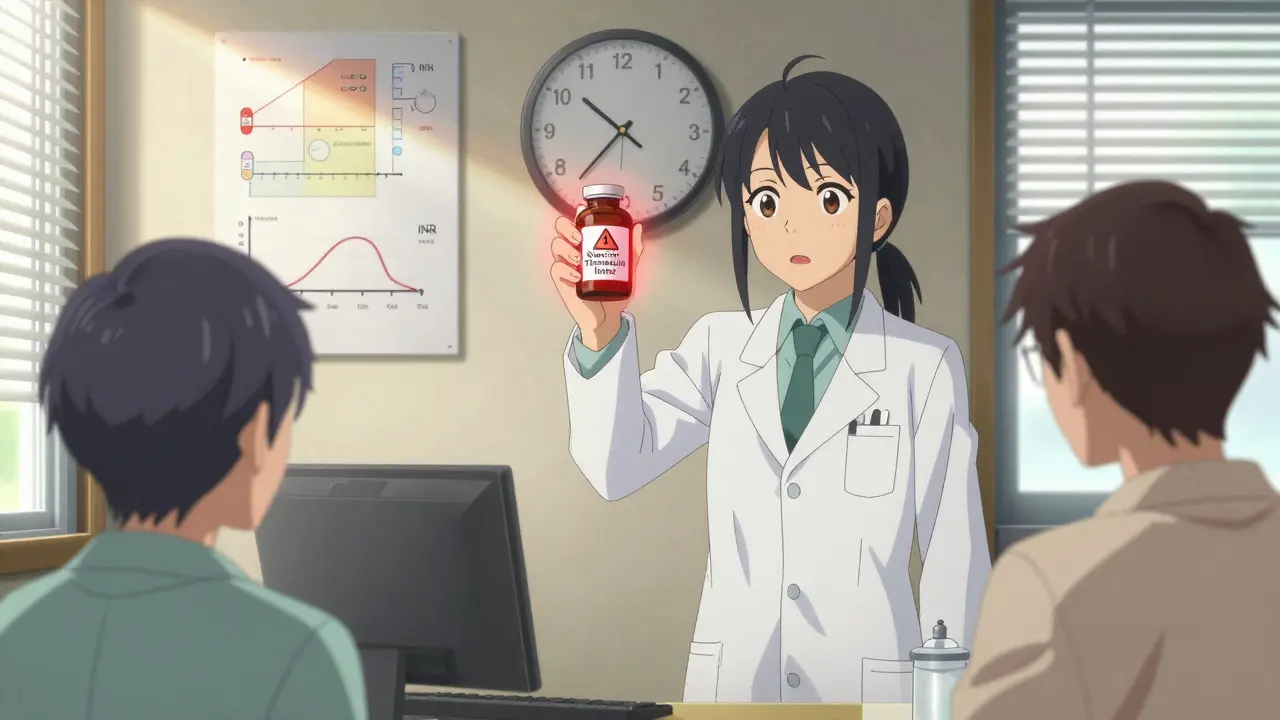
Missing a dose by an hour might seem harmless - until it isn’t. For people taking time-sensitive medications, even small delays can cause serious problems. Warfarin users might see dangerous spikes in INR levels. Diabetics on insulin could slip into hypoglycemia. Epilepsy patients risk seizures. Immunosuppressants after transplants? A missed dose could trigger organ rejection. These aren’t hypothetical risks - they’re documented emergencies. According to the CDC, over 60% of travelers crossing five or more time zones struggle with medication timing, and nearly half report real health issues because of it.
Know Your Medication’s Risk Level
Not all meds are created equal when it comes to timing. Start by asking: What’s the half-life? If your drug clears your body in less than 8 hours (like insulin, antibiotics, or anti-seizure drugs), you’re in the high-risk group. These need near-perfect timing. Low-risk meds - like some blood pressure pills with half-lives over 24 hours - can usually be taken 1-2 hours early or late without issue. But here’s the catch: even some low-risk drugs become high-risk if they have a narrow therapeutic window. That means the difference between the right dose and a toxic one is tiny. Warfarin, lithium, and many chemotherapy pills fall into this category. Check your prescription label or ask your pharmacist: "Is this a narrow therapeutic index drug?" If yes, treat it like a bomb with a timer.
Plan Your Schedule Before You Leave
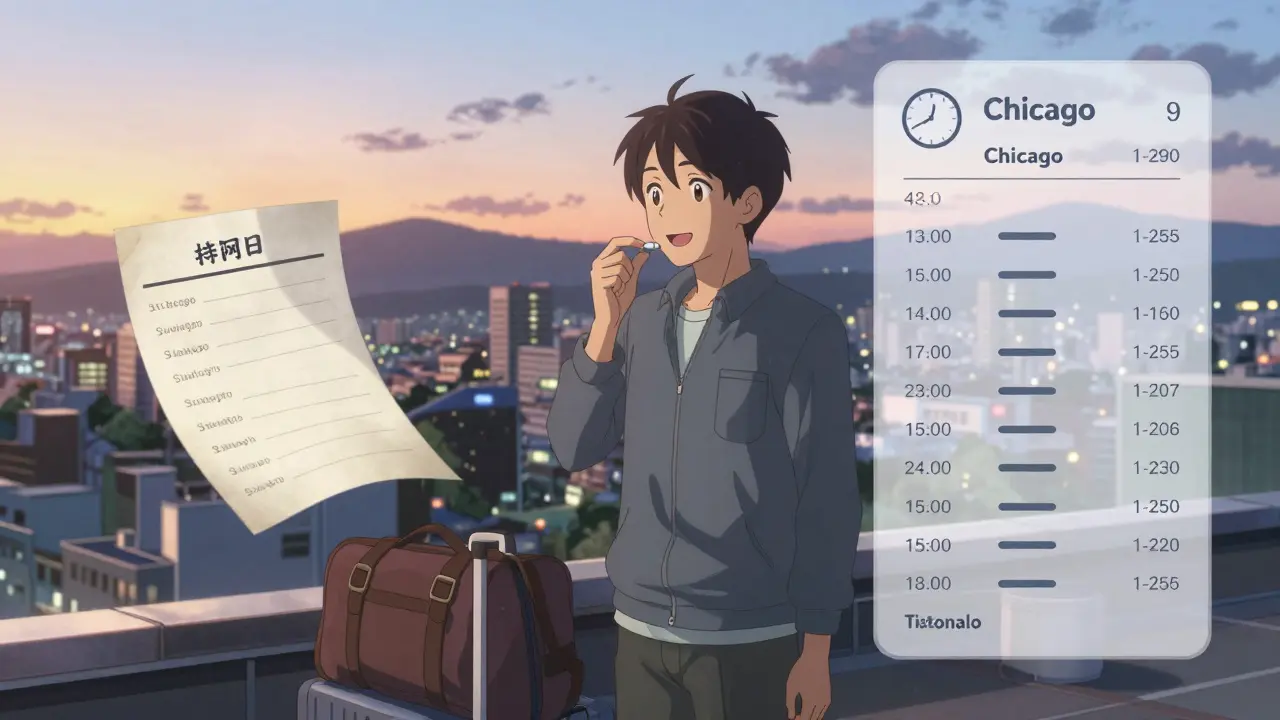
Don’t wait until the airport to figure this out. At least 72 hours before your flight, map out your dosing schedule using your home time zone. For example: if you take insulin at 7 a.m. and 7 p.m. London time, and you’re flying to Tokyo (9 hours ahead), your first dose in Tokyo will be at 4 a.m. local time - which feels like 7 p.m. the night before back home. That’s confusing. Instead, follow this rule: Stick to your home schedule for the first 48 to 72 hours after arrival. That gives your body time to adjust. After that, shift your doses gradually - one hour per day - until you match the local time. For eastbound trips (like London to Tokyo), you’ll be skipping hours, so take doses slightly earlier. For westbound (Tokyo to London), you’re gaining hours - delay doses slightly. Use apps like Medisafe to auto-adjust your alarms based on your flight itinerary. It’s not magic, but it cuts down human error.
What to Do During the Flight
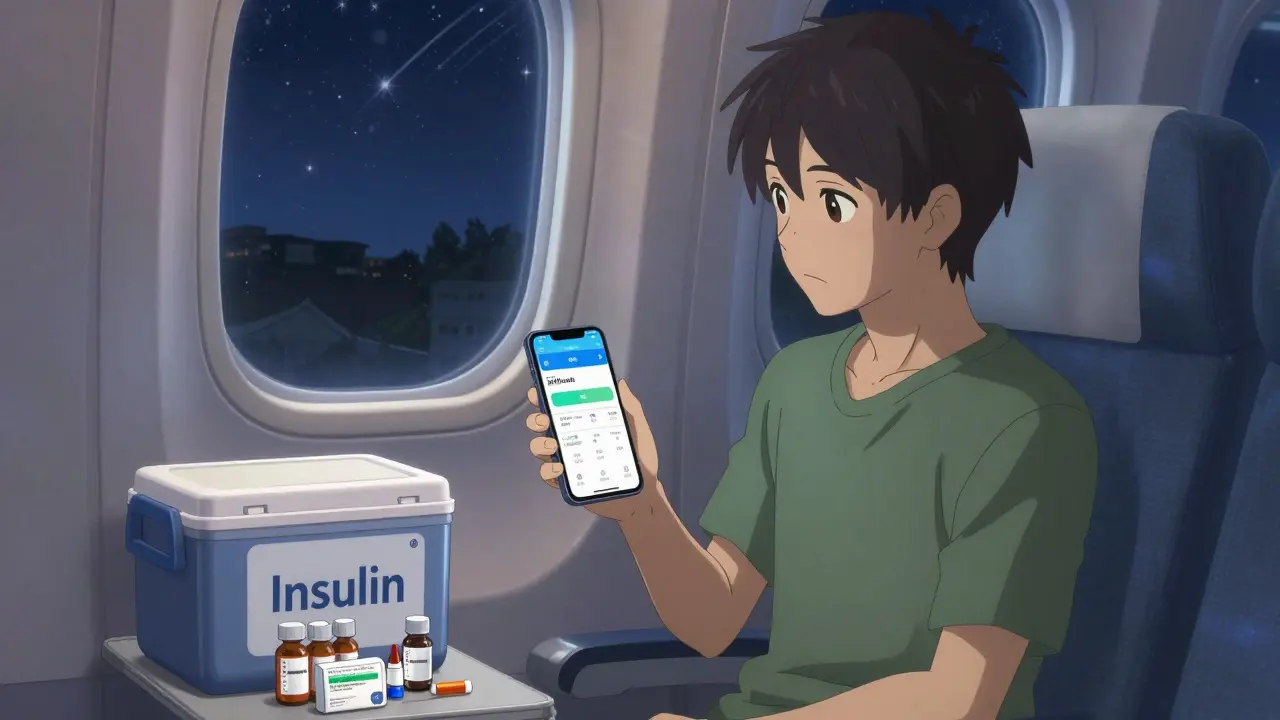
Take your meds on your home schedule, even if it’s 3 a.m. on the plane. Don’t wait until you land to take your dose because you’re "sleeping." If you’re on a 12-hour flight and your dose is due at 10 p.m. your time, take it at 10 p.m. plane time - not when you wake up at 7 a.m. local time. Flight attendants can help you set an alarm if needed. Keep your meds in your carry-on. Never check them. Temperatures in cargo holds can drop below freezing or spike over 100°F - both can ruin insulin, biologics, and other temperature-sensitive drugs. TSA allows you to carry unlimited solid medications and reasonable amounts of liquids (even over 3.4 oz) as long as they’re labeled and declared. Bring your original prescription bottles. If you’re asked, say: "These are medically necessary." You’re not asking for permission - you’re stating a fact.
Storage Is Non-Negotiable
If your meds need to stay cold - insulin, epinephrine pens, some antibiotics - you need a cooler. Not a regular ice pack. Use a medical-grade portable cooler like the Travelport 3.0. These use phase-change material to hold 35-46°F for up to 48 hours without power. Regular coolers? They don’t last. And gel packs? TSA lets you bring them, even if they’re melted. Just tell them they’re for medication. Don’t rely on airplane fridges - they’re not regulated, and you have no idea what temp they’re set to. One study found that 37% of travelers who stored insulin in airline fridges experienced dose failure due to temperature exposure. That’s not a gamble worth taking.
Watch Out for Hidden Triggers
Some meds you didn’t think about can mess with your schedule. Antihistamines like Benadryl or Unisom? They linger in your system for up to 60 hours. If you take one to sleep on the plane, you might feel groggy for days - and that’s not just annoying, it’s dangerous if you’re driving or operating equipment after landing. The FAA warns pilots to avoid these for five full days. Even if you’re not flying a plane, your body still reacts. Also, avoid alcohol with medications like warfarin or seizure drugs. It can spike side effects. And don’t try to "catch up" by doubling a dose. That’s how overdoses happen. If you miss a dose, call your pharmacist. Don’t guess.
Prepare for the Unexpected
Flights get delayed. Time zones get confusing. Your phone dies. That’s why you need a paper backup. Write down: drug name (brand and generic), dosage, frequency, prescribing doctor’s name, pharmacy phone number, and a short note on why timing matters (e.g., "Insulin - missed dose = hypoglycemia"). Keep it in your wallet or attach it to your medication case. Emergency rooms in 83% of cases can treat you faster if you hand them this list. Also, know the local emergency number at your destination. In the UK, it’s 999. In the US, it’s 911. Save it in your phone and write it down. Don’t assume you’ll remember.
What to Do If You Mess Up
It happens. You oversleep. You forget. You land in a different time zone and lose track. Don’t panic. Don’t double up. Call your pharmacy or prescriber. Most can guide you on what to do next. For insulin? If you miss a dose, check your blood sugar. If it’s high, take your usual correction dose - but don’t replace the missed one. For warfarin? Call your anticoagulation clinic. They may need to check your INR sooner. For seizure meds? Take the next dose as soon as you remember, even if it’s 2 hours early. Then go back to your adjusted schedule. The key is consistency after the mistake. One missed dose won’t kill you - but three in a row might.
Real Stories, Real Consequences
A Reddit user crossing 8 time zones with warfarin reported her INR jumped from 2.1 to 5.8 after just two days - she almost bled internally. Another traveler with type 1 diabetes passed out on a flight because she waited until landing to take her insulin, thinking she’d "sleep through it." She woke up in the hospital. On the flip side, a transplant patient in Michigan followed the 1-hour-per-time-zone adjustment plan. She flew from Chicago to Seoul and had zero issues. Her immunosuppressant levels stayed stable. The difference? Planning. Preparation. Respect for the clock.
Final Checklist Before You Fly
- ✅ Know your medication’s half-life and therapeutic risk level
- ✅ Consult your pharmacist at least two weeks before departure
- ✅ Use Medisafe or similar app to auto-adjust your schedule
- ✅ Pack meds in carry-on, in original bottles
- ✅ Bring a medical-grade cooler if meds need refrigeration
- ✅ Carry a printed medication list with dosing instructions
- ✅ Never take a new medication for the first time before flying
- ✅ Avoid sedating antihistamines during travel
- ✅ Don’t double doses if you miss one
- ✅ Know your destination’s emergency number
Traveling with time-sensitive meds isn’t about being rigid. It’s about being smart. You’ve managed your condition for years. Now, you just need to manage the clock - and the plane - the same way.
Comments
Time isn't just a number. It's the rhythm your body learned. Disrupt it, and everything stutters.
Flight schedules don't care about your pancreas.
They say 'stick to home time' but who's really watching your meds? The TSA? The airline? Nah. They're just trying to keep the plane from crashing. Meanwhile, your insulin is rotting in some cargo hold because some bureaucrat thinks 'reasonable amount' means 2 vials. This is a government failure. They don't want you alive overseas. It's cheaper to bury you than to help you.
I just got back from a trip to Japan with my dad-he's on warfarin, and I was terrified...
But we followed every step: printed list, Medisafe, medical cooler, even told the flight attendant to wake him at 10 p.m. plane time.
He didn’t miss a single dose.
And you know what? He said it felt like he never left home.
Thank you for writing this. It’s not just advice-it’s a lifeline.
In my village, we say: the clock is not your enemy, but your friend who remembers what you forget.
Traveling with medicine is like carrying a baby-never let it out of sight, never let it get too hot or too cold.
Simple things. But people forget.
They think the world moves like their phone. But bodies? Bodies move slower.
Respect that.
The precision of this guidance is exemplary. The distinction between half-life and therapeutic index is clinically accurate and critically undercommunicated to patients.
Furthermore, the recommendation to utilize a medical-grade cooler aligns with FDA storage guidelines for biologics.
One might argue that the burden of compliance should not fall entirely on the patient, but in the absence of systemic infrastructure, individual agency remains the most reliable safeguard.
You call this advice? This is just a checklist written by someone who’s never missed a dose because they’re too lazy to set an alarm.
Real people don’t have apps. Real people don’t carry coolers. Real people just take their pills and hope.
And you know what? Most of them survive.
But you? You’re here writing essays because you’re terrified of your own body.
Stop treating medicine like a sacred ritual. It’s chemistry. Not a religion.
I CAN’T BELIEVE PEOPLE STILL DO THIS.
YOU’RE ON INSULIN AND YOU THINK YOU CAN ‘SLEEP THROUGH IT’?
YOU’RE NOT A VACATIONER. YOU’RE A MEDICAL PATIENT.
IF YOU CAN’T MANAGE YOUR OWN BODY WHILE TRAVELING, THEN DON’T TRAVEL.
STOP BEING A BURDEN ON FLIGHT ATTENDANTS AND HOSPITALS.
THIS ISN’T A ‘TIP’-IT’S A SURVIVAL MANUAL.
AND IF YOU’RE TOO LAZY TO PRINT A LIST? THEN YOU DESERVE WHAT HAPPENS.
I heard the FAA uses your meds to track you. That’s why they let you bring unlimited liquids. They’re scanning your insulin for GPS signals. I saw a guy in Denver with a cooler that looked like a cell tower. He said his epinephrine pen ‘pings’ every time he lands. I’m not joking. Google ‘medication surveillance program.’
This made me cry a little 😭
I take seizure meds and I’ve missed doses on planes before and felt like I was dying
But now I know I’m not alone
Thank you for saying it like it is 💙
Thank you for this comprehensive and compassionate guide. It is evident that considerable thought and clinical insight have been invested in its composition.
For individuals managing complex pharmacological regimens, such clarity is not merely helpful-it is indispensable.
I encourage all healthcare providers to distribute this resource to their patients preparing for international travel.
Ah, the neoliberal pharmacopeia: individualized bio-surveillance disguised as self-care.
You’ve commodified temporal discipline into a checklist aesthetic-Medisafe, Travelport 3.0, original bottles.
But the real crisis isn’t the missed dose-it’s the epistemic collapse wherein the body becomes a logistics problem for capital.
Why aren’t we demanding airline-mandated refrigerated cargo? Why isn’t this covered under the WHO’s Essential Medicines List for transit?
You’ve turned survival into a boutique travel hack.
And for that, I’m both impressed and profoundly disappointed.