
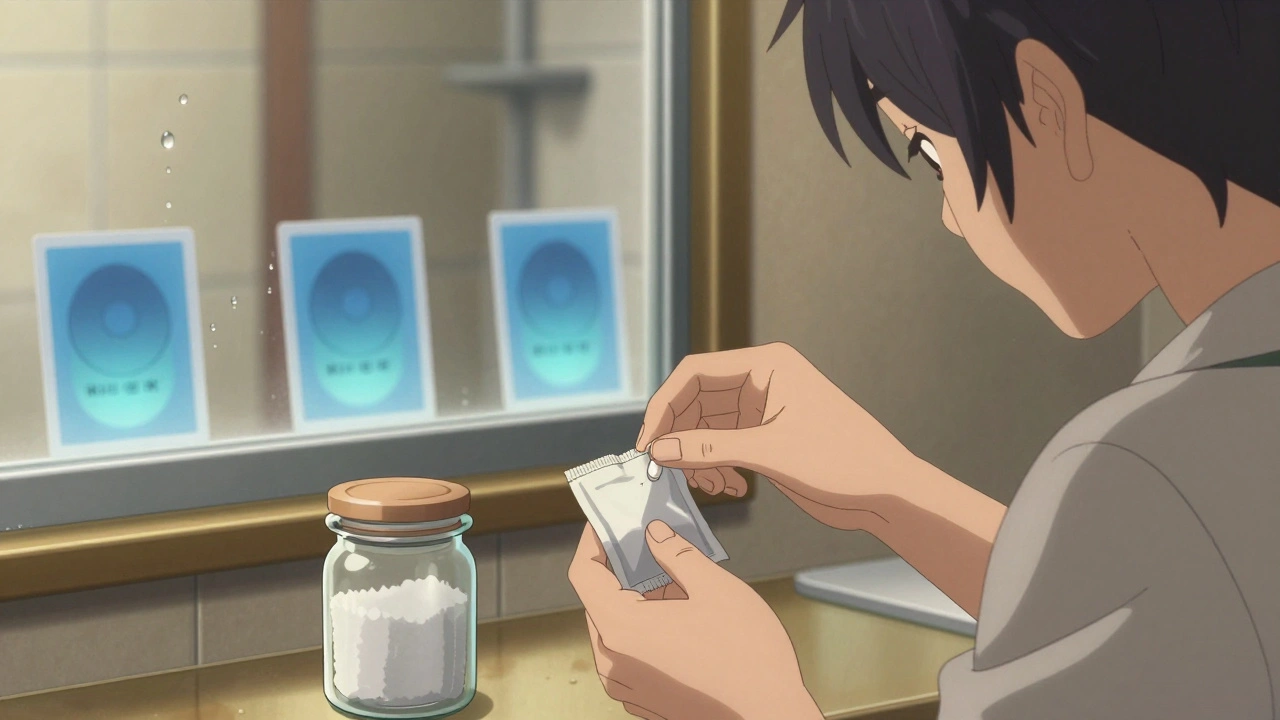
When you're traveling to a tropical destination, packing your meds isn't just about throwing pills into a bag. High heat and sticky humidity can quietly destroy your medications before you even take them. You might not see it happen, but your antibiotics could lose potency, your inhaler might stop working, or your anti-seizure pills could turn into a sticky mess. This isn't speculation-it's a documented problem. The medication degradation caused by tropical humidity affects millions of travelers and patients every year, especially in places where temperatures stay above 25°C and humidity hovers near 80%.
Why Humidity Destroys Your Pills
Medications aren’t like snacks or clothes. They’re chemically engineered to stay stable under specific conditions. When you expose them to tropical humidity, water molecules sneak into the packaging and start breaking down the active ingredients. This process is called hydrolysis, and it’s responsible for about 70% of moisture-related drug failures. Take amoxicillin, for example. If left in a humid bathroom, it can absorb up to 10% of its own weight in water. That’s enough to cut its potency by half in just 30 days. Different formulations react differently. Tablets with microcrystalline cellulose hold up better than those with anhydrous lactose. Orally disintegrating tablets (ODTs) can take 3 to 5 times longer to dissolve after just a week in 80% humidity. Dry powder inhalers? Their fine particles clump together, making them useless for delivering the right dose. Even your insulin pen or vaccine vial can be ruined if humidity creeps in. Microbes don’t help either. Once humidity hits 70%, fungi like Aspergillus and Penicillium start growing on exposed meds within 72 hours. You won’t always see mold, but the contamination is there-and it’s dangerous.What Medications Are Most at Risk?
Not all drugs are equally fragile. Some are practically built to survive humidity. Others? They’re delicate. Here’s what you need to watch out for:- Antibiotics like tetracycline and amoxicillin degrade rapidly in moisture. Tetracycline changes color visibly after 14 days in high humidity.
- Antifungals such as fluconazole and clotrimazole lose effectiveness quickly when damp.
- Pediatric formulations-especially syrups and chewables-are often sugar-rich, making them magnets for moisture and microbes.
- Insulin and biologics need cold, dry storage. Even a few hours in a hot, humid hotel room can ruin them.
- Dry powder inhalers and freeze-dried vaccines require humidity below 20-40% RH to work properly.
What’s the Safe Storage Range?
The International Pharmaceutical Federation (FIP) recommends keeping medications in a controlled environment of 30-45% relative humidity and 15-25°C. That’s not just a suggestion-it’s the threshold where most drugs remain stable. Here’s what you need to know about temperature and humidity together:- Every 10°C increase above 25°C doubles the rate of chemical breakdown.
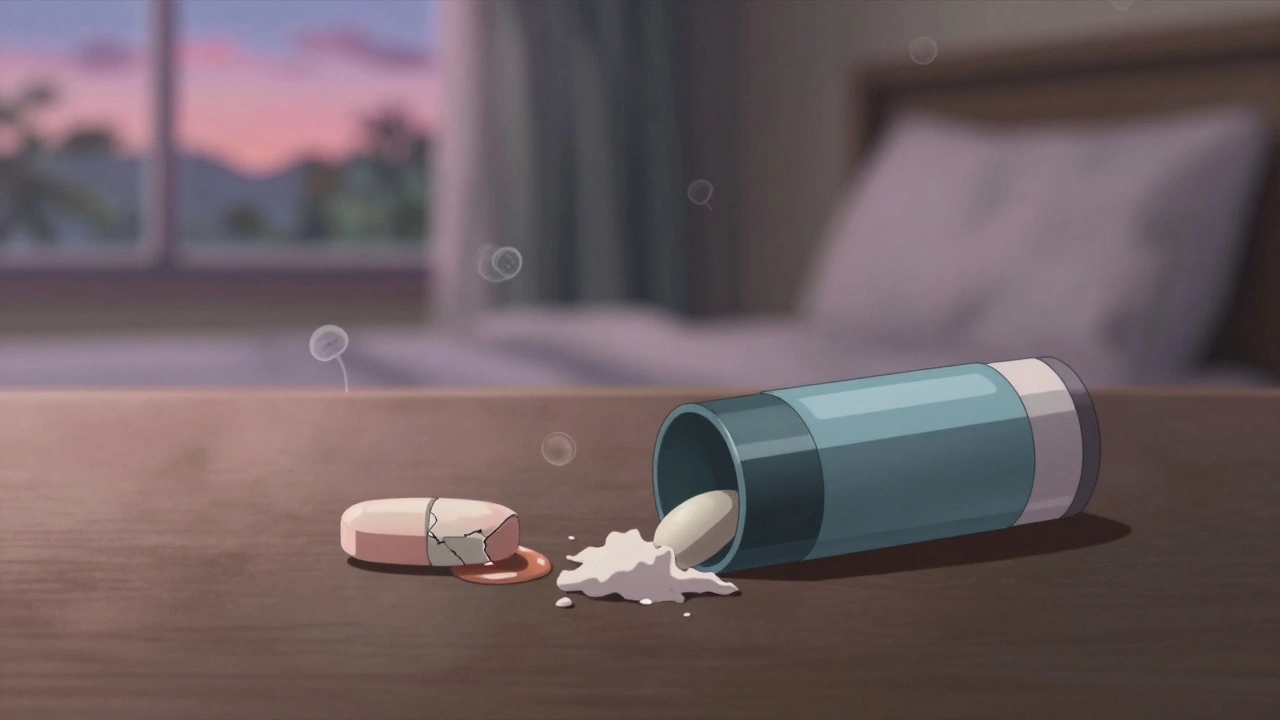
- Humidity above 60% RH causes capsule shells to soften and tablets to crack or stick together.
- Humidity above 70% RH triggers microbial growth.
- Even if your meds say “store at room temperature,” that usually means below 30°C and 65% RH-still too high for long-term safety.
How to Protect Your Medications While Traveling
You can’t control the weather, but you can control your storage. Here’s how to do it right:- Use airtight containers. Transfer pills from their original bottles into small, sealable plastic containers with tight lids. Glass jars with rubber seals work too.
- Add silica gel desiccants. These little packets absorb moisture. Use one for every 100mL of container space. Replace them every 30 days-or sooner if they feel warm or clumpy.
- Avoid bathrooms and kitchens. These rooms are the most humid in any home or hotel. Store meds in a bedroom drawer, suitcase, or hotel safe instead.
- Use humidity indicator cards. These cheap cards change color when humidity crosses 40-55%. Blue means dry. Pink means danger. Keep one in your container.
- Never leave meds in the car. Even in the shade, a car can hit 50°C on a tropical day. That’s enough to melt tablets and degrade liquids.
Low-Cost Solutions for Budget Travelers
You don’t need fancy gear to protect your meds. In fact, the WHO’s “PharmaSeal” system-used in 32 tropical countries-costs just $0.85 per unit. It’s a reusable desiccant canister that keeps humidity below 35% RH for six months. Here’s a DIY version that works:- Buy a plastic food container with a locking lid (like a Tupperware).
- Place 5-10 silica gel packets inside (check the weight: aim for 1-2g per 100mL of space).
- Add a humidity indicator card.
- Put your meds in, seal it tight, and store it in a cool, dry spot.
What to Do If Your Medication Looks Off
Sometimes, damage is visible. Look for:- Tablets that are cracked, discolored, or sticky
- Powders that clump or smell musty
- Capsules that are swollen, soft, or leaking
- Insulin that’s cloudy or has particles
- Inhalers that feel heavier or don’t spray properly
What’s Changing in the Industry?
The pharmaceutical world is finally catching up. Since 2021, companies like Aptar have been rolling out blister packs with built-in moisture-scavenging polymers. These aren’t just silica gel-they’re advanced materials that absorb 200-300% more water than traditional desiccants. The Gates Foundation has distributed over 500 million of these humidity-proof blister packs across sub-Saharan Africa. Early results show a 58% drop in medication spoilage. In 2023, MIT researchers published a breakthrough: graphene oxide coatings that reduce moisture penetration by 99.7%. These could be in consumer packaging by 2027. The ICH is also finalizing new guidelines (Q1H) expected in 2025 that will require all new drugs targeting tropical markets to prove stability under 30°C and 75% RH. That means future meds may be designed to handle humidity better-but you can’t wait for that. Right now, you’re responsible for your own meds.Final Checklist: Your Tropical Medication Survival Kit
Before you leave for a humid destination, run through this:- ✅ Pack meds in airtight containers
- ✅ Add silica gel desiccants (replace monthly)
- ✅ Include a humidity indicator card
- ✅ Keep meds away from bathrooms, kitchens, and cars
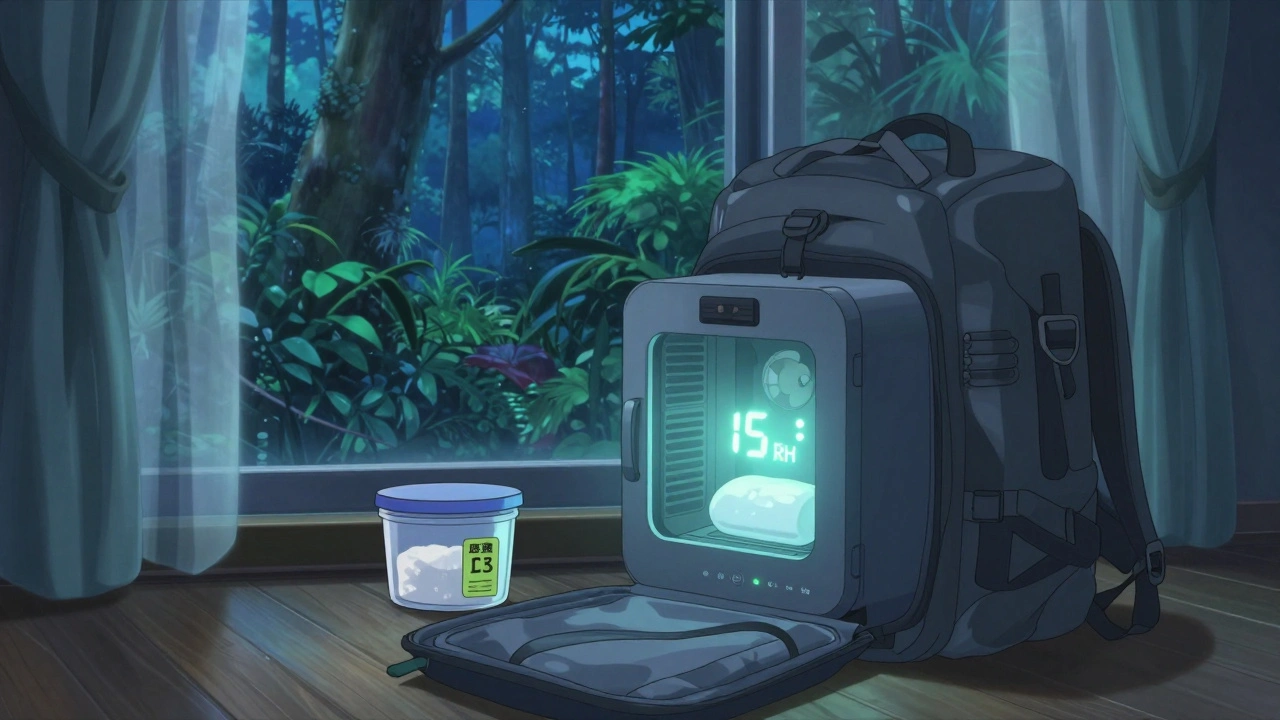
- ✅ Store in a cool, dark place (not in your suitcase by the window)
- ✅ Carry a copy of your prescription and a doctor’s note
- ✅ Know the signs of degradation (stickiness, discoloration, clumping)
- ✅ Never take meds that look or smell wrong
Medication degradation isn’t a myth. It’s a silent, widespread problem that costs health systems over $1 billion a year. But you don’t need to be a scientist to stop it. With a few simple tools and habits, you can protect your health-even in the most humid places on earth.
Comments
Just throw your pills in a ziplock and hope for the best.
Oh my gosh, YES! I learned this the hard way in Bali-my amoxicillin turned into a sticky, beige paste. I didn’t realize how dangerous it was until I got sick again. Silica gel packets? I now carry them everywhere-even in my makeup bag. Don’t be like me. Don’t wait for a medical emergency to take this seriously. Also, humidity indicator cards are $2 on Amazon. Buy them. Use them. Thank me later. P.S. Never store meds in a bathroom. Ever. Even if it’s the only drawer available. I’m still traumatized.
Let’s be real-most of these ‘travelers’ are just overreacting to tropical climates because they’ve never experienced real humidity. In Mumbai, we’ve been storing meds in cloth bags for generations. The WHO guidelines are a Western luxury. You don’t need $2,500 dry cabinets. You need common sense and cultural humility. Also, graphene oxide coatings? That’s not innovation-that’s corporate over-engineering. Real solutions are low-tech, local, and don’t require a Kickstarter campaign.
Thank you for sharing this. It’s incredibly important to raise awareness about medication stability in extreme environments. I’ve worked with community health workers in Puerto Rico and the Philippines, and the lack of education on this topic is alarming. Many patients don’t realize that their insulin might be compromised just because it was left in a hot car. I always recommend the Tupperware + silica gel method-it’s simple, accessible, and effective. Please keep spreading this knowledge. It saves lives.
great post! i never knew tetracycline changes color in humidity. i always kept my meds in my suitcase by the window because it was ‘cool’. oops. also, silica gel packs-i thought they were just for shoes. who knew? thanks for the tip on the humidity cards. i’m gonna buy some now. ps: typos are probably here because i typed this on my phone in a train.
I appreciate the depth of this guide. It’s easy to assume that ‘room temperature’ means safe, but the reality is far more nuanced. I’ve seen friends lose critical medications on tropical vacations and never realize why they weren’t working. The checklist at the end is perfect-clear, actionable, and non-alarmist. This should be required reading for anyone traveling to humid climates. Thank you for doing the research and sharing it so clearly.
This is exactly the kind of practical, life-saving info we need more of. I’ve been traveling to Southeast Asia for years and never thought twice about my inhaler until I saw it clump up after a monsoon trip. The DIY solution with the food container and silica gel? Genius. I’m going to start making these for my elderly parents who take multiple meds. You’ve turned a scary problem into something manageable. Keep doing this work.
Oh, so now we’re treating antibiotics like fine wine that needs a climate-controlled cellar? Next you’ll tell us to wrap our ibuprofen in bubble wrap and hum lullabies to it. Look-I get it, humidity is bad. But let’s not turn every traveler into a pharmaceutical engineer. The real issue is that pharma companies still use packaging from the 1980s. Blame the industry, not the tourist trying to get through airport security with a ziplock full of pills. Also, graphene oxide? Cute. Meanwhile, my cousin in Lagos just uses a clay pot. Works fine. Just saying.
OMG I CRIED WHEN I READ THIS. 🥹 I lost my mom’s seizure meds in Goa because I thought ‘it’s just a little humid’ and left them in the bathroom. She had a seizure. We had to rush to a clinic. They gave us a new prescription… but it cost 10x more. I didn’t know about humidity cards. I didn’t know about silica gel. I thought it was just a myth. I’m so sorry I didn’t know sooner. Thank you for writing this. I’m sharing it with EVERYONE. 🙏
Okay, but let’s talk about the real elephant in the room: why are we still using paper blister packs in 2024? 🤔 The fact that we’re telling people to buy silica gel packets and Tupperware instead of fixing the packaging infrastructure is a total failure of global pharmaceutical policy. I’m all for DIY solutions-they’re brilliant and necessary-but we’re treating symptoms, not causes. The Gates Foundation’s blister packs? Amazing. But why isn’t every drug manufacturer required to use moisture-resistant packaging in high-risk regions? Why is this still a ‘traveler’s burden’? I’ve seen clinics in Kerala using desiccant closets-why aren’t we scaling that globally? We need policy change, not just Pinterest hacks. Also, I made 3 of those DIY kits yesterday. I’m giving them to my cousins going to Thailand. 💪💧
As someone who works in global health logistics, I can confirm: this is not hyperbole. In fact, in some regions, up to 40% of antimalarials fail potency tests due to improper storage en route. The fact that travelers are being left to solve this with Tupperware and silica gel speaks volumes about systemic neglect. But-let’s not dismiss the power of grassroots solutions. The ‘PharmaSeal’ system you mentioned? I’ve seen it in rural clinics in Zambia. It’s cheap, durable, and culturally adopted. The real breakthrough isn’t graphene-it’s community trust in low-tech, locally managed systems. We need both: innovation and equity. And yes, I’m now buying a humidity card for my insulin. Thank you for the clarity. 🌍💊