
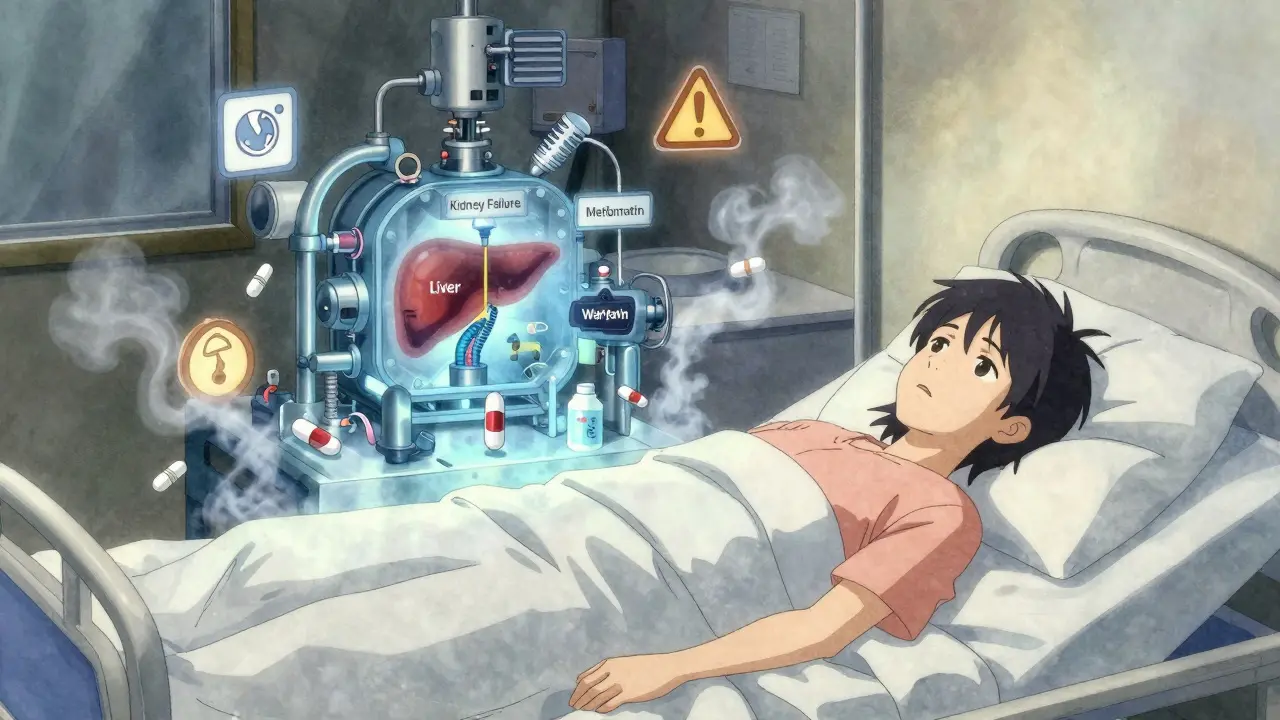
Most people know that mixing two drugs can cause problems. But what many don’t realize is that your health conditions themselves can turn a safe medication into a dangerous one. This isn’t about drug-drug clashes-it’s about how diseases like kidney failure, heart disease, or diabetes change the way your body handles medicine. These are called drug-disease interactions (DDIs), and they’re behind a surprising number of hospital visits each year.
How a Disease Can Make Medicine Harmful
Think of your body like a factory. When you have a disease, that factory doesn’t run the same way. Liver disease slows down how fast drugs are broken down. Kidney disease means drugs stick around longer because they can’t be flushed out. Heart failure changes how fluids move, so a drug meant to help one condition might make another one worse.
Take beta-blockers, commonly prescribed for high blood pressure or heart rhythm issues. They’re lifesaving for many-but if you have asthma, they can tighten your airways and trigger a serious attack. Or consider NSAIDs like ibuprofen for joint pain. They seem harmless, but if you have heart failure, they cause your body to hold onto salt and water, making swelling and shortness of breath worse. These aren’t rare edge cases. In fact, 84% of the most dangerous drug-disease interactions involve chronic kidney disease.
Top Conditions That Trigger Dangerous Interactions
Some health problems are more likely to cause trouble with medications than others. According to the American Society of Health-System Pharmacists, four conditions account for nearly 80% of serious drug-disease interactions:
- Chronic kidney disease - Drugs like metformin (for diabetes) or lithium (for mood disorders) build up in your blood when kidneys can’t filter them. This can lead to lactic acidosis or lithium toxicity, both life-threatening.
- Heart failure - Medications that cause fluid retention (like NSAIDs) or lower blood pressure too much (like some diabetes drugs) can push your heart into crisis.
- Liver disease - The liver breaks down most drugs. If it’s damaged, drugs like warfarin (a blood thinner) or statins (cholesterol pills) can stay in your system too long, increasing bleeding or muscle damage risk.
- Psychiatric conditions - Antidepressants like SSRIs can interact with herbal supplements like St. John’s wort, triggering serotonin syndrome-a dangerous spike in brain chemicals that can cause seizures, high fever, or even death.
These aren’t theoretical risks. A 2023 FDA safety alert highlighted how SGLT2 inhibitors, a newer class of diabetes drugs, can raise the risk of diabetic ketoacidosis in patients with advanced kidney disease. That’s a drug-disease interaction most patients never hear about.
Hidden Risks: When Medication Masks Symptoms
Some of the most dangerous interactions don’t cause direct harm-they hide warning signs. This is especially risky for people with diabetes.
Beta-blockers, again, are a classic example. They prevent the physical symptoms of low blood sugar-shaking, sweating, rapid heartbeat. Without those signals, a person might not realize their blood sugar is dropping until they pass out. This isn’t just inconvenient. It’s life-threatening.
The same goes for painkillers in people with heart conditions. If you’re on blood pressure meds and take a strong NSAID for back pain, you might not notice your blood pressure creeping up. No headache, no dizziness-just silent damage to your heart and kidneys.
Why Doctors Miss These Interactions
You’d think this would be easy to catch. After all, doctors know your conditions. But here’s the problem: most clinical guidelines focus on treating one disease at a time. A diabetes guideline tells you how to control blood sugar. A heart failure guideline tells you how to reduce fluid. Few mention how the drugs for one condition might harm the other.
Studies show that only 16% of treatment guidelines include clear warnings about drug-disease interactions. Even when they do, electronic health records often flood doctors with alerts-42% of them false. That leads to alert fatigue. Doctors start ignoring them. And patients? Most have no idea their condition changes how their meds work.
A 2022 survey found that only 22% of patients with high blood pressure understood why a common cold medicine like pseudoephedrine could spike their pressure. Yet 89% of them had been prescribed it.
What You Can Do to Stay Safe
You can’t control your disease. But you can take control of your meds. Here’s how:
- Keep a full list of everything you take-prescriptions, over-the-counter pills, vitamins, herbs, even supplements. Include dosages and why you take them.
- Ask your pharmacist or doctor during every visit: "Could any of these medications make my other conditions worse?" Don’t wait for them to bring it up.
- Know your kidney and liver numbers - If you have diabetes, heart disease, or liver issues, ask for your eGFR (kidney function) and liver enzyme tests. A drop in eGFR below 60 means your body handles drugs differently.
- Use the Beers Criteria - This is a trusted list of medications that are risky for older adults with certain conditions. You can find it online. If your drug is on it, ask if there’s a safer alternative.
- Watch for changes - If you start a new drug and suddenly feel more tired, dizzy, swollen, or confused, don’t assume it’s just aging. Call your provider.
What’s Changing in the Medical World
Thankfully, the medical community is waking up. The 2023 update to the Beers Criteria added 12 new drug-disease warnings, including avoiding anticholinergics in dementia patients and opioids in people with COPD. The FDA now requires drug makers to test their medications in patients with common comorbidities-not just healthy volunteers.
Hospitals like Mayo Clinic have cut readmissions by 27% by adding dedicated drug-disease interaction screenings. The NIH’s All of Us program is using genetic data and health records to predict who’s at highest risk-early results show 38% better accuracy than before.
But the system still has gaps. Medical schools spend less than five hours teaching this topic. Insurance companies don’t pay pharmacists enough time to review interactions. And patients? Most still think their meds are safe as long as they’re prescribed.
The Bottom Line
Medication safety isn’t just about avoiding drug combos. It’s about understanding how your body’s illness changes the rules. A pill that helps one part of you can hurt another. What’s safe for one person might be dangerous for you.
If you have more than one chronic condition, don’t assume your prescriptions are automatically safe. Ask the hard questions. Keep track. Push for clarity. Your life might depend on it.
What’s the difference between drug-drug and drug-disease interactions?
Drug-drug interactions happen when two or more medications affect each other’s effects-like warfarin and antibiotics increasing bleeding risk. Drug-disease interactions occur when a pre-existing health condition changes how your body handles a drug. For example, kidney disease can cause metformin to build up to toxic levels. One is about pills clashing; the other is about your body’s illness changing how the pill works.
Can over-the-counter drugs cause drug-disease interactions?
Absolutely. Many people think "natural" or "over-the-counter" means safe. But decongestants like pseudoephedrine can spike blood pressure in people with heart disease. NSAIDs like ibuprofen can worsen kidney function or heart failure. Even herbal supplements like St. John’s wort can cause serotonin syndrome when taken with antidepressants. Always check with your pharmacist before taking anything new.
Why aren’t drug-disease interactions listed on prescription labels?
Prescription labels are limited by space and focus on common side effects and drug-drug interactions. Drug-disease interactions are more complex and depend on your personal health history. That’s why your doctor or pharmacist needs to review your full medical profile-not just your current meds. If you have multiple conditions, always ask for a full medication review.
Are older adults more at risk for drug-disease interactions?
Yes. On average, adults over 65 take 5.4 medications and have 4.7 chronic conditions. That’s a perfect storm for interactions. The Beers Criteria specifically targets this group because drugs that were safe in their 40s or 50s can become dangerous with age-related changes in kidney and liver function. Age isn’t the issue-it’s the combination of multiple diseases and multiple drugs.
What should I do if I think a medication is making my condition worse?
Don’t stop the medication on your own. Call your doctor or pharmacist immediately. Note the symptoms, when they started, and what else you’ve changed in your routine. Many drug-disease interactions can be fixed by adjusting the dose, switching to a different drug, or adding a monitoring plan. But you need professional guidance to do it safely.
Drug-disease interactions aren’t something you can ignore. They’re not rare. They’re not theoretical. They’re happening right now to people who think they’re doing everything right. The key isn’t fear-it’s awareness. Ask. Listen. Track. Your body’s health conditions aren’t just background noise. They’re part of the prescription.
Comments
Oh sweet mercy, another article that sounds like it was written by a pharmaceutical rep trying to sell us more tests. "Ask your pharmacist" yeah right, they’re paid by the hour and you’re lucky if they remember your name. I’ve been on 7 meds for 3 conditions and no one ever mentioned that my kidney numbers could turn my diabetes drug into a poison pill. Until I almost died. Now I print out every label and highlight the warnings myself. Good luck with that, healthcare system.
This is why we need to stop letting people live with chronic diseases. It’s not fair to the rest of us. Your body is a liability. If you can’t manage your health, maybe you shouldn’t be on meds at all. 💔
The data presented here is compelling and aligns with clinical observations across multiple institutions. Drug-disease interactions represent a systemic blind spot in pharmacovigilance. The lack of integration between comorbidity profiles and prescribing algorithms is not accidental but structural. We must advocate for integrated clinical decision support tools that prioritize patient-specific risk profiles over protocol-driven prescribing.
lol they dont tell you this but big pharma knows all this. they design drugs to be dangerous for people with conditions so they can sell more pills later. its all a scam. my cousin died from this and the hospital said "its just a side effect" but i know its intentional. they even hide the real numbers. the eGFR test? fake. its all controlled by the cia and the who. #truth
The institutional failure to recognize drug-disease interactions as a distinct category of adverse event is not merely negligent-it is criminal. The FDA’s current framework is predicated on a flawed assumption: that patients are monomorphic. The absence of mandatory comorbidity testing in Phase III trials constitutes a breach of the Hippocratic Oath by proxy. We are not just undermedicated-we are systematically poisoned.
my grandma took ibuprofen for her arthritis and ended up in the er. no one told her her heart failure made it dangerous. just saying. always ask. always.
This is why American medicine is failing. In India, we have Ayurveda and traditional knowledge that has understood these interactions for millennia. You westerners overcomplicate everything with your lab tests and algorithms. We just know. Our elders taught us. Your system is broken because you trust machines over wisdom. 🙏
I’ve been a nurse for 18 years and I can tell you this: 90% of patients don’t even know what their meds are for. I had one guy on metformin who didn’t know he had diabetes. He thought it was for "energy." And now he’s got lactic acidosis. This isn’t about drug-disease interactions. It’s about people not caring. Stop blaming the system. Start blaming the patients.
I’ve been living with 4 chronic conditions and I’ve been prescribed 19 medications. I’ve been hospitalized twice because of interactions no one warned me about. This article? It’s not enough. It’s a whisper in a hurricane. The real tragedy isn’t the science-it’s that no one cares until it’s too late. I’m still here. But I’m tired. So tired.
who even reads this stuff. i have 3 kids and a job. i dont have time to memorize every drug interaction. if my doc says take it, i take it. if i die, its on them.
The Beers Criteria update is a step forward, but we’re still treating this like a checklist instead of a dynamic system. What we need is pharmacogenomic integration with EHRs that auto-adjusts dosing based on eGFR, liver enzymes, and polypharmacy burden. We’re not talking about patient education anymore-we’re talking about algorithmic safety nets. The data’s there. The tech’s there. The will? Not so much. We’re in the age of precision medicine. Why are we still prescribing in the stone age?