
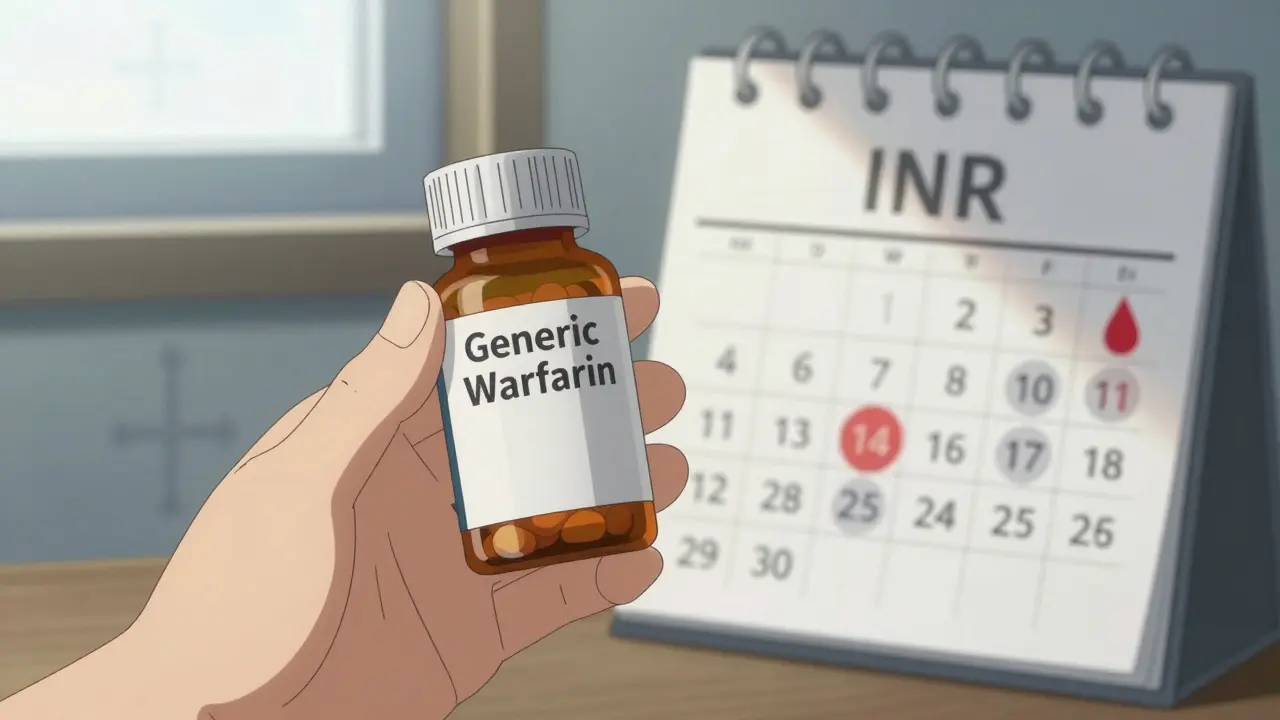
Switching from brand-name warfarin (Coumadin) to a generic version sounds simple-cheaper pill, same active ingredient. But for people taking warfarin, this switch isn’t just about cost. It’s about INR monitoring, bleeding risks, and whether your body responds the same way to a different manufacturer’s version. For millions of Americans on long-term anticoagulation, this isn’t theoretical. It’s daily reality.
Why Warfarin Is Different
Warfarin isn’t like most medications. It’s not a one-size-fits-all drug. It works by blocking vitamin K, which your body needs to make blood clot. Too little, and you risk clots-stroke, pulmonary embolism, deep vein thrombosis. Too much, and you bleed internally-guts, brain, joints. The goal? Keep your INR between 2.0 and 3.0. For some, like those with mechanical heart valves, it’s even tighter: 2.5 to 3.5. That’s a narrow window. A single point outside it can mean disaster.
That’s why INR checks aren’t optional. They’re life-saving. When you start warfarin, you might get tested every other day. Once stable, it drops to every 4-6 weeks. But even then, small changes-new antibiotics, a salad rich in spinach, skipping a dose-can throw your INR off. And switching generics? That’s another variable.
Generic Warfarin: Same Drug, Different Results?
The FDA says all approved generic warfarin products are therapeutically equivalent to Coumadin. That means they meet strict bioequivalence standards: absorption (AUC) and peak concentration (Cmax) must fall within 80-125% of the brand. Sounds solid. But here’s the catch: those numbers were set for drugs with wide therapeutic windows. Warfarin isn’t one of them.
Studies show mixed results. A 2002 study tracking 182 patients who switched from Coumadin to Barr Labs’ generic found no change in INR control, dose adjustments, or bleeding events. Another review of over 40,000 patients showed almost no difference in average INR after switching. But individual responses? That’s where things get messy.
One patient might switch from Teva to Mylan and stay perfectly stable. Another might see their INR jump from 2.8 to 4.1 in three days-no dietary changes, no new meds. No one knows why. It could be tiny differences in fillers, coating, or how the tablet breaks down. It could be how your liver metabolizes it. CYP2C9 and CYP3A4 enzymes handle warfarin, and small genetic variations affect how fast or slow that happens. That’s why some people react more strongly to a switch than others.
What the Experts Say
Dr. Jack Ansell, who led a major review of warfarin generics, put it plainly: “Generic warfarin products may be as safe and effective as brand name products… but closer monitoring may be reasonable when switching.” That’s the consensus.
The Cleveland Clinic recommends: if you’re switching from Coumadin to generic, check your INR every other day for the first week, then weekly for the next two weeks. If your INR stays stable, you can go back to your usual schedule. The American Family Physician guidelines agree: expect more frequent testing during transition.
And here’s what they don’t tell you: not all generics are created equal. The FDA’s Orange Book lists 12 approved generic warfarin products from 8 different manufacturers. Switching from one generic to another-say, from Sandoz to Teva-isn’t the same as switching from brand to generic. It’s still a switch. And that’s where the risk spikes.

Real-World Risks and What You Can Do
A 12-month study of nursing home residents found 720 adverse events among 3,000 people on warfarin. One-sixth of those events were preventable. That’s not just bad luck. It’s system failure. Missed tests. Poor communication. Unexplained INR swings.
Here’s what works:
- Track your INR like a journal. Write down every number, every date. Note if you ate kale, started a new pill, or felt unusually tired.
- Ask for the manufacturer name. When you pick up your prescription, ask: “Which company made this?” Write it down. If you switch brands again, you’ll know.
- Don’t wait for symptoms. Bleeding doesn’t always come with warning signs. A bruise that won’t fade, dark stool, headache, dizziness-these aren’t normal. Call your doctor.
- Know your dose. Generic warfarin comes in 1 mg, 2 mg, 3 mg, 5 mg, and 10 mg tablets. Some are scored. Others aren’t. If your tablet looks different, ask if it’s the same strength.
Non-compliance is a huge problem. Up to 30% of patients miss doses. A single missed dose can drop your INR. A double dose can spike it. That’s why consistency matters more than ever when switching generics.
Cost vs. Safety: The Hard Truth
Generic warfarin costs $4-$10 a month with Medicare. DOACs like Eliquis or Xarelto? $300-$500. That’s why 30-40% of long-term users still take warfarin. But here’s the trade-off: DOACs don’t need INR checks. You take them once or twice a day, no blood tests. Warfarin demands vigilance.
For someone on Medicare, the cost difference is huge. But for someone with unstable INR, frequent falls, or kidney issues, DOACs might be safer. The American College of Chest Physicians still recommends warfarin for mechanical heart valves and antiphospholipid syndrome. That’s because DOACs can’t be reversed as easily in emergencies. Warfarin? Vitamin K or fresh frozen plasma can stop bleeding fast.
What to Do If Your INR Goes Off Track
If your INR suddenly changes and you can’t explain why:
- Check your diet. Did you eat more leafy greens? Vitamin K in spinach, broccoli, or kale can lower your INR.
- Review your meds. Antibiotics, aspirin, NSAIDs, even St. John’s Wort can interfere.
- Confirm you took your dose. Did you miss it? Double it? Use a pill box.
- Ask if your pharmacy switched manufacturers.
- If none of those explain it, your doctor should adjust your dose by 5-10% and retest in 3-7 days.
Never adjust your own dose. Ever. That’s how accidents happen.
The Bigger Picture
Warfarin isn’t going away. Even with DOACs taking over 65% of new prescriptions, warfarin remains essential. It’s the only option for mechanical valves. It’s the only affordable one for many. And it’s still the go-to for patients with severe kidney disease, where DOACs aren’t cleared.
Generic substitution is now routine. But routine doesn’t mean risk-free. The FDA’s 2021 GDUFA III rules now require stricter post-market data for narrow-therapeutic-index drugs like warfarin. That’s progress. But it doesn’t replace vigilance.
Patients who stay informed, track their INR, and communicate with their care team do best. Switching generics? It’s safe-if you’re prepared. Don’t assume it’s automatic. Don’t ignore the numbers. Your body doesn’t care if the pill says “Coumadin” or “Teva.” It only cares if your INR is in range.
Can I switch between different generic warfarin brands without checking my INR?
No. Switching between different generic manufacturers-even if both are FDA-approved-can cause unexpected changes in your INR. The FDA and clinical guidelines recommend checking your INR within 3-7 days after switching, regardless of whether you’re moving from brand to generic or one generic to another. Don’t assume they’re identical. Your body may react differently.
Why do some people have problems with generic warfarin but others don’t?
It’s likely due to genetic differences in how your liver processes warfarin. Variants in the CYP2C9 and VKORC1 genes affect how quickly your body breaks down the drug. Some people metabolize it slowly and are more sensitive to small changes in dose or formulation. Others are fast metabolizers and less affected. That’s why one person can switch without issue, while another sees their INR jump from 2.5 to 4.2.
Should I ask my doctor to keep me on brand-name Coumadin?
If cost isn’t an issue and you’ve been stable on Coumadin for years, there’s no harm in requesting it. But most doctors will agree that generic warfarin is just as safe-when monitored properly. The bigger risk isn’t the generic itself. It’s skipping INR checks after switching. If you’re willing to test regularly, generic is fine. If you’ve missed tests before, staying on brand might reduce risk.
What should I do if my INR is suddenly too high or too low?
If your INR is above 4.0, you’re at risk for bleeding. Call your doctor immediately. Do not stop taking warfarin unless instructed. If your INR is below 1.5, you’re at risk for clots. Again, contact your provider. Never adjust your dose yourself. Your doctor may hold a dose, give vitamin K, or change your next dose based on your history and recent changes.
Are there any foods I should avoid completely while on warfarin?
You don’t need to avoid vitamin K-rich foods entirely-just keep them consistent. If you normally eat spinach every day, keep doing it. If you rarely eat it, don’t start. Sudden changes in intake (more than 100-150 mcg daily) can lower your INR. Avoid large, irregular doses of cranberry juice, alcohol, or herbal supplements like ginkgo or garlic, which can increase bleeding risk.
How often should I get my INR checked after switching generics?
Check your INR 3-7 days after switching, then again in 7-14 days. If stable, return to your regular schedule (usually every 4-6 weeks). If your INR fluctuates, your provider may recommend weekly checks for a month. The goal is to confirm stability before returning to less frequent monitoring.
Comments
Y’all act like switching generics is some conspiracy. FDA approves these things for a reason. If your INR goes haywire after a switch, maybe you’re not tracking your diet or missing doses. Stop blaming the pill and start taking responsibility. I’ve been on warfarin for 12 years-switched between 5 different generics. No issues. Consistency > brand name.
Also, if you’re eating kale and then suddenly stop because you’re scared of ‘vitamin K fluctuations,’ you’re doing it wrong. Eat the damn greens the same way every week. Done.
lol i got switched to teva last month and my inr went to 5.2. doc said ‘oh weird’ and gave me vitamin k. i was scared i was gonna bleed out. now i just ask for coumadin every time. worth the extra 20 bucks a month to not panic. also who even reads the orange book? lol
same here 😭 switched to mylan and my INR spiked in 3 days. called my pharma, they said ‘oh that’s the new batch’ like it’s a flavor of ice cream. now i take a pic of the pill before i swallow. if it looks different? i call my doc. no cap. this ain’t a game. 💯
My mom’s on warfarin and we started tracking everything-diet, meds, pill manufacturer. It made such a difference. We even made a little spreadsheet. It’s not scary if you’re organized. Also, ask your pharmacist to write the brand name on the label. It helps.
How quaint. You Americans think regulation = safety. In India, we use warfarin generics for decades without INR checks. People just take it and live. Your obsession with numbers is a symptom of over-medicalization. Also, vitamin K? We eat spinach daily. No one’s bleeding. Maybe your system is broken, not the drug.
The fundamental issue here is not bioequivalence-it’s therapeutic index. Warfarin operates on a knife’s edge, and the FDA’s 80-125% bioequivalence criterion was designed for drugs with wide margins, not narrow ones. The system is structurally ill-equipped to handle this. We’re not talking about aspirin. We’re talking about a drug where a 10% change in plasma concentration can mean the difference between stroke and hemorrhage. This isn’t about individual variation-it’s about regulatory misalignment.
Until the FDA revises its standards for narrow-therapeutic-index drugs, generic substitution without mandatory pre- and post-switch INR monitoring is a public health gamble.
INR tracking isn’t optional. It’s your early warning system. Think of it like your car’s oil light. Ignore it? You’re gonna be stranded-or worse. Document every change. Even if it’s ‘ate avocado today.’ Consistency beats perfection. And if you’re switching generics? Treat it like a new prescription. No shortcuts.
Pro tip: Set a recurring phone alarm for your INR day. Your future self will thank you.
What if… the real problem isn’t the generic? What if it’s the *idea* that we can reduce a complex physiological process to a number? INR is a proxy. It’s not the truth. It’s a shadow. We’ve turned ourselves into data points. We measure our blood to feel safe. But safety is an illusion. The body doesn’t care about FDA guidelines. It only cares about survival. Maybe we should stop trying to control it so hard.
As someone who moved from the Philippines to the U.S. and had to learn this whole system, I’m just amazed at how much care and attention this takes. Back home, people just got the pill and went on. Here, you’ve got spreadsheets, pharmacy calls, food logs… it’s intense. But honestly? It’s beautiful. It shows how much we care about each other’s lives. Even if it’s exhausting. Keep tracking. You’re doing something meaningful.
Man, I used to work at a pharmacy in Winnipeg. We’d get these warfarin scripts and the pharmacist would always say, ‘Check the manufacturer. If it changed, call the doc.’ We’d even write it on the bag with a Sharpie. ‘Teva’ or ‘Sandoz’ right there. Patients loved it. One guy said, ‘I didn’t know I could ask.’ Turns out, most didn’t. Simple things save lives. Don’t be shy. Ask for the label. Write it down. It’s not weird-it’s wise.